
Which logic model template do you need?
Pick the template by how far your funder or evaluation plan asks you to follow the results:
| Your situation | Template on this page |
|---|---|
| A program plan or class assignment with short- and long-term outcomes | Five-column template |
| You are a student and need an example to model an assignment on | Start from the simple five-column template and read the education example |
| A grant application that asks for short-, medium- and long-term outcomes and an impact statement | Template with impact |
| You want to see one filled in for your field first | Public health, healthcare, education, social work, community development, youth mentoring |
All eight figures use the same reading order: resources on the left, results on the right, with the outcome boxes stacked in one column so the time order (short, medium, long) reads top to bottom.
Simple logic model template: five columns, blank
The simple version: inputs, activities, outputs, then short-term and long-term outcomes, with placeholder items to replace.
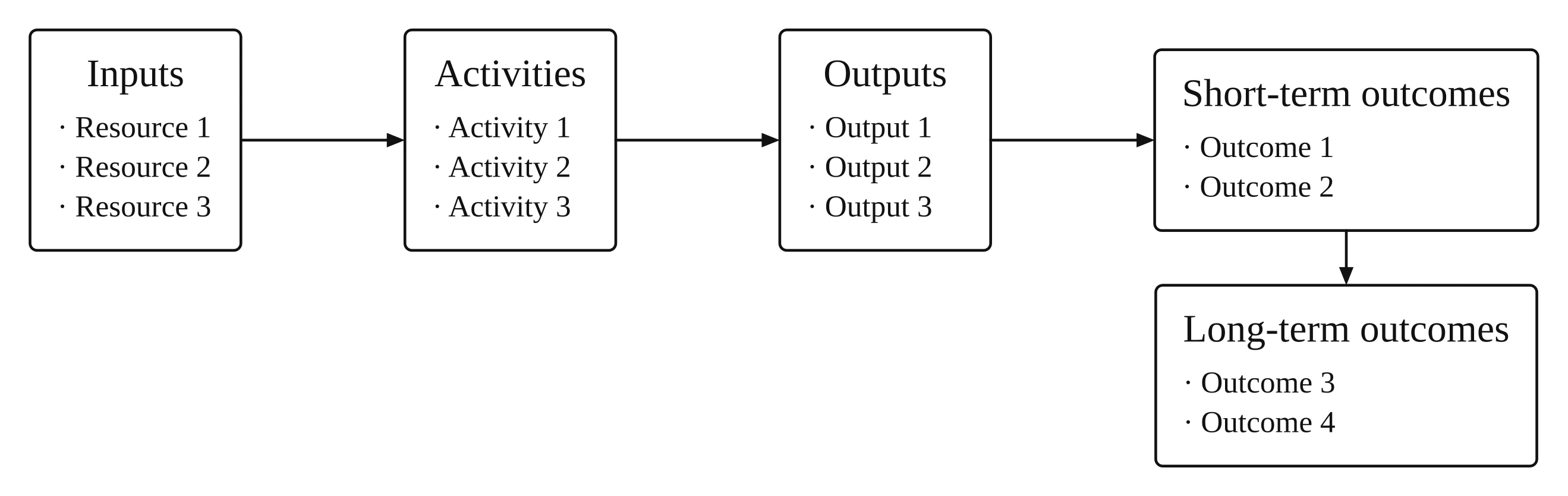
Description used: Blank logic model template. Inputs: Resource 1, Resource 2, Resource 3. Activities: Activity 1, Activity 2, Activity 3. Outputs: Output 1, Output 2, Output 3. Short-term outcomes: Outcome 1, Outcome 2. Long-term outcomes: Outcome 3, Outcome 4.
Three items per column is only a starting point. Add or remove items in the description and the boxes grow or shrink to fit; long items wrap onto a second line inside the box.
Open this template in the generator and replace the items with your program's.
Logic model template with short-, medium- and long-term outcomes and impact
The longer template many grant applications ask for: three outcome boxes by time frame and a separate impact box.
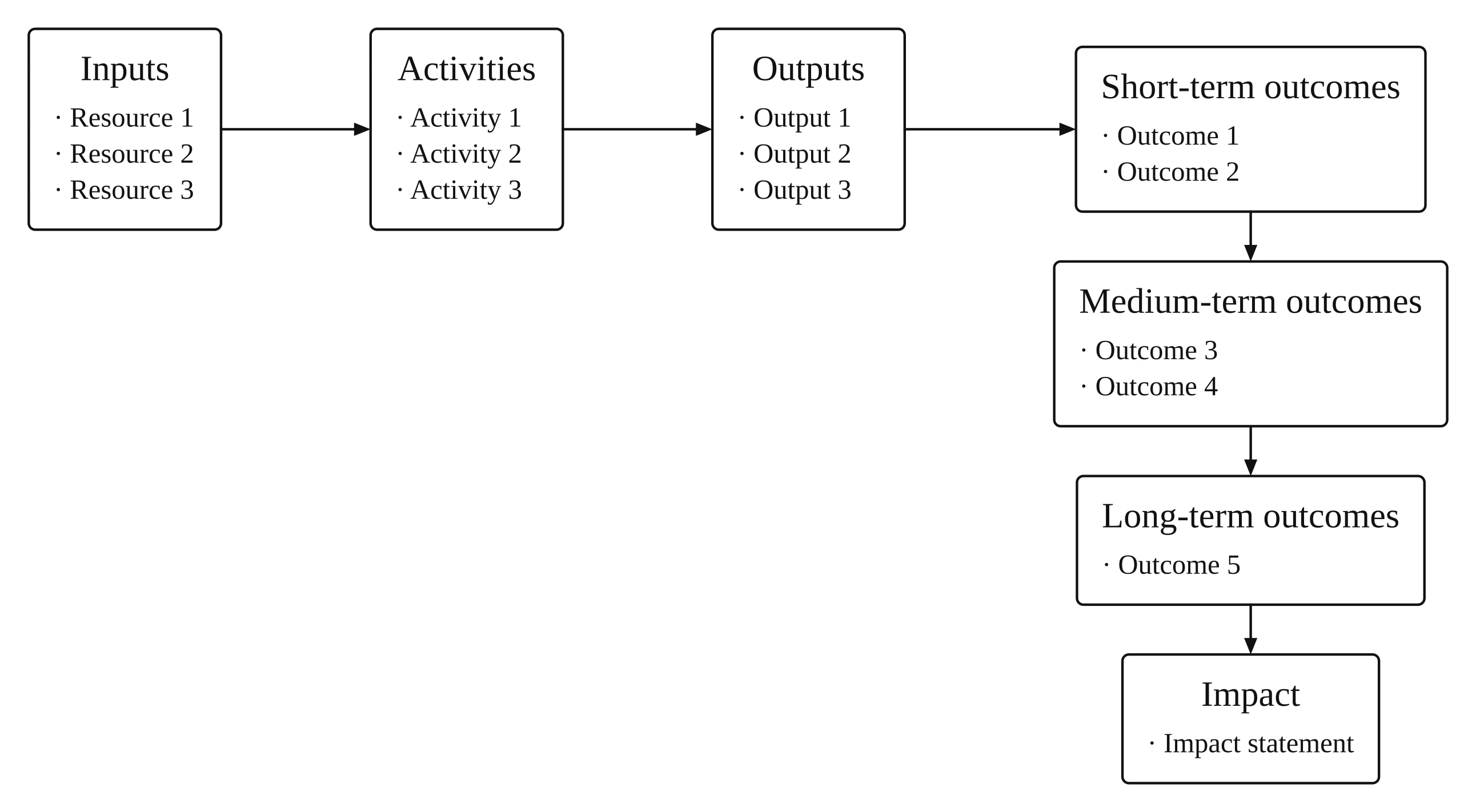
Description used: Blank logic model template. Inputs: Resource 1, Resource 2, Resource 3. Activities: Activity 1, Activity 2, Activity 3. Outputs: Output 1, Output 2, Output 3. Short-term outcomes: Outcome 1, Outcome 2. Medium-term outcomes: Outcome 3, Outcome 4. Long-term outcomes: Outcome 5. Impact: Impact statement.
Some funders say "intermediate outcomes" instead of "medium-term outcomes". Use your funder's words as the column names in the description, and keep "outcomes" or "impact" in the name: boxes at the end of the chain are stacked into the results column when their names contain one of those words.
Open this template in the generator and replace the items with your program's.
What are the five components of a logic model?
A basic logic model has five components, read left to right as a chain of if-then statements:
| Component | Question it answers | Example |
|---|---|---|
| Inputs (resources) | What do we invest? | Funding, staff, space, partners |
| Activities | What do we do with them? | Classes, counseling, workshops |
| Outputs | What can we count right after the activities? | Sessions held, people served |
| Outcomes | What changes for participants? | Knowledge, behavior, condition |
| Impact | What changes for the community in the long run? | Lower disease rates, higher graduation rates |
These are the components named in the W.K. Kellogg Foundation's Logic Model Development Guide: resources (inputs), activities, outputs, outcomes and impact. The guide puts short-term outcomes at 1 to 3 years, long-term outcomes at 4 to 6 years and impact at 7 to 10 years. Many templates add a medium-term box between the two. Not every source uses the same labels: the University of Kansas Community Tool Box section on logic models lists purpose, context, inputs, activities, outputs and effects, and notes that some fields call the early results "outcomes" and the later ones "impacts" while others do the reverse. Use the words your funder uses.
The most common mistake is mixing up outputs and outcomes. An output counts what the program delivered ("12 workshops held"); an outcome describes what changed for the people who took part ("participants can read a nutrition label").
How do you use a logic model template?
There are two ways to use the templates below.
- Fill it in by hand. Download the image, print it for a planning meeting or a class handout, and write your program's items over the placeholders.
- Generate it with your program. Click "Open this template in the generator", replace each placeholder in the description with your own item (keep the column names and the colons), and generate. Code lays out the boxes and sets each item in type.
When you generate, a text model reads your description and sorts each item into its column; code then draws the figure. The words in the boxes are typeset from that analysis, not painted by an image model, so they are not misspelled the way image-model text can be. Check that every item landed in the column you meant: the code places the text, and the sorting is still yours to check.
How do you write a logic model?
Write it from the result backward, then check it forward:
- State the long-term outcome or impact the program exists for.
- List the medium- and short-term outcomes that have to happen first, in the order they would happen.
- List the activities that should produce those outcomes.
- For each activity, write the output you will count.
- List the inputs the activities need.
- Read the chain forward as if-then statements: if we have these inputs, then we can run these activities; if we run them, then we deliver these outputs; and so on.
Then put it in one paragraph, one sentence per column, the way the descriptions on this page are written: "Inputs: ... Activities: ... Outputs: ... Short-term outcomes: ...". That paragraph is all the generator needs.
What does a good logic model look like?
A good logic model fits on one page and can be read as if-then statements from left to right. Check a draft against these points, based on the Kellogg guide's checklist and the Community Tool Box:
- Every activity has at least one output that counts it.
- Each outcome is written as a change (something increases, decreases or stays the same).
- Outcomes are specific, measurable, action-oriented, realistic and timed.
- Outcomes are within the program's control or reasonable influence; impact is not beyond what the program could plausibly contribute to.
- The model is simple enough to read at a glance and detailed enough for its purpose.
The six filled examples can each be checked this way.
Logic model examples by field
The six examples below show the template filled in for programs in public health, healthcare, education, social work, community development and youth mentoring. The programs are illustrative, not evaluations of real programs: use them as a pattern for wording your own inputs, activities, outputs and outcomes. Each figure was generated from the description printed under it and was not edited by hand; the images are only cropped to the figure.
Logic model example in public health: a diabetes prevention program
A community program that runs lifestyle classes and counseling to lower type 2 diabetes incidence.
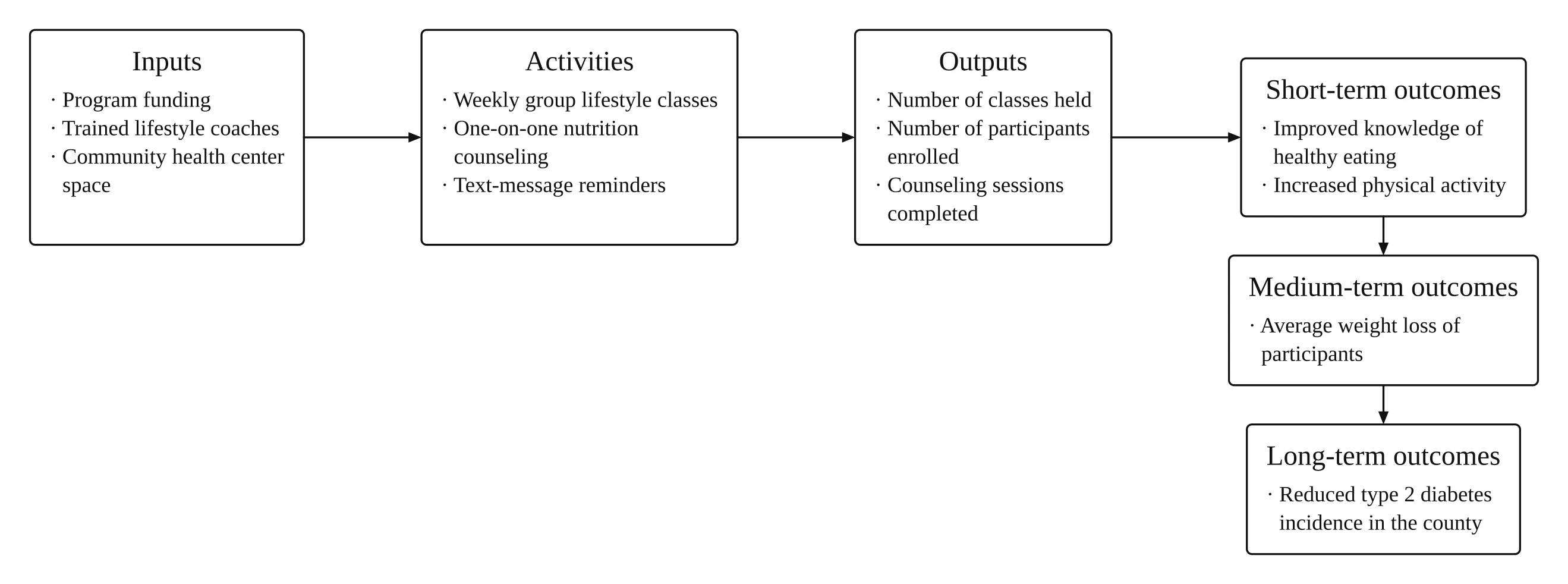
Description used: Logic model for a community diabetes prevention program. Inputs: program funding, trained lifestyle coaches, community health center space. Activities: weekly group lifestyle classes, one-on-one nutrition counseling, text-message reminders. Outputs: number of classes held, number of participants enrolled, counseling sessions completed. Short-term outcomes: improved knowledge of healthy eating, increased physical activity. Medium-term outcomes: average weight loss of participants. Long-term outcomes: reduced type 2 diabetes incidence in the county.
The outputs are counts the program can report every quarter. The outcomes move from what participants know and do, to a measured change in weight, to a population-level rate, each one a step further from the program's direct control. Under the Kellogg definitions a county-wide rate is an impact, because it describes a community and not the participants. Many funder templates still label it a long-term outcome; if yours has an Impact box, move this item there.
Open this example in the generator and replace the items with your program's.
Logic model example in healthcare: a hospital discharge follow-up program
A hospital program that follows heart failure patients after discharge to keep them from being readmitted.
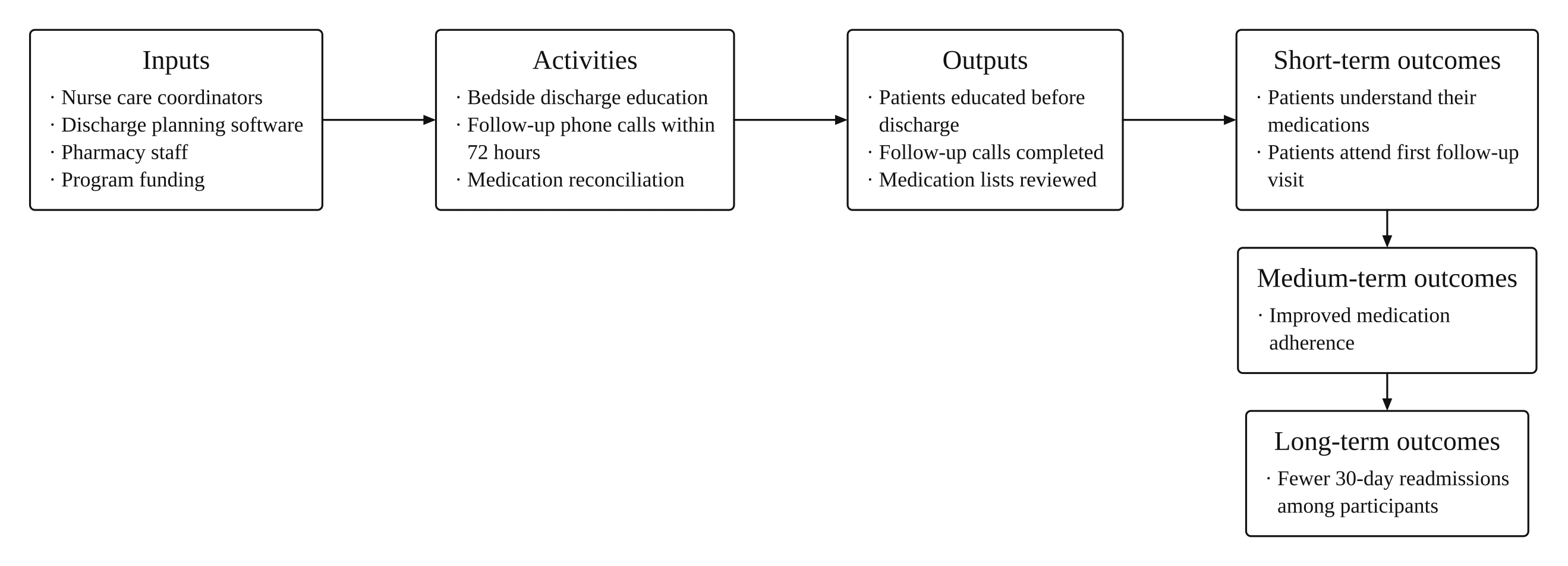
Description used: Logic model for a hospital discharge follow-up program for heart failure patients. Inputs: nurse care coordinators, discharge planning software, pharmacy staff, program funding. Activities: bedside discharge education, follow-up phone calls within 72 hours, medication reconciliation. Outputs: patients educated before discharge, follow-up calls completed, medication lists reviewed. Short-term outcomes: patients understand their medications, patients attend first follow-up visit. Medium-term outcomes: improved medication adherence. Long-term outcomes: fewer 30-day readmissions among participants.
Every outcome here is about the participants themselves, down to the long-term one ("among participants"), so all three belong in outcome boxes. A hospital-wide readmission rate would be an impact.
Open this example in the generator and replace the items with your program's.
Logic model example in education: an after-school reading program
One-to-one reading tutoring for grade 3 students, with tutor training and family reading nights.
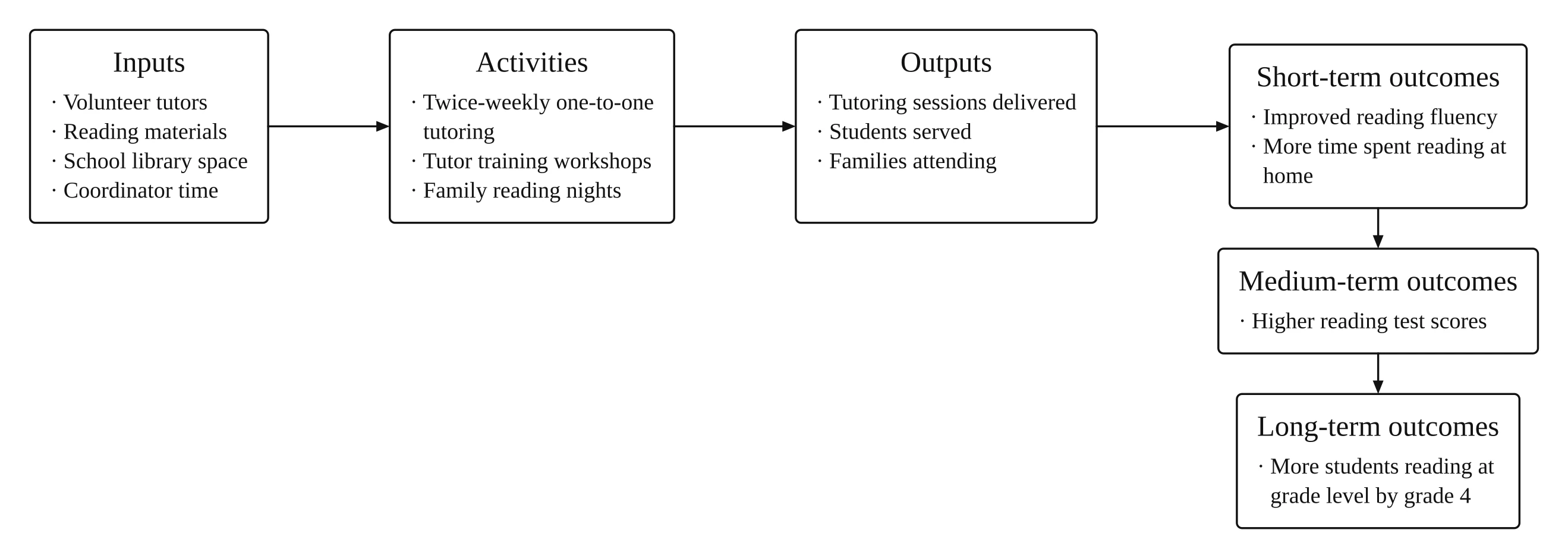
Description used: Logic model for an after-school reading tutoring program for grade 3 students. Inputs: volunteer tutors, reading materials, school library space, coordinator time. Activities: twice-weekly one-to-one tutoring, tutor training workshops, family reading nights. Outputs: tutoring sessions delivered, students served, families attending. Short-term outcomes: improved reading fluency, more time spent reading at home. Medium-term outcomes: higher reading test scores. Long-term outcomes: more students reading at grade level by grade 4.
Each activity has an output that counts it: tutoring has sessions delivered and students served, family nights have families attending. Pairing activities with outputs this way makes the evaluation plan easier to write. For a class assignment, instructors usually check two things: that each activity has an output, and that outputs and outcomes are not mixed up.
Open this example in the generator and replace the items with your program's.
Logic model example in community development: a neighborhood garden
A community garden on a vacant lot, drawn with three outcome boxes and an impact box.
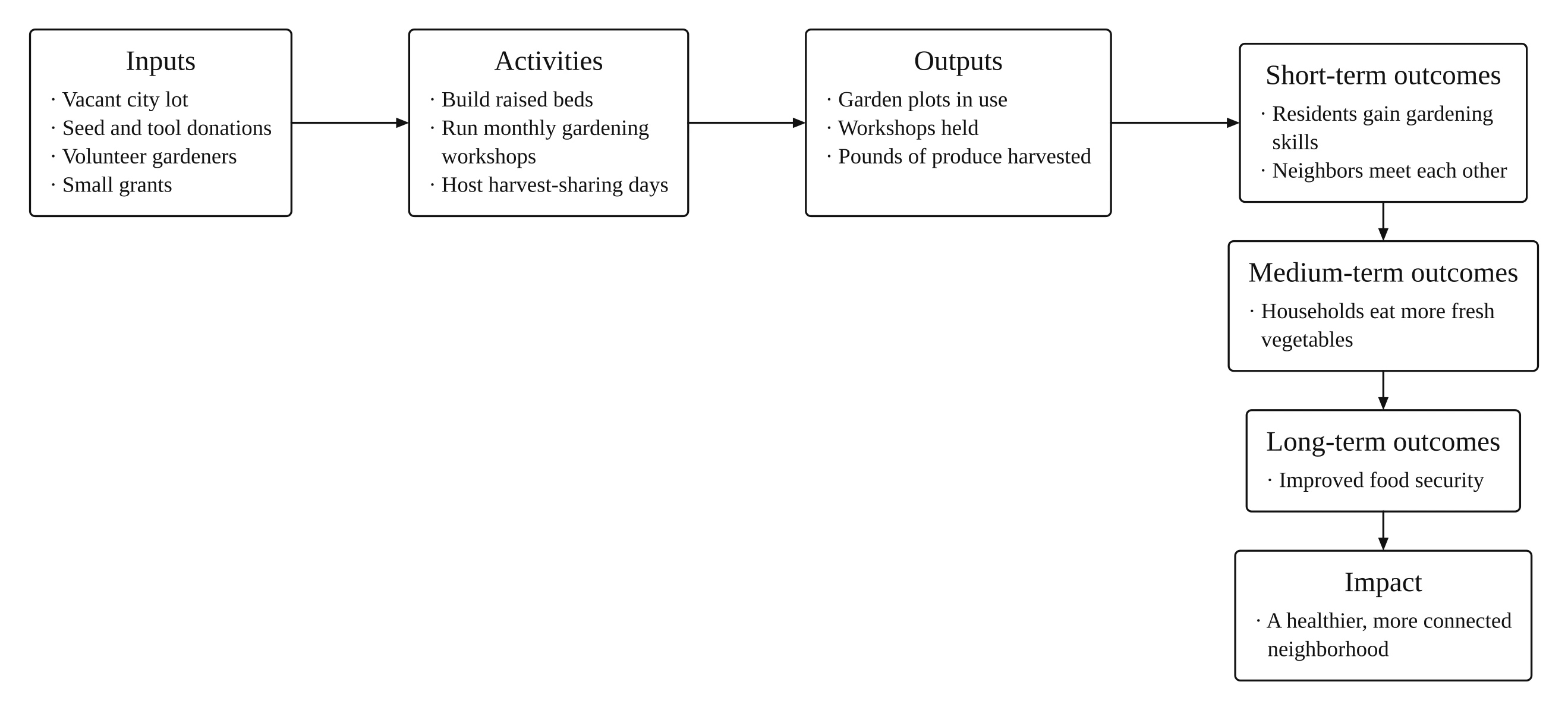
Description used: Logic model for a neighborhood community garden project. Inputs: vacant city lot, seed and tool donations, volunteer gardeners, small grants. Activities: build raised beds, run monthly gardening workshops, host harvest-sharing days. Outputs: garden plots in use, workshops held, pounds of produce harvested. Short-term outcomes: residents gain gardening skills, neighbors meet each other. Medium-term outcomes: households eat more fresh vegetables. Long-term outcomes: improved food security. Impact: a healthier, more connected neighborhood.
This is the template with impact filled in. The impact box holds one broad statement about the neighborhood, while the outcome boxes above it stay specific enough to measure.
Open this example in the generator and replace the items with your program's.
Logic model example for a nonprofit: school-based youth mentoring
A nonprofit mentoring program that matches students with trained adult mentors.
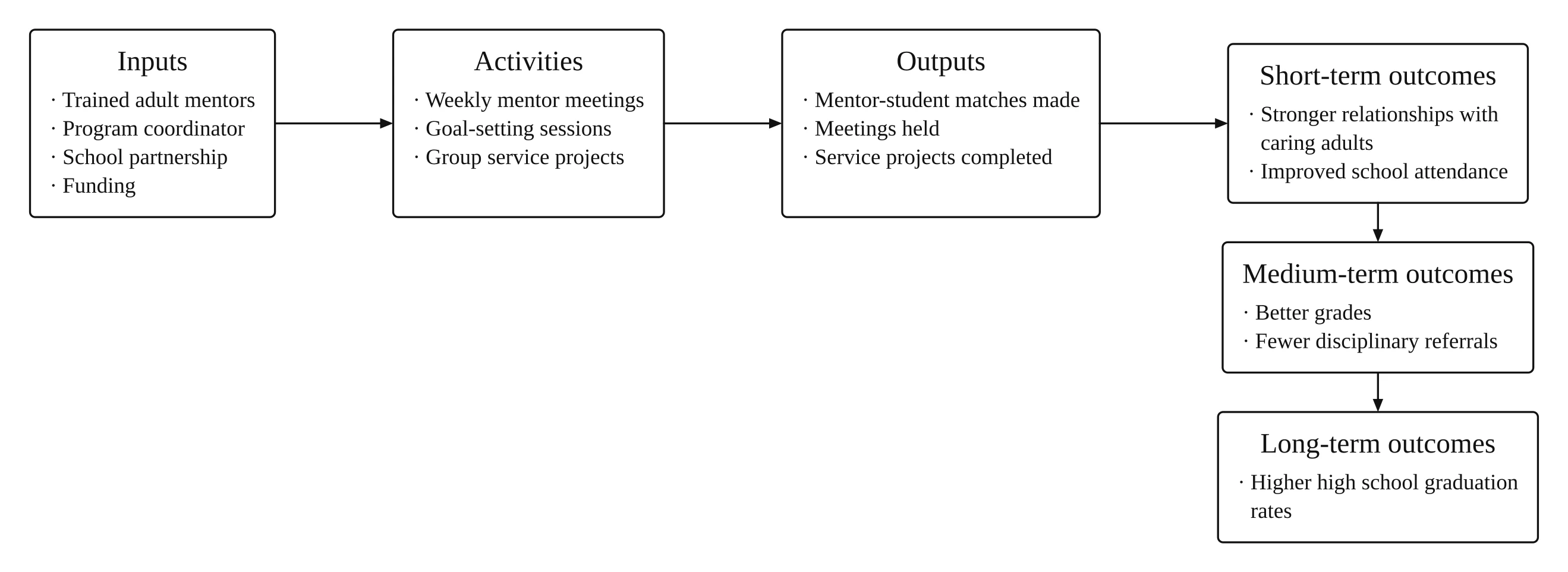
Description used: Logic model for a school-based youth mentoring program. Inputs: trained adult mentors, program coordinator, school partnership, funding. Activities: weekly mentor meetings, goal-setting sessions, group service projects. Outputs: mentor-student matches made, meetings held, service projects completed. Short-term outcomes: stronger relationships with caring adults, improved school attendance. Medium-term outcomes: better grades, fewer disciplinary referrals. Long-term outcomes: higher high school graduation rates.
Read it backward to test it: graduation rates rise if grades and behavior improve, which happens if students attend school and have an adult they trust, which the weekly meetings are meant to produce. If a step does not follow, the model has a gap. Under the Kellogg definitions a school-wide graduation rate is an impact, because it describes a community and not the participants. Many funder templates still label it a long-term outcome; if yours has an Impact box, move this item there.
Open this example in the generator and replace the items with your program's.
How do you use the template in Word, PowerPoint or Google Slides?
Vizcept does not produce a .docx or .pptx template file. It gives you the figure as an image you place on the page or slide:
- Generate the logic model from a template or example above.
- Download it. The free download is a watermarked PNG preview; a paid plan or credit pack gives the watermark-free PNG plus an editable SVG.
- In Word, PowerPoint or Google Slides, insert the PNG as a picture. In Microsoft 365 and Word 2019 or later you can insert the SVG instead and it stays sharp at any size; see how to insert an SVG into Word.
If you would rather type into table cells, a logic model also works as a plain table. To build the table version in Word: Insert > Table > 5 columns by 2 rows. Type Inputs, Activities, Outputs, Outcomes and Impact in the first row. List your items in the second row, one per line. Set the page to landscape (Layout > Orientation) so the five columns fit. The figure is the better choice when the model goes into a proposal, poster or slide and has to be read at a glance.
How do you add indicators to a logic model?
An indicator is the measure you will use to tell whether an output or outcome happened. Outputs are usually their own indicator ("number of classes held"). Outcomes need one written for them: for "improved reading fluency", the indicator could be words read correctly per minute on a fluency test in fall and spring. Keep indicators out of the figure and list them in a table under it, one row per outcome, so the logic model stays readable on one page.
Where do assumptions and external factors go?
Many logic model templates add a band along the bottom for assumptions (what has to be true for the chain to work) and external factors (conditions outside the program's control). The generator does not draw that band today. If you write "Assumptions: ..." and "External factors: ..." into the description, they come out as separate boxes beside the chain, not as a band under it, and the outcome boxes are laid out in a row.
For a clean figure, leave them out of the description and list them in the text under the figure, where reviewers usually look for them anyway.
Logic model vs theory of change: what is the difference?
The two terms overlap. The Kellogg guide treats a theory-of-change model as one type of logic model, and the Community Tool Box lists "theory of change" as another name for one. Where people do separate them, the split follows the Center for Theory of Change: a logic model lays out what a program will do and what it expects to result, as one chain from inputs to impact. A theory of change explains why those results should follow: it starts from the long-term goal, maps the preconditions for it and states the assumptions behind each link.
| Logic model | Theory of change | |
|---|---|---|
| Answers | What will we do, and what will result? | Why and how will change happen? |
| Shape | One left-to-right chain | A map of preconditions that can branch |
| Typical use | Program plans, grant applications, evaluation plans | Strategy and program design |
The templates and examples on this page are single-chain logic models. A branching map of preconditions is a different figure and is not what these templates draw.
What does the generator draw with code, and what does it not?
The logic models on this page come from the conceptual framework generator, which lays out a described model with code. For a logic model that means:
- A single chain of columns, each with its list of items, joined by arrows.
- When the chain ends in two or more outcome or impact columns, those are stacked top to bottom in one column, as in every figure above.
- With a single Outcomes column, the model is drawn as one row of boxes.
Descriptions in Chinese, Japanese or Korean, and uploaded sketches, go to an image model instead of the code layout, so proofread every word in those. A text model decides which item belongs in which column; check its sorting against your plan. The accuracy page explains what code drawing does and does not guarantee.
Logic model template: frequently asked questions
What is a logic model template?
It is a blank chart with one column each for inputs, activities, outputs and outcomes, and often impact, that you fill in for your own program. The blank templates on this page come with placeholder items to replace.
How can I check a logic model before I submit it?
It fits on one page, has an output for every activity, and each outcome plausibly follows from the step before it. See the checklist and the filled examples.
Is there a logic model template for Word?
Vizcept does not export .docx. It gives you the logic model as a PNG and, on a paid plan or credit pack, an editable SVG that Microsoft 365 and Word 2019 or later can place directly. See using the template in Word.
Can I make a logic model from these templates for free?
You can generate one without an account and download a watermarked PNG preview. A watermark-free PNG and an editable SVG come with a paid plan (from $14.90 a month) or a one-time credit pack (from $19.90 for 150 credits). Free credit on sign-up is smaller in some countries.
What is the difference between outputs and outcomes?
Outputs count what the program delivered, such as classes held or people served. Outcomes describe what changed for participants as a result, such as new skills, changed behavior or better health.
Is a logic model the same as a theory of change?
Not always. Some guides use the two names for the same thing. Where they are separated, a logic model shows what a program does and expects to result, in one chain, and a theory of change explains why the change should happen and maps the preconditions behind it. See the comparison.
Can the generator add assumptions and external factors?
Not as a band under the model. If you put them in the description they are drawn as separate boxes beside the chain, so the cleaner option is to list them in the text under the figure.
Turn the template into your program's logic model
Write one line per column; each item is sorted into its box and set in type.

Logic model example in social work: a job readiness program
Workshops, case management and paid placements for adults leaving homeless shelters.
Description used: Logic model for a job readiness program for adults leaving homeless shelters. Inputs: case managers, employer partners, grant funding, training room. Activities: resume and interview workshops, one-on-one case management, paid work placements. Outputs: workshops delivered, participants completing placements, case management hours. Short-term outcomes: stronger job search skills, increased confidence. Medium-term outcomes: participants employed within six months. Long-term outcomes: stable housing, sustained income.
The medium-term outcome carries its own time frame ("within six months"), which tells an evaluator when to measure it. Write time frames into the item when your funder expects them.
Open this example in the generator and replace the items with your program's.