
Why does a study need a theoretical framework?
A theoretical framework does three jobs. It tells you which variables to measure, because the theory names them. It gives each hypothesis a reason, because the theory predicts the relationship. And it gives you something to discuss: whether your results support, refine or contradict the theory.
Which theoretical framework fits your study?
Start from the outcome your study explains, then pick the theory whose constructs already name your variables. All five below are used mainly in quantitative studies that test hypotheses with survey data; for qualitative lenses, see below.
| Your study explains… | Theory on this page | Typical fields |
|---|---|---|
| Why people intend to do something and whether they do it | Theory of Planned Behavior | Psychology, health, education, marketing |
| Why people adopt or reject a technology | UTAUT, which builds on the Technology Acceptance Model | Information systems, e-learning, business |
| Whether people take a recommended health action | Health Belief Model | Nursing, public health |
| How people, their behavior and their environment shape each other | Social Cognitive Theory | Education, health promotion, psychology |
| What sustains motivation and well-being | Self-Determination Theory | Education, sport, workplace psychology |
If none of them names your outcome, your study may need a conceptual framework built from your own variables instead, which can still borrow one theory's structure.
Theory of Planned Behavior (Ajzen, 1991)
The Theory of Planned Behavior is a social psychology theory that explains a deliberate behavior through the intention to perform it. Three beliefs predict intention: attitude toward the behavior, subjective norm and perceived behavioral control. Intention then predicts behavior. Perceived behavioral control also predicts behavior directly, which is what separates it from the earlier Theory of Reasoned Action.
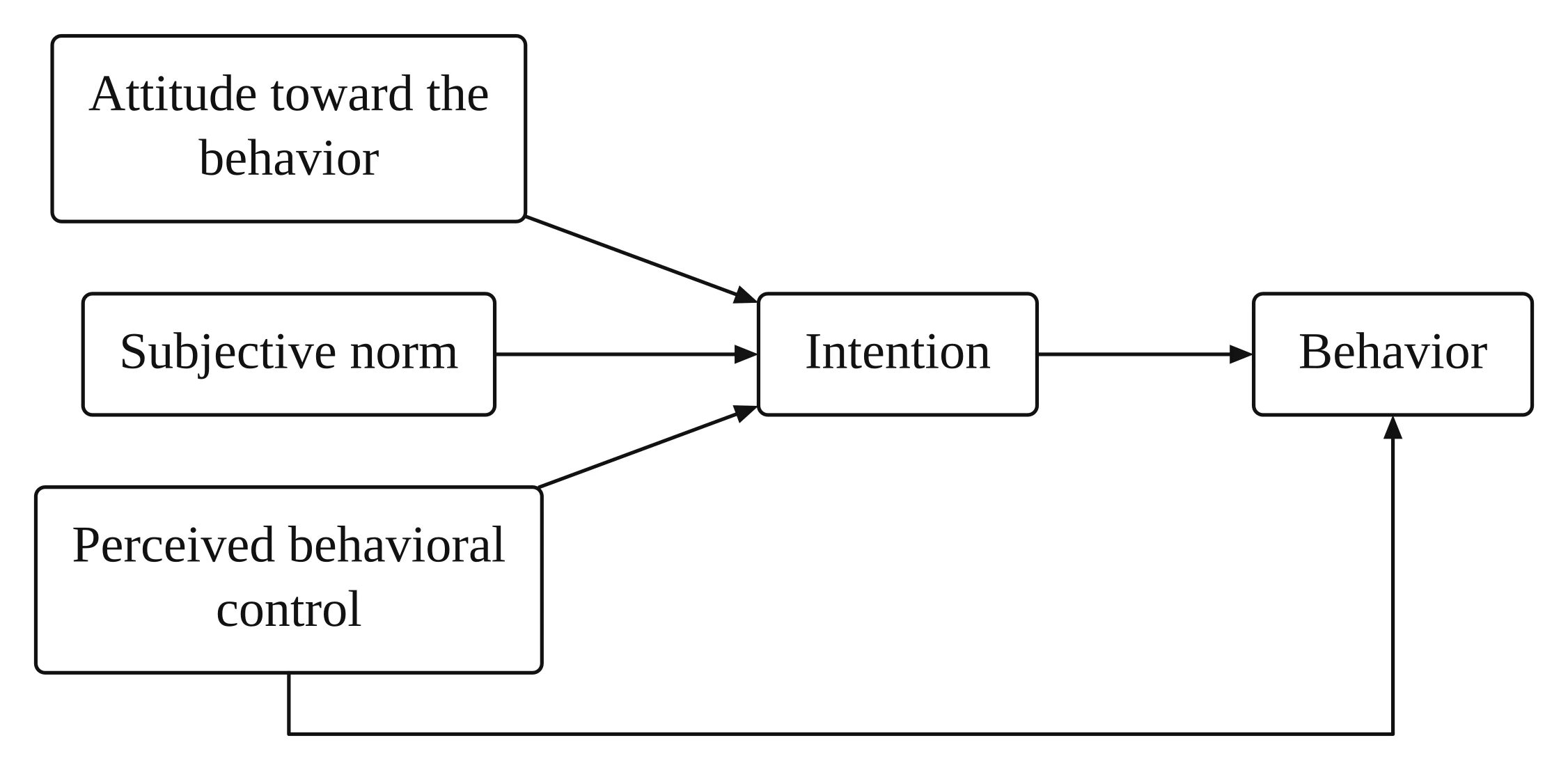
Description used: Theory of Planned Behavior (Ajzen, 1991). Attitude toward the behavior predicts intention. Subjective norm predicts intention. Perceived behavioral control predicts intention. Intention predicts behavior. Perceived behavioral control also predicts behavior directly.
Open this example in the generator
Source: Ajzen, I. (1991). The theory of planned behavior. Organizational Behavior and Human Decision Processes, 50(2), 179–211.
Used for: health behavior, environmental behavior, technology use and education studies that measure intention with a questionnaire. Replace "the behavior" with yours, for example "attitude toward using a reusable cup".
Unified Theory of Acceptance and Use of Technology, UTAUT (Venkatesh et al., 2003)
UTAUT is a technology acceptance theory that unifies eight earlier models into four determinants of intention and use. It grew out of the Technology Acceptance Model (TAM; Davis, 1989) and the others: performance expectancy plays the role of perceived usefulness, and effort expectancy the role of perceived ease of use. Performance expectancy, effort expectancy and social influence predict behavioral intention; behavioral intention and facilitating conditions predict use behavior.
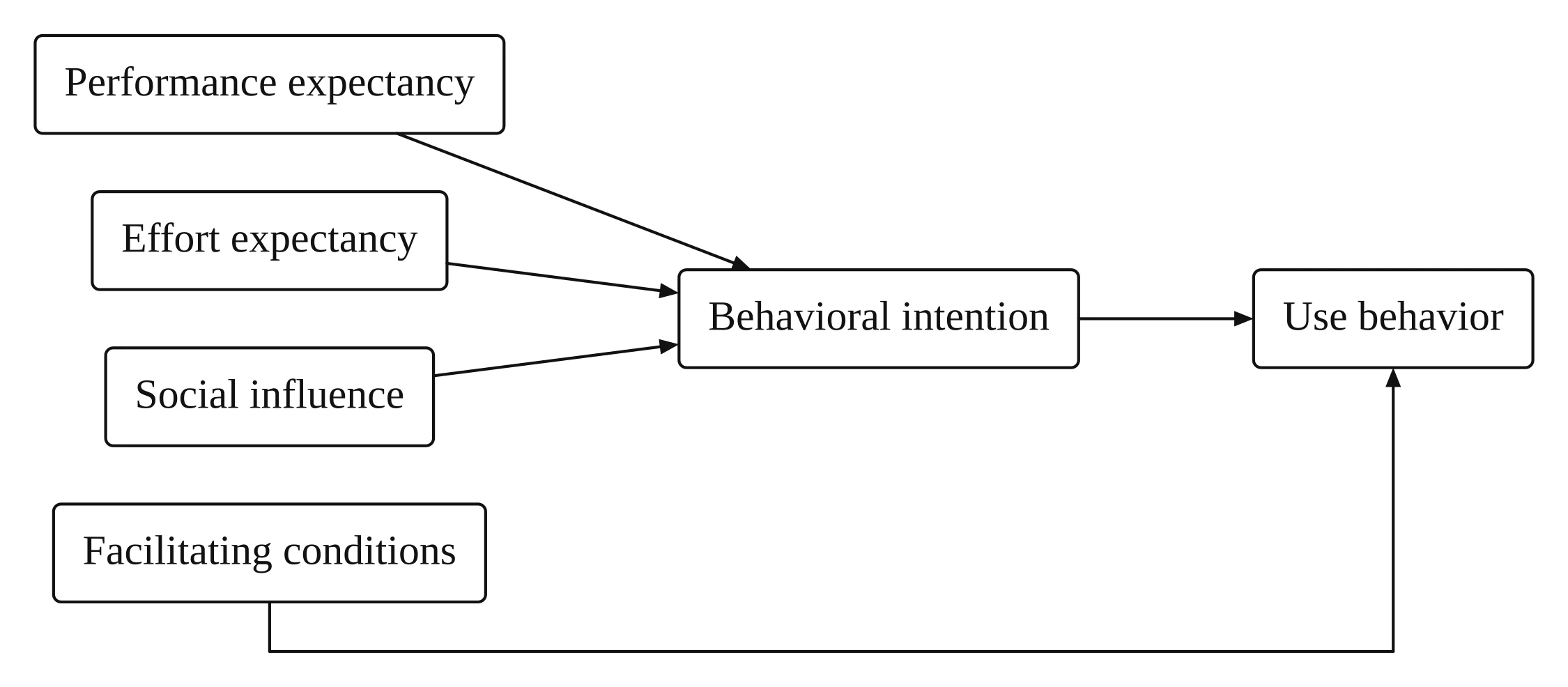
Description used: Unified Theory of Acceptance and Use of Technology, UTAUT (Venkatesh, Morris, Davis & Davis, 2003). Performance expectancy predicts behavioral intention. Effort expectancy predicts behavioral intention. Social influence predicts behavioral intention. Behavioral intention predicts use behavior. Facilitating conditions predict use behavior.
Open this example in the generator
Source: Venkatesh, V., Morris, M. G., Davis, G. B., & Davis, F. D. (2003). User acceptance of information technology: Toward a unified view. MIS Quarterly, 27(3), 425–478.
This figure is simplified: the original model also has four moderators (gender, age, experience and voluntariness of use) on specific paths. They are left off here because drawing all of them makes the figure hard to read; see the original paper for which moderator acts on which path, and add the ones your study tests to the description, for example "Age moderates the effect of effort expectancy on behavioral intention."
Health Belief Model (Rosenstock, 1974)
The Health Belief Model is a public health theory that explains whether people take a recommended health action from their beliefs about the threat and about the action. Modifying factors shape perceived susceptibility and severity and the balance of perceived benefits against barriers. Susceptibility and severity, together with cues to action, make up perceived threat; perceived threat and the benefits-minus-barriers balance predict the likelihood of taking the recommended health action.
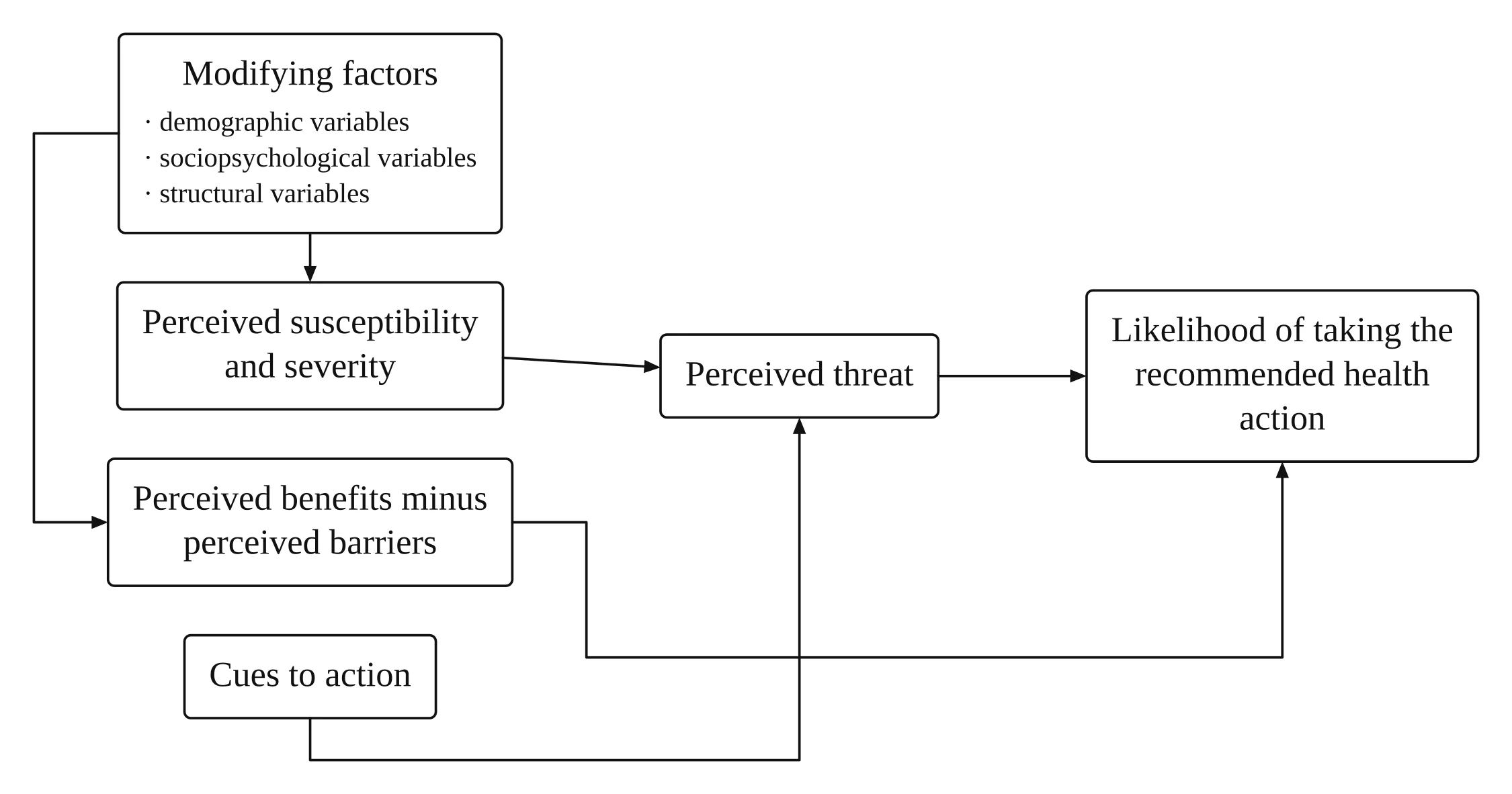
Description used: Health Belief Model (Rosenstock, 1974). Modifying factors (demographic variables, sociopsychological variables, structural variables) predict perceived susceptibility and severity, and predict perceived benefits minus perceived barriers. Perceived susceptibility and severity predicts perceived threat. Cues to action predict perceived threat. Perceived threat predicts likelihood of taking the recommended health action. Perceived benefits minus perceived barriers predicts likelihood of taking the recommended health action.
Open this example in the generator
Source: Rosenstock, I. M. (1974). Historical origins of the health belief model. Health Education Monographs, 2(4), 328–335. The grouping follows the diagram commonly reproduced from that era; see the original paper.
Used for: screening uptake, vaccination and medication adherence studies in nursing and public health. Many studies add self-efficacy as a further construct; write it into the description if yours does.
Self-Determination Theory, simplified (Deci & Ryan, 1985; Ryan & Deci, 2000)
Self-Determination Theory is a theory of human motivation that explains the quality of motivation through three basic psychological needs: autonomy, competence and relatedness. Satisfying those needs supports autonomous motivation, which in turn supports well-being.
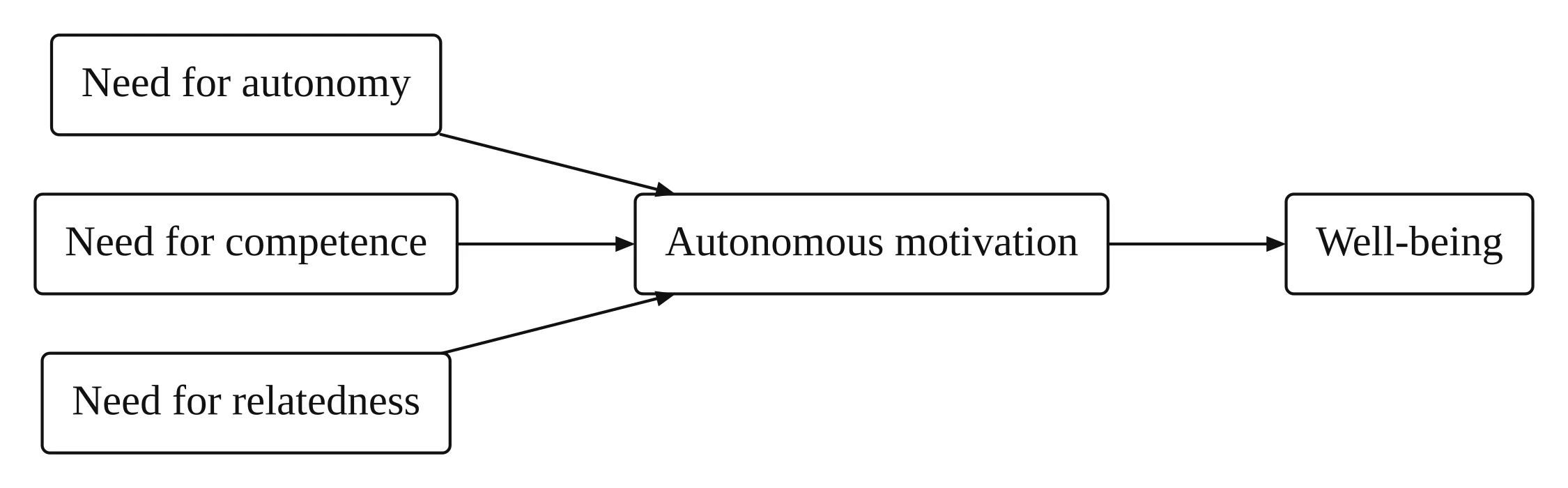
Description used: Self-Determination Theory, simplified (Deci & Ryan, 1985; Ryan & Deci, 2000). Satisfaction of the need for autonomy, the need for competence and the need for relatedness each predicts autonomous motivation. Autonomous motivation predicts well-being.
Open this example in the generator
Source: Deci, E. L., & Ryan, R. M. (1985). Intrinsic Motivation and Self-Determination in Human Behavior. Plenum. Ryan, R. M., & Deci, E. L. (2000). Self-determination theory and the facilitation of intrinsic motivation, social development, and well-being. American Psychologist, 55(1), 68–78.
This figure is simplified: the full theory distinguishes several types of motivation along a continuum. Studies often add need frustration, or a specific outcome such as engagement or performance in place of well-being.
Theoretical framework examples in qualitative research
Qualitative studies often use a theory as a lens rather than a model of predicted paths, so there is no box-and-arrow figure to draw. Three common ones:
- Symbolic interactionism (Blumer, 1969): people act on the meanings things have for them, and those meanings come from social interaction. Used in interview studies of patients, students and workers.
- Sociocultural theory (Vygotsky, 1978): learning happens through social interaction and cultural tools before the learner can do it alone. Used in classroom and language-learning studies.
- Critical race theory (Delgado & Stefancic, 2001): racism is built into laws and institutions, not only into individual acts. Used in education and policy studies.
If your qualitative study does name relationships between concepts, write them as sentences and draw them like the examples above.
Sources: Blumer, H. (1969). Symbolic Interactionism: Perspective and Method. Prentice-Hall. Vygotsky, L. S. (1978). Mind in Society: The Development of Higher Psychological Processes. Harvard University Press. Delgado, R., & Stefancic, J. (2001). Critical Race Theory: An Introduction. New York University Press.
How do you write the theoretical framework section of a thesis?
Writing the theoretical framework section takes seven steps: name the theory, define its constructs, state its relationships, map your variables, explain changes, draw the figure and credit it.
- Name the theory and cite the original source, not only a textbook that summarizes it.
- Define each construct you will use, in the theory's own terms, and say how you will measure it.
- State the relationships the theory predicts and which of them your study tests. If you test only part of a model, say so.
- Map your variables onto the constructs. "Perceived usefulness" becomes "perceived usefulness of the hospital's patient portal".
- Say what you change: constructs you add (such as trust in TAM studies), drop or move, and why.
- Draw the figure and number its paths to match your hypotheses (H1, H2…), so a reader can find each hypothesis on it.
- Credit the figure. If it follows a published diagram, write "Adapted from" with the citation in the caption.
A written example (Theory of Planned Behavior). "This study adopts the Theory of Planned Behavior (Ajzen, 1991) as its theoretical framework. The theory explains a deliberate behavior through the intention to perform it, which depends on three beliefs: attitude toward the behavior, subjective norm and perceived behavioral control. In this study, the behavior is getting the seasonal flu vaccine. Attitude toward vaccination (H1), subjective norm (H2) and perceived behavioral control (H3) predict vaccination intention; intention predicts vaccination (H4), and perceived behavioral control also predicts vaccination directly (H5). Figure 1 shows the framework, adapted from Ajzen (1991)."
To draw it, open any example above in the generator and change the construct names, or write your hypotheses into the description ("Perceived usefulness predicts intention to use (H1)") and the numbers are drawn on the arrows.
Theoretical framework vs conceptual framework
A theoretical framework is an existing, published theory you apply, such as the five on this page. A conceptual framework is your own model of how your study's variables relate, often built from one or more theories. Many theses have both: the theory in Chapter 2 and the study's own model in Chapter 2 or 3. Some programs use only one of the two terms, so follow your department's template.
For worked examples of the second kind, see conceptual framework examples by field.
How these figures were made, and what to check
Every figure on this page came out of the conceptual framework generator from the description printed under it. A text model read the description into constructs and paths; code then laid out the boxes and arrows and set the labels in type, so the words are spelled the way you wrote them. The figures were not edited by hand; the images are only cropped to the figure.
What to check before you use one:
- The model's reading. The text model decides which construct is which and where each arrow goes. Compare every arrow with the theory and with your hypotheses.
- Simplifications. UTAUT and Self-Determination Theory are drawn in simplified form, as noted under each.
- Language. Descriptions in Chinese, Japanese or Korean, and uploaded sketches, are drawn by an image model instead of the code layout, so proofread every label in those.
See accuracy and limits for more.
Theoretical framework examples: frequently asked questions
What is an example of a theoretical framework?
The Theory of Planned Behavior is one: attitude, subjective norm and perceived behavioral control predict intention, and intention predicts behavior (Ajzen, 1991). UTAUT, the Health Belief Model, Social Cognitive Theory and Self-Determination Theory are others; each is drawn on this page with its source.
How do I draw a theoretical framework for my thesis?
Open the closest example above in the generator, rename the constructs to your study's variables, add your hypothesis numbers to the description and generate. Then cite the original theory in the caption, for example "Adapted from Ajzen (1991)".
Can I use one of these figures in my thesis?
Yes. Figures you generate are yours to use in a thesis, paper or presentation. Cite the theory the figure is based on in the caption, since the model itself belongs to its authors.
Is it free to make a theoretical framework figure?
You can generate your first figure without an account and download a watermarked PNG preview. A watermark-free PNG, 4K and an editable SVG come with a paid plan (from $14.90 a month) or a one-time credit pack (from $19.90 for 150 credits) that never renews. Free credit on sign-up is smaller in some countries.
Where does the theoretical framework go in a thesis?
Usually in Chapter 2, at the end of the literature review or in its own section, before the hypotheses. Some programs place it in Chapter 1. Follow your department's template.
Is a theoretical framework the same as a conceptual framework?
No. A theoretical framework is a published theory you apply; a conceptual framework is your own model of your study's variables, which may borrow a theory's structure. See the comparison.
Turn a theory into your study's framework
Rename the constructs, add your hypotheses, and the figure is laid out for you.

Social Cognitive Theory: triadic reciprocal determinism (Bandura, 1986)
Social Cognitive Theory is a psychology theory that explains behavior through continuous interaction between the person, the behavior and the environment. Personal factors (cognition, affect and biological events), behavior and the environment each influence the other two. The generator merges each pair of opposite paths into one double-headed arrow.
Description used: Social Cognitive Theory, triadic reciprocal determinism (Bandura, 1986). Personal factors (cognition, affect, biological events) influence behavior and behavior influences personal factors. Behavior influences environmental factors and environmental factors influence behavior. Environmental factors influence personal factors and personal factors influence environmental factors.
Open this example in the generator
Source: Bandura, A. (1986). Social Foundations of Thought and Action: A Social Cognitive Theory. Prentice-Hall.
Used for: education and health promotion studies. If your study centers on self-efficacy or outcome expectations, name them as personal factors in the description.