
How do you read a conceptual framework diagram?
Read it left to right: predictors (independent variables) on the left, the outcome (dependent variable) on the right, and anything that explains or changes the effect in between or above.
| Drawn as | Means | Example below |
|---|---|---|
| Solid arrow with an H number | One testable hypothesis about one relationship | All except the education example |
| Construct in the middle of a chain | A mediator: it explains how the effect happens | Nursing, psychology, business |
| Arrow pointing at another arrow | A moderator: it changes the strength of that path | Business, psychology |
| Dashed box and dashed arrow | A control variable (or confounder) you measure and hold in the analysis | Nursing, public health |
| Boxes with bullet lists, no hypotheses | An input–process–output (IPO) framework | Education |
The six examples below cover those five shapes. Each one links to the exact description that produced it, so you can open it in the generator and change the variables to yours.
What are the core elements of a conceptual framework?
A conceptual framework has five core elements:
- The research question it serves.
- The variables, split into independent (predictor) and dependent (outcome) variables.
- The role variables: mediators, moderators and controls.
- The relationships between them, usually numbered as hypotheses (H1–Hn).
- The literature or theory that supports each relationship.
Sources count for as much as the boxes: a diagram with no theory behind its arrows is a sketch, not a framework. Mediation and moderation are distinguished in Baron and Kenny (1986, Journal of Personality and Social Psychology), the usual citation for the difference.
Mediator, moderator, control or confounder: which one is it?
| Variable | Question it answers | Drawn as |
|---|---|---|
| Mediator | How or why does the effect happen? | Box between predictor and outcome |
| Moderator | When, or for whom, is the effect stronger? | Arrow pointing at another arrow |
| Control | What do I hold constant or measure? | Dashed box |
| Confounder | What else could explain the result? | Dashed box, once you measure it |
A confounder is a variable linked to both the predictor and the outcome that can make an effect look bigger or smaller than it is. If you measure it and enter it in the analysis, draw it as a control.
Where do these examples come from?
Each figure below was generated by the Vizcept conceptual framework generator from the one- or two-sentence description printed under it. Nothing was redrawn or edited by hand; the images are only cropped to the figure. The generator reads the description (a language model identifies each construct's role and each path), then the figure is laid out by code, so every construct name is typeset exactly as the analysis returned it and cannot be misspelled the way an image model can.
The variables are illustrative. They are typical of studies in each field, not findings from a particular paper, so use them as a pattern for your own framework and cite your own literature for the relationships you propose.
Conceptual framework example in education: an input–process–output (IPO) framework
Blended learning in senior high school reading classes, drawn as three columns. Each column holds the items you list for it.
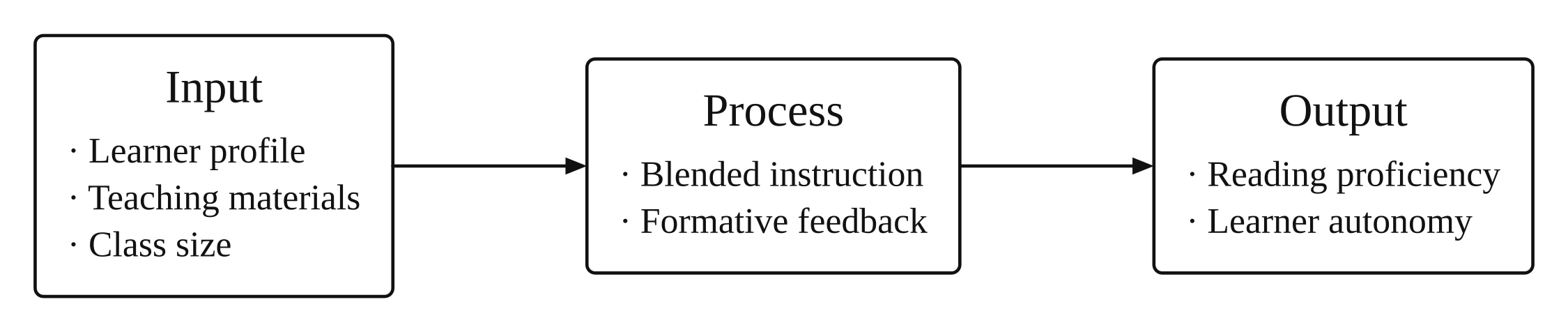
Description used: Conceptual framework for my study on blended learning in senior high school reading classes. Input: learner profile, teaching materials, class size. Process: blended instruction and formative feedback. Output: reading proficiency and learner autonomy.
Many education and TVET programs ask for an IPO framework rather than a variables-and-hypotheses model. Nothing is tested path by path here, so the arrows carry no hypothesis labels; the boxes hold the items you plan to measure or implement. If your committee wants hypotheses, say so in the description and give each relationship an H number.
Open this example in the generator and swap in your own variables.
Conceptual framework example in nursing: a mediation model with a control variable
Staffing adequacy, emotional exhaustion and patient safety behaviors, with clinical experience as a control.
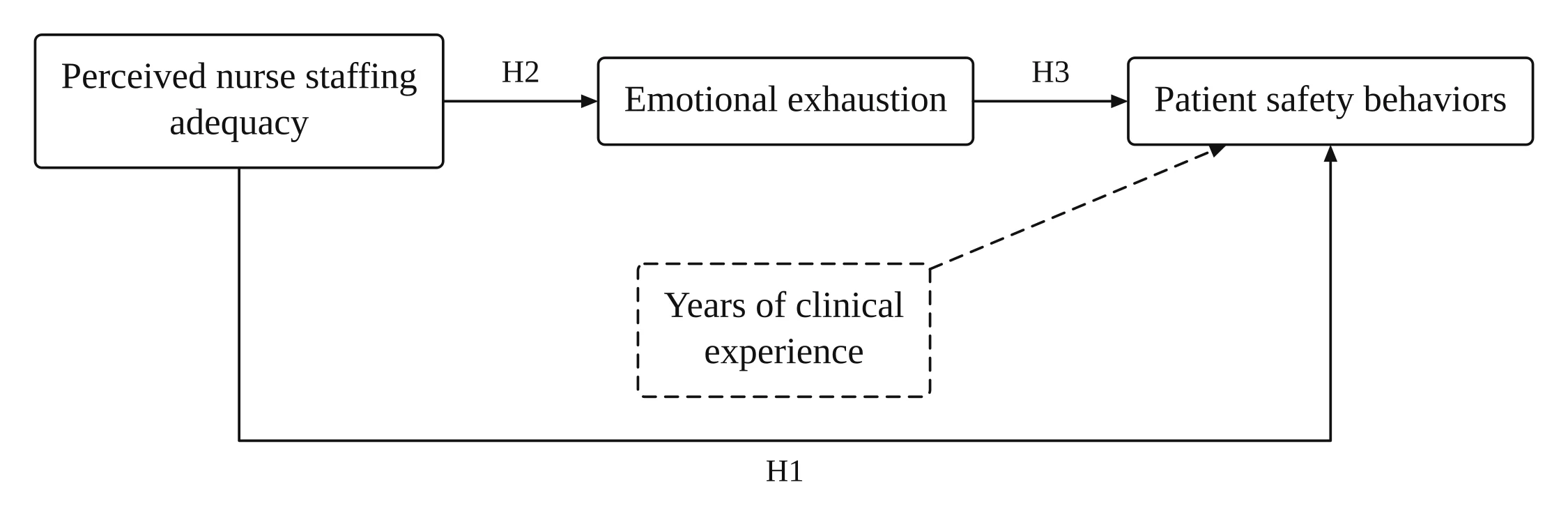
Description used: Perceived nurse staffing adequacy predicts patient safety behaviors (H1). Emotional exhaustion mediates this relationship (H2, H3). Years of clinical experience is a control variable on patient safety behaviors.
The mediator sits on the path between predictor and outcome, and the direct path (H1) runs underneath it. The control variable is dashed and points at the outcome only. Notice that each hypothesis number sits on exactly one arrow: H2 and H3 are the two legs of the indirect effect.
Open this example in the generator and swap in your own variables.
Conceptual framework example in business: a mediator and a moderator together
Social media marketing, brand trust and purchase intention, with brand familiarity changing the first link.
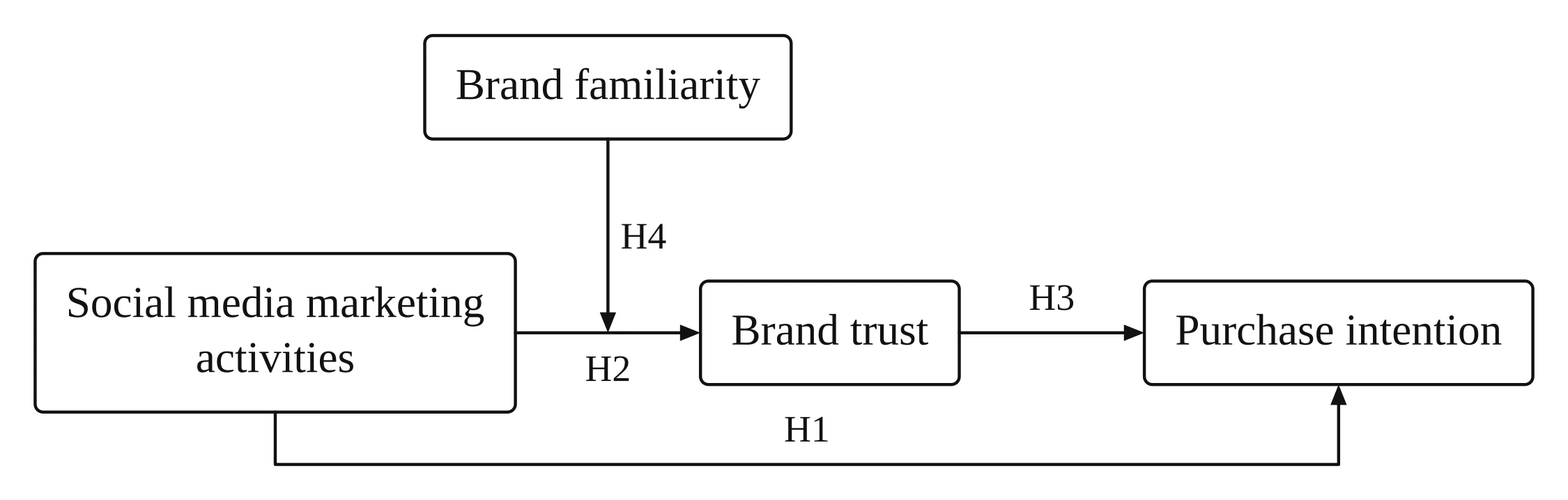
Description used: Social media marketing activities increase purchase intention (H1) and brand trust (H2). Brand trust increases purchase intention (H3). Brand familiarity moderates the effect of social media marketing activities on brand trust (H4).
A moderator does not point at a box; it points at the arrow it changes. Here H4 lands on the middle of the H2 path, which reads as 'the effect of marketing activities on trust depends on how familiar the brand is'. That is the difference between a moderator and a mediator, and the most common thing students get wrong when they draw it by hand.
Open this example in the generator and swap in your own variables.
Conceptual framework example in psychology: a mediation model with a moderated first path
Perceived stress, rumination and depressive symptoms, with social support buffering the stress-to-rumination path.
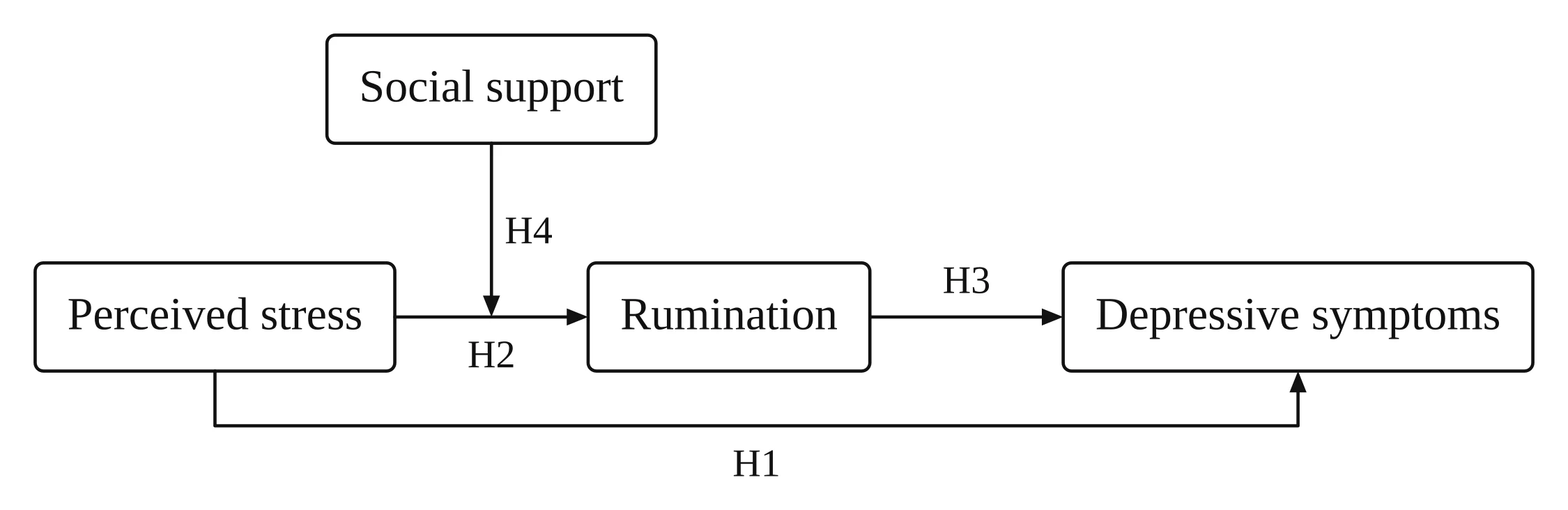
Description used: Perceived stress predicts depressive symptoms (H1). Rumination mediates the link from perceived stress to depressive symptoms (H2, H3). Social support moderates the path from perceived stress to rumination (H4).
This is the layout behind most 'moderated mediation' proposals: an indirect path with one moderator on its first leg. If your moderator acts on the second leg or on the direct path instead, change the sentence that names the moderated path and the arrow moves with it.
Open this example in the generator and swap in your own variables.
Conceptual framework example in public health: several predictors and two controls
Three predictors of vaccine uptake, with age and household income held as controls.
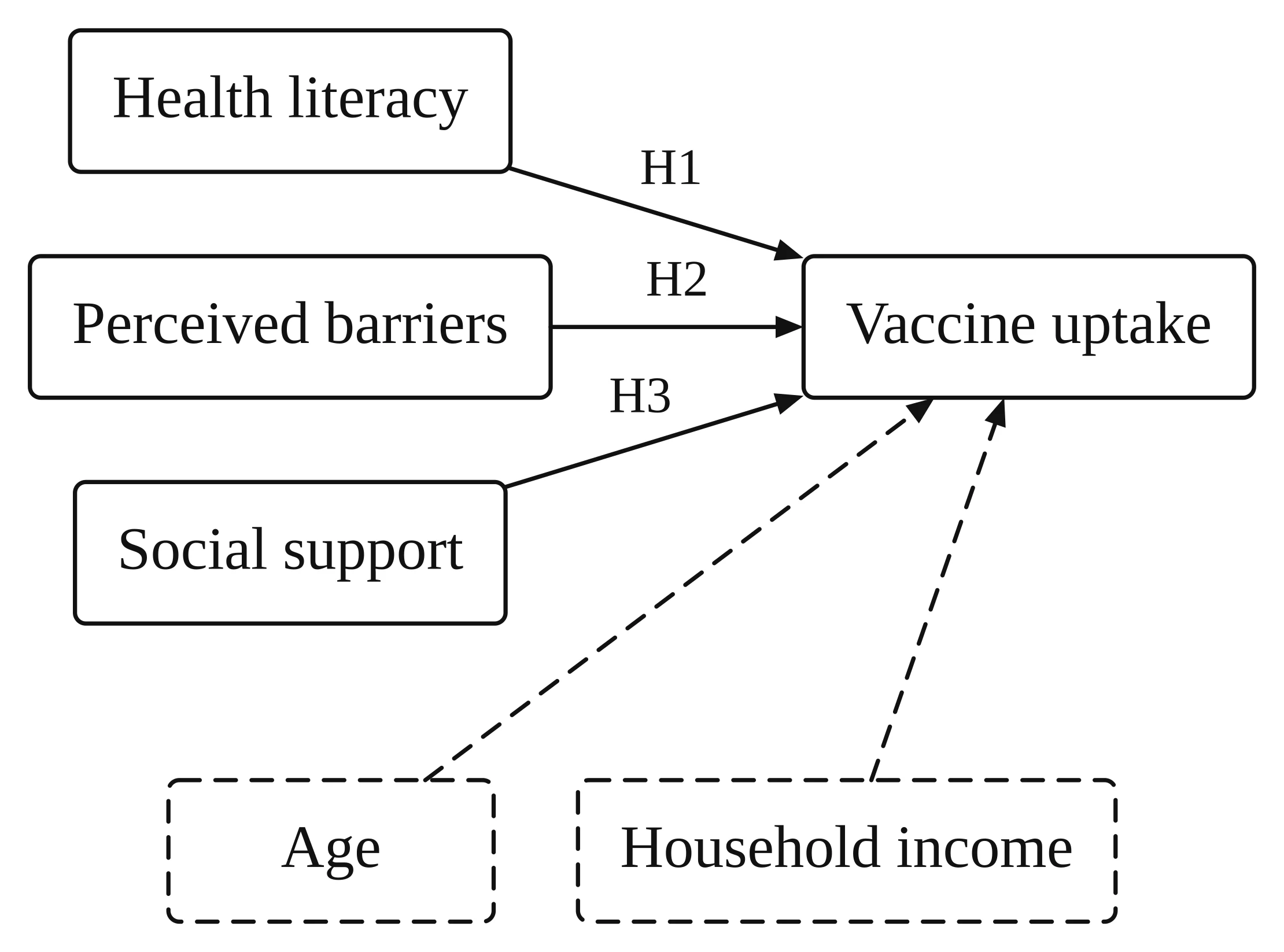
Description used: Health literacy (H1), perceived barriers (H2) and social support (H3) each predict vaccine uptake among adults. Age and household income are control variables on vaccine uptake.
A cross-sectional survey study often needs nothing more than this: several independent variables, one outcome and the demographic controls you will enter in the regression. Controls are dashed so a reader can tell them from the hypotheses at a glance.
Open this example in the generator and swap in your own variables.
Conceptual framework example in information systems: a chain of predictors
Three quality dimensions lead to user satisfaction, which leads to continuance intention for an e-learning platform.
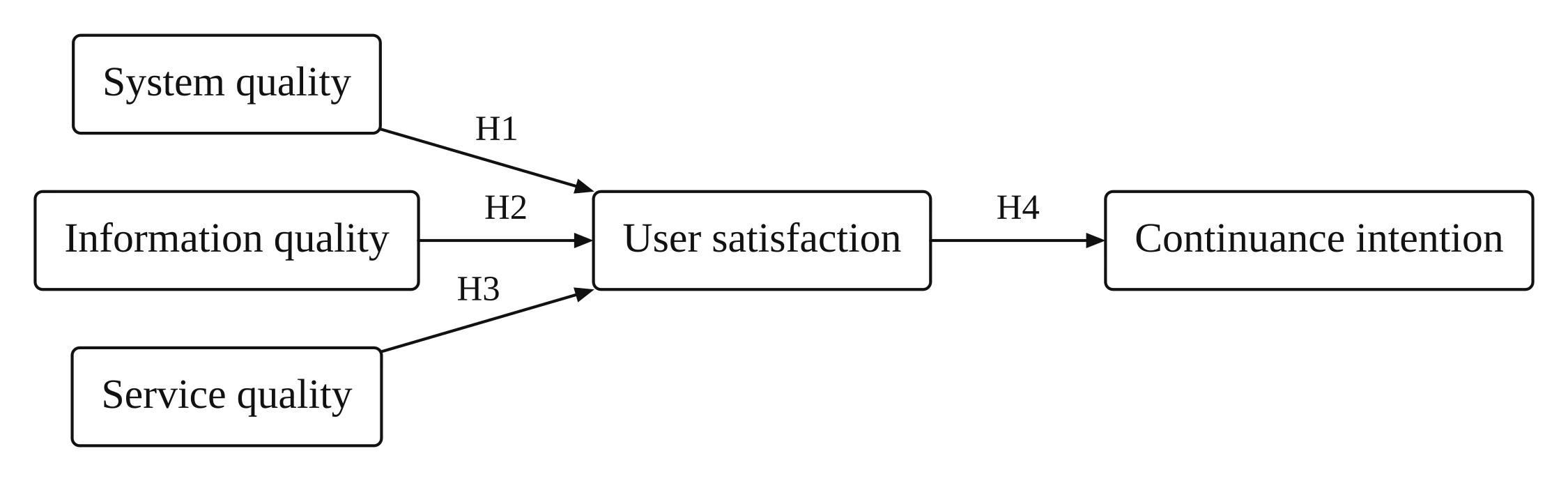
Description used: System quality, information quality and service quality each influence user satisfaction (H1, H2, H3). User satisfaction influences continuance intention to use the e-learning platform (H4).
Models built on the DeLone and McLean information systems success model (2003, Journal of Management Information Systems), or on expectation–confirmation theory, usually look like this: several quality factors feeding a satisfaction construct that feeds an intention. Every construct here is a single box; if you measure sub-dimensions, list them as items inside the box.
Open this example in the generator and swap in your own variables.
What does a qualitative conceptual framework example look like?
A qualitative conceptual framework names the concepts that shape your study and how they connect, usually without hypothesis numbers and without predicting an effect. The education example above, with three input–process–output columns and no H labels, is the closest layout on this page. Describe your concepts and the connections you expect to explore, and leave out the H numbers.
What is the difference between a conceptual and a theoretical framework example?
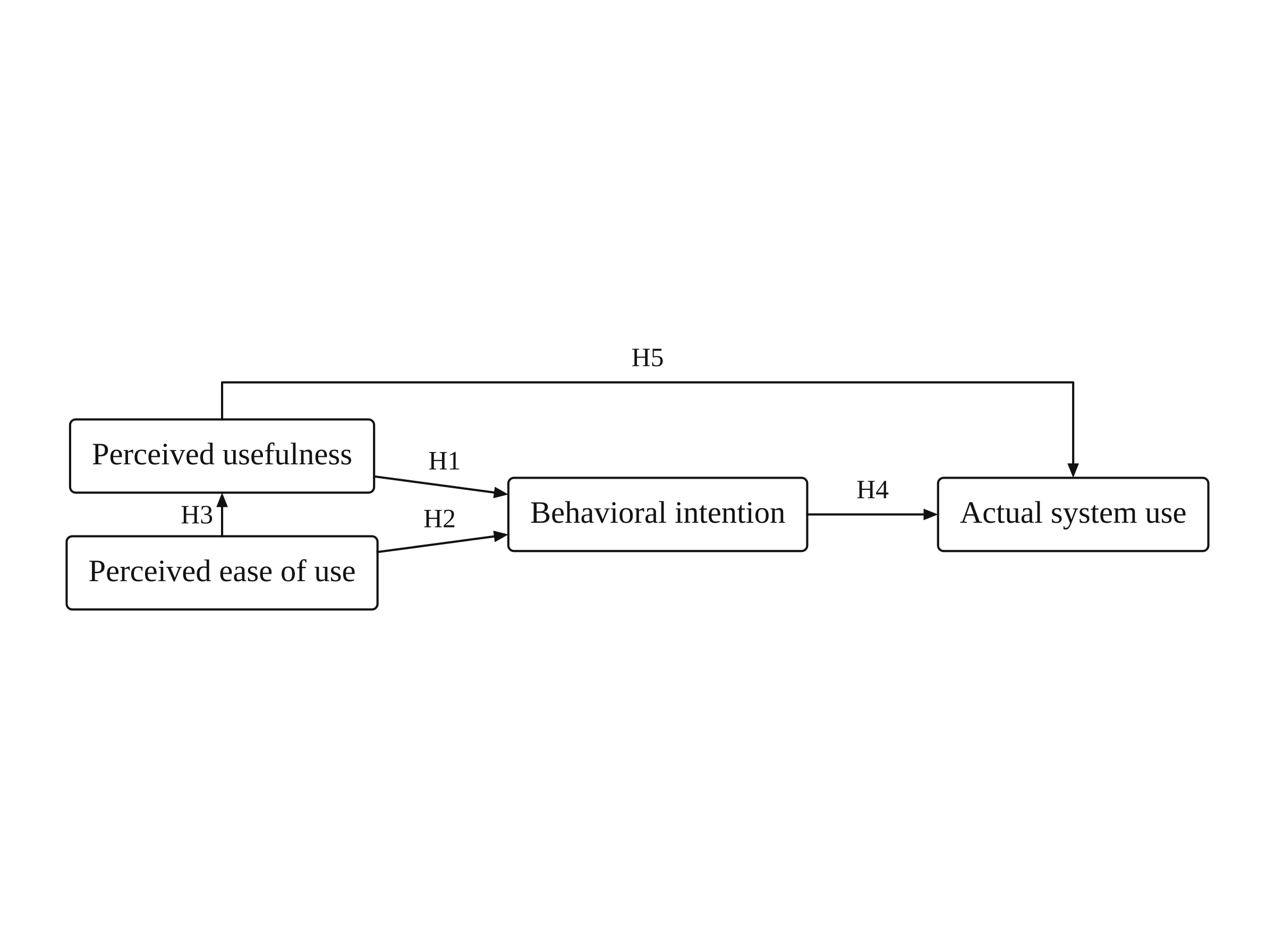
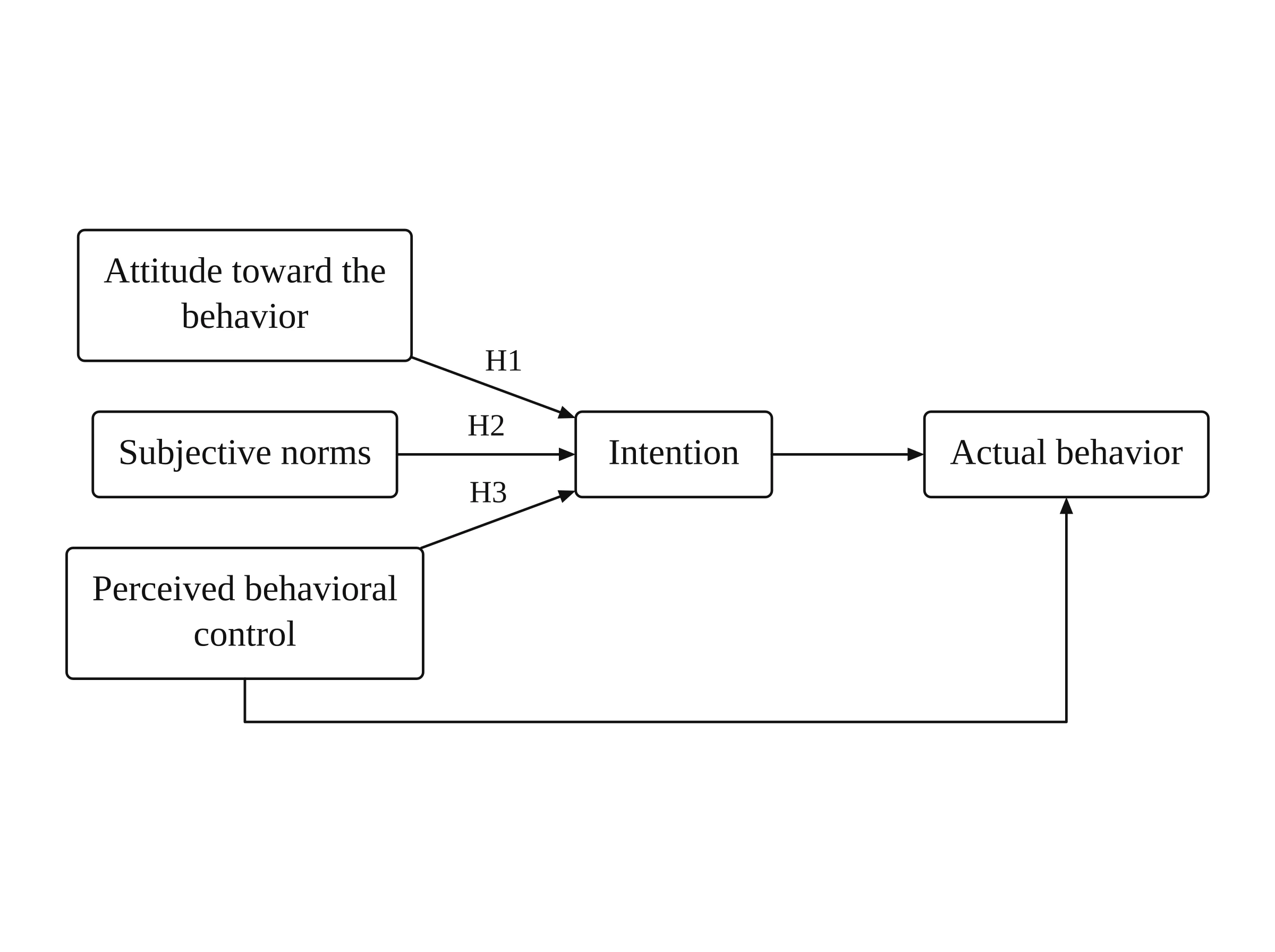
A theoretical framework example names an established theory and shows its constructs, such as the Technology Acceptance Model (perceived usefulness and perceived ease of use predicting intention to use; Davis, 1989, MIS Quarterly) or the Theory of Planned Behavior (attitude, subjective norms and perceived behavioral control predicting intention and behavior; Ajzen, 1991, Organizational Behavior and Human Decision Processes). A conceptual framework example, like the six above, is your own model: your variables, their roles and your hypotheses, which may borrow a theory's structure.
The full side-by-side comparison is on the generator page.
To draw a theory-based model, name the theory in the description. These two come from the same generator:
If your program uses the term 'research paradigm' or 'paradigm of the study' for this figure, the same input–process–output or variables-and-arrows layout applies; follow your department's template for the labels.
How do you write your own conceptual framework from an example?
Start from the example whose shape matches your design, then replace everything that is specific to it:
- Rewrite the outcome as the construct your research question asks about.
- Replace each predictor with a variable your literature review supports, and keep one hypothesis number per relationship.
- If you claim an explanation, name the mediator; if you claim 'it depends on', name the moderator and the path it changes.
- List the controls you will enter in the analysis.
- Generate it, then check the roles and arrow directions against your own plan before the figure goes into your thesis.
The figure only shows the model; defending each arrow with sources is the part your committee reads. For wording around the terms in your Chapter 1, see definition of terms in research; for turning a supervisor's comments on the figure into a revised version, see how to revise a figure from supervisor comments.
Where does the conceptual framework go in a thesis or dissertation?
Usually the framework is introduced in Chapter 1 and developed in the literature review chapter, with the figure placed where you explain it. Programs differ, so follow your department's thesis template; if it does not say, ask your supervisor which chapter should hold the figure.
What should you check before using a generated framework?
The construct names are typeset from the analysis, but the analysis itself is a model's reading of your description, so it can get a role or a direction wrong. Before you use the figure, check that:
- Every construct from your plan is on the figure.
- Each mediator sits between its predictor and outcome.
- Each moderator points at the right arrow.
- Each H number matches your hypothesis list.
Details are on the accuracy page.
Conceptual framework examples: frequently asked questions
What is a conceptual framework?
A conceptual framework is a diagram of your study's variables, the role each plays (predictor, outcome, mediator, moderator or control) and the relationship you expect between each pair, usually numbered as hypotheses. The six examples on this page show the common shapes.
What is an example of a conceptual framework in research?
A conceptual framework in research is a diagram of your study's variables and the relationships you hypothesize, for example nurse staffing adequacy predicting patient safety behaviors through emotional exhaustion (a mediator), with years of experience as a control variable. Six full examples are on this page, one per common model shape.
Can I use these conceptual framework examples in my thesis?
Use them as patterns, not as content. The variables are illustrative and the relationships are not backed by a citation here, so replace them with your own variables and support each hypothesis with your own literature. For what you may do with a figure you generate, see publication rights, and check your institution's rules on AI-generated figures.
What is a good conceptual framework example for a thesis in nursing, education or business?
Pick the shape that matches your design: a mediation model if you explain how an effect happens (the nursing example), an input–process–output framework if your program uses IPO (the education example), or a mediator plus moderator for a business model (the business example).
How do I show a moderator in a conceptual framework?
Draw the moderator as a box with an arrow pointing at the middle of the path whose strength it changes, not at the outcome box. In the business example, brand familiarity points at the arrow from social media marketing to brand trust.
What is the difference between a conceptual framework and a theoretical framework?
A theoretical framework is an existing theory from the literature; a conceptual framework is your own model for this study, built from your research question and hypotheses. The section above shows theory-based examples, and the generator page has a side-by-side comparison.
Can I make a conceptual framework like these for free?
Partly. Visitors can try the generator with a small free credit allowance (5 credits; one 2K figure costs 5 credits) and download a watermarked preview. A watermark-free PNG and an editable SVG need a paid plan or credit pack. Free credit on sign-up is smaller in some countries.
What are the 5 elements of a conceptual framework?
The research question, the variables (independent and dependent), the role variables (mediators, moderators, controls), the hypothesized relationships between them, and the literature or theory behind each relationship. The core elements section lists them.
What is the difference between a qualitative and a quantitative conceptual framework?
A quantitative framework predicts relationships between measured variables and numbers them as hypotheses. A qualitative framework names concepts and how they connect without predicting an effect. See the qualitative example above.
Draw your own conceptual framework
Describe your variables and hypotheses; get a framework diagram with typeset labels, ready to edit.

