
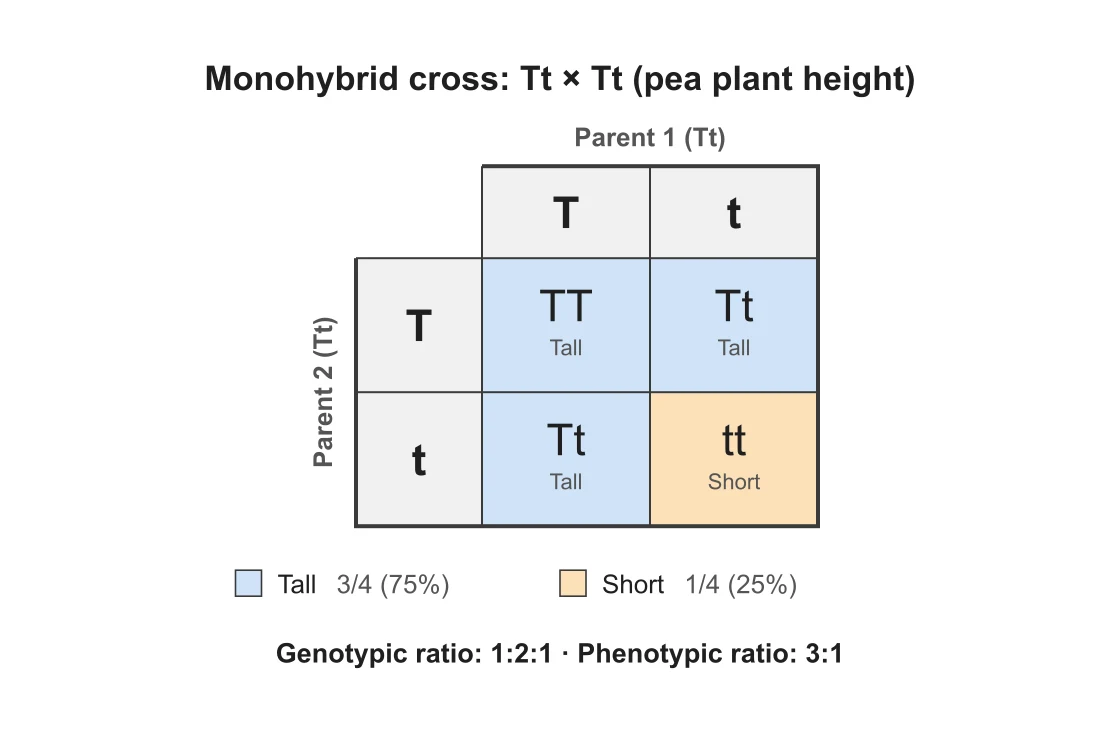
Monohybrid cross: Tt × Tt
Mendel's pea plants: two heterozygous tall plants. One box in four is tt, so 1/4 of the offspring are expected to be short. Genotypes 1 TT : 2 Tt : 1 tt, phenotypes 3 tall : 1 short.
Type both parents' genotypes, such as Tt × Tt or RrYy × RrYy, and get the Punnett square with the genotypic and phenotypic ratios and the probability of each offspring, worked out step by step. It handles one to four genes, incomplete dominance, codominance, ABO blood types and X-linked traits.
One letter per gene: uppercase is dominant, lowercase is recessive. Aa, RrYy, AaBbCc (up to 4 genes). Spaces are ignored.
Genotypes only · free, worked out on this page · download PNG (300 DPI) or SVG, or print a blank worksheet with an answer key
PNG prints at 300 DPI; SVG keeps every letter editable. The print button puts a blank square on page 1 and the answer key on page 2 (choose Save as PDF to get a file).
| Genotype | Boxes | Probability |
|---|---|---|
| TT | 1/4 | 1/4 · 25% |
| Tt | 2/4 | 1/2 · 50% |
| tt | 1/4 | 1/4 · 25% |
| Phenotype | Boxes | Probability |
|---|---|---|
| Tall | 3/4 | 3/4 · 75% |
| Short | 1/4 | 1/4 · 25% |
The square is worked out on this page as you type. When you download or print it, the cross and settings are saved to your history so you can reopen it later.
Each square below is what this calculator draws for the cross in its title, unedited. Open one in the tool to change the parents, rename the traits or turn it into a blank worksheet.
Mendel's pea plants: two heterozygous tall plants. One box in four is tt, so 1/4 of the offspring are expected to be short. Genotypes 1 TT : 2 Tt : 1 tt, phenotypes 3 tall : 1 short.
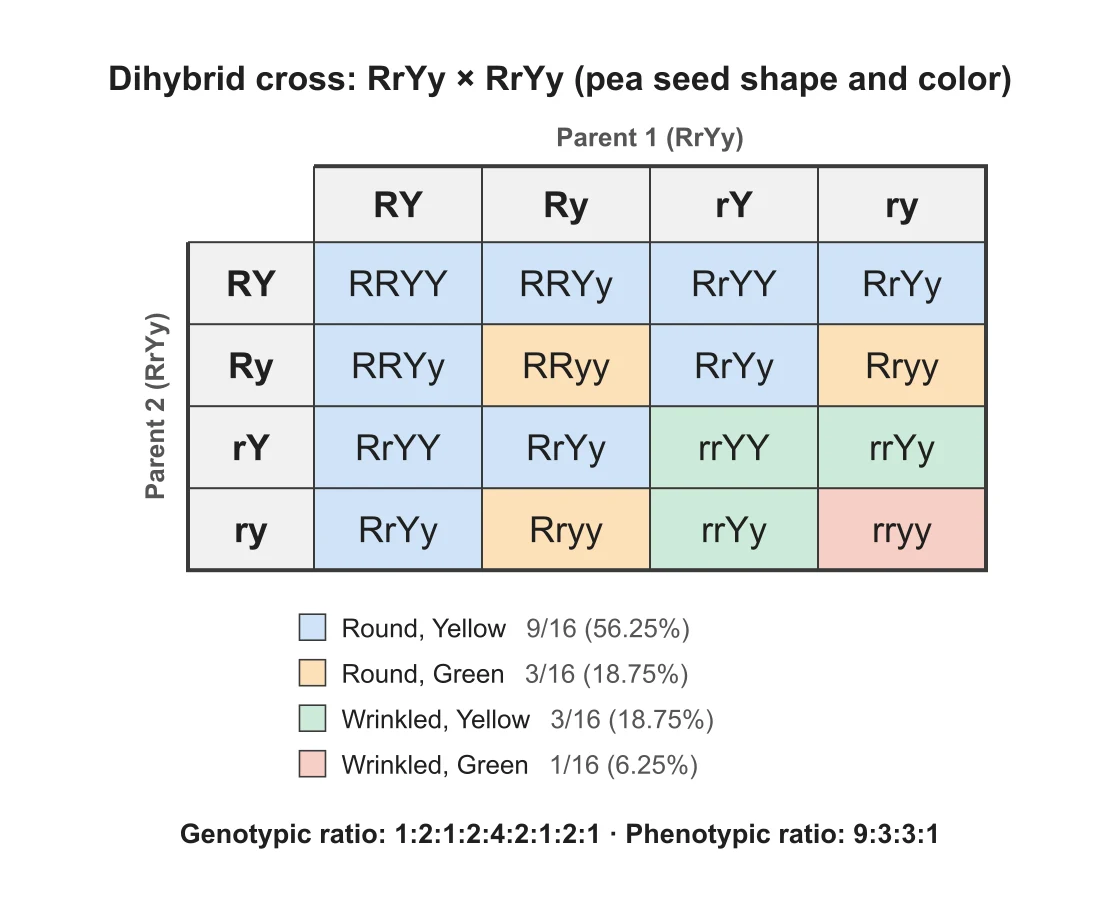
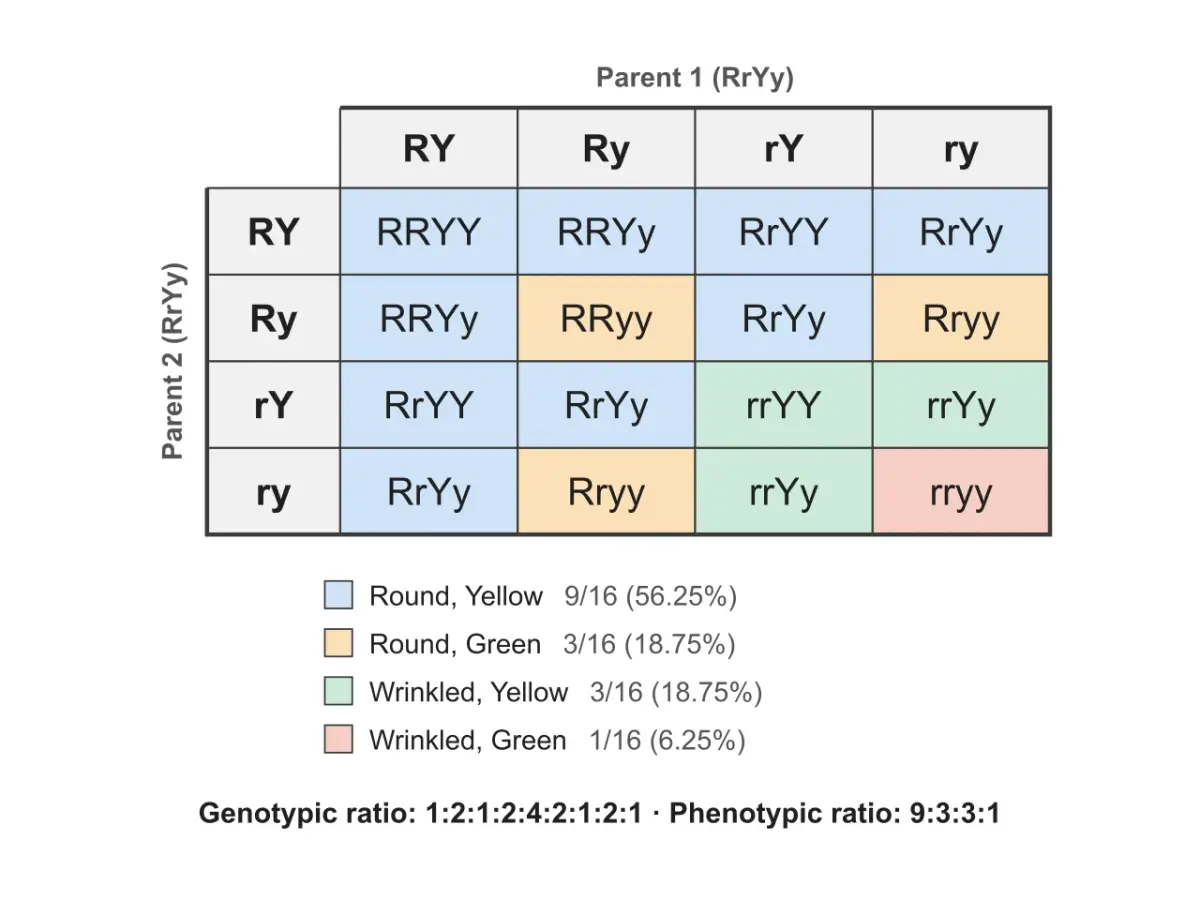
Seed shape (round R, wrinkled r) and color (yellow Y, green y). Four gametes per parent give a 4 × 4 square of 16 boxes and the 9:3:3:1 ratio: 9 round yellow, 3 round green, 3 wrinkled yellow, 1 wrinkled green.
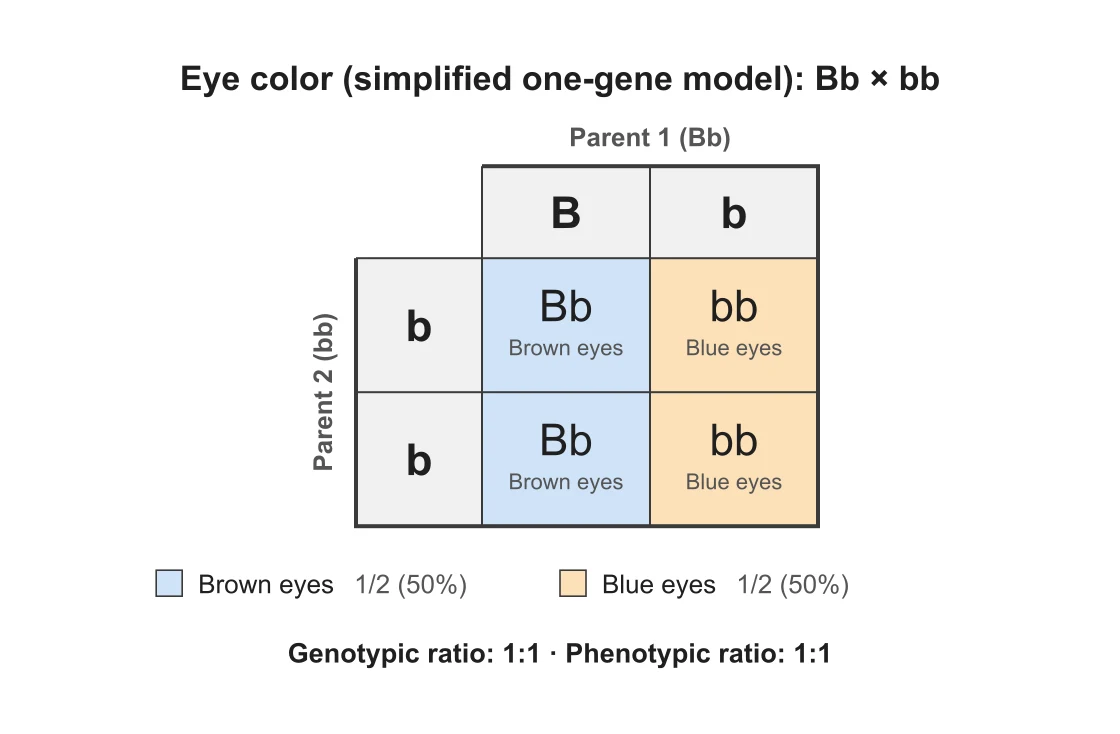
The one-gene model taught in class: brown (B) over blue (b). A heterozygous brown-eyed parent and a blue-eyed parent give 1/2 brown, 1/2 blue. Real eye color depends on at least eight genes, so real families vary more.
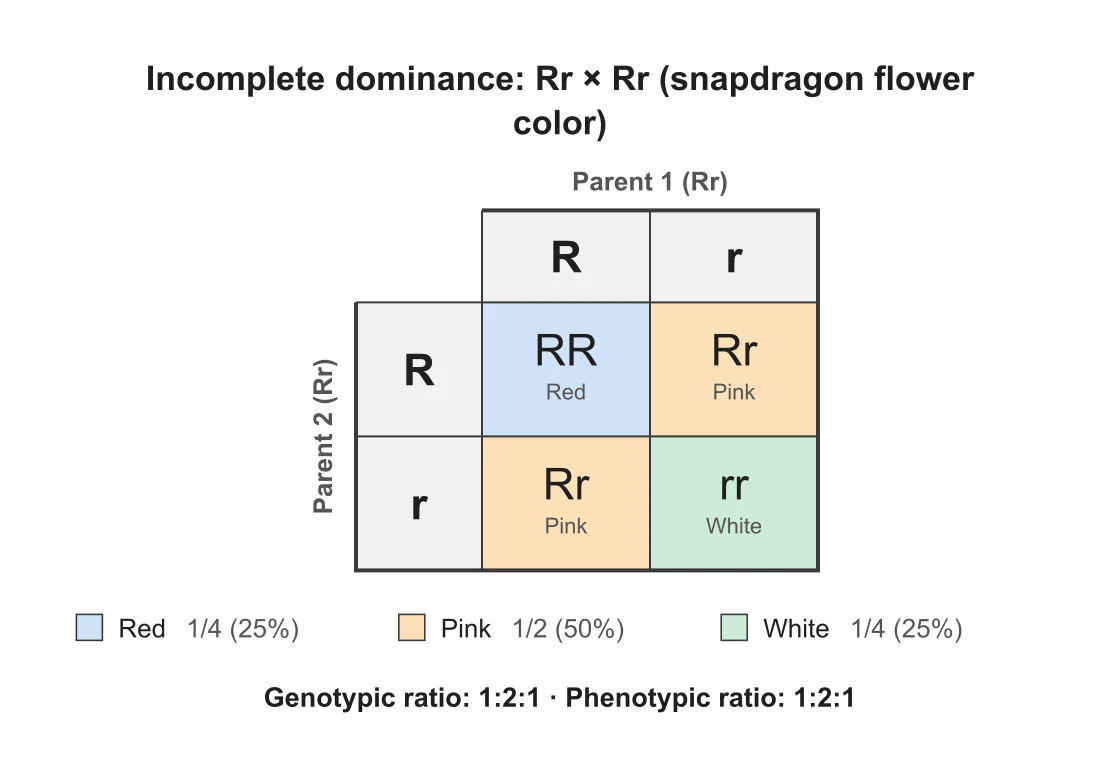
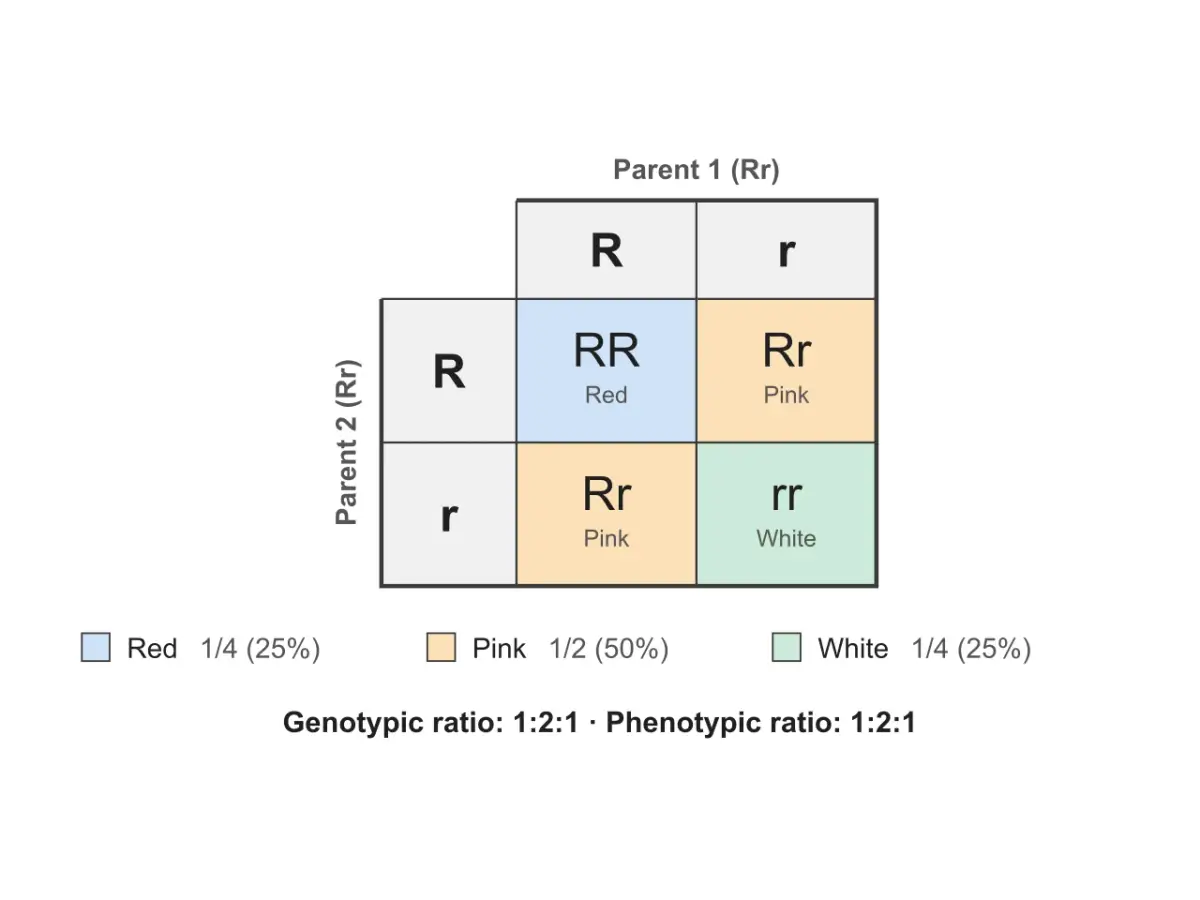
Snapdragon flower color: red and white homozygotes, pink heterozygotes. With a blend, every genotype has its own phenotype, so the phenotypic ratio equals the genotypic ratio, 1 red : 2 pink : 1 white.
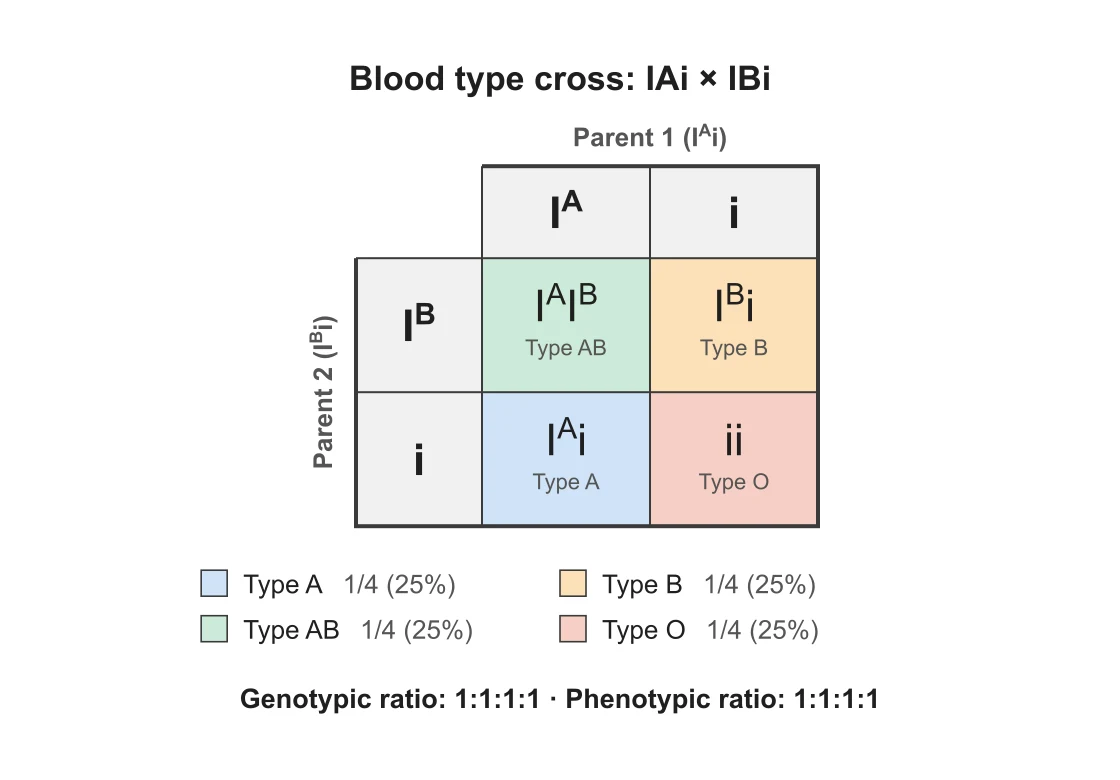
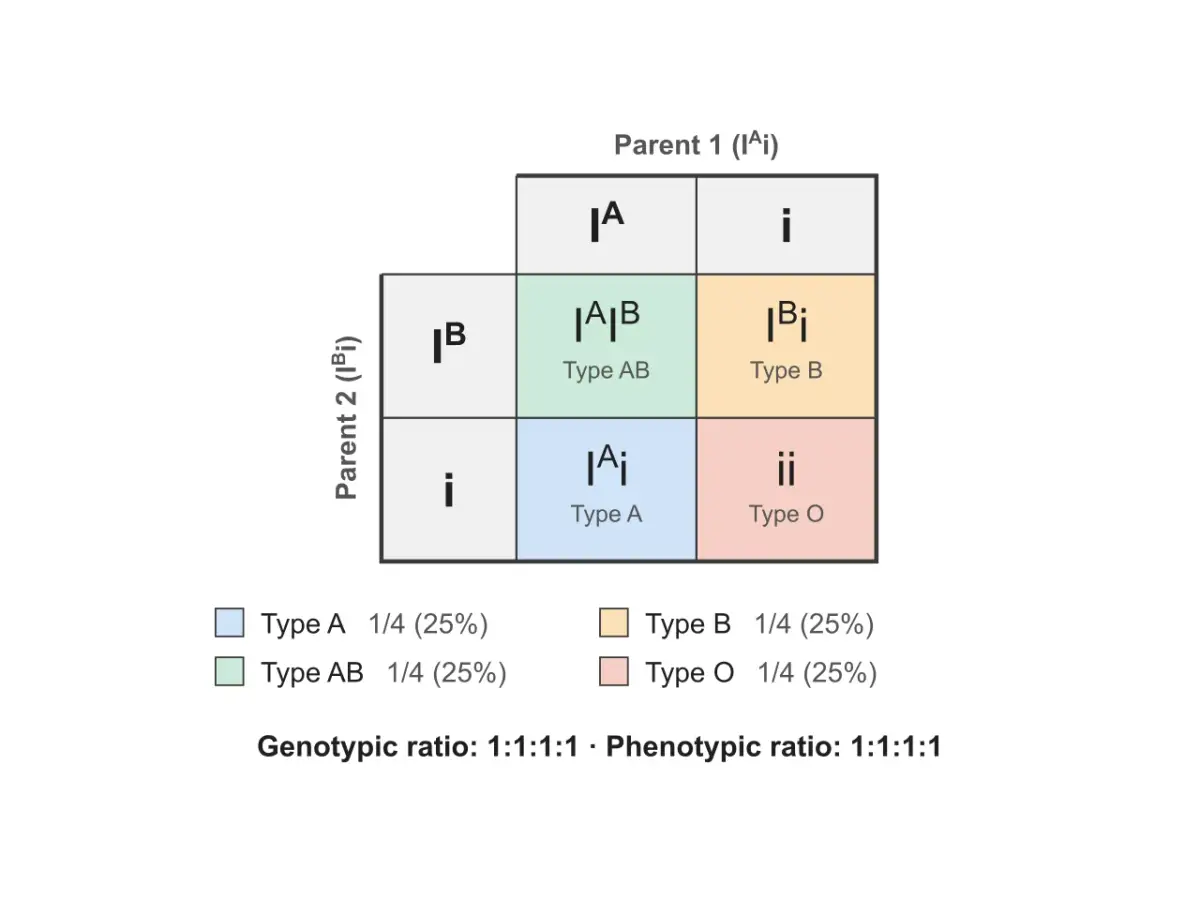
A type A parent and a type B parent who each carry i. All four blood types are possible, each with a probability of 1/4: A (IAi), B (IBi), AB (IAIB) and O (ii).
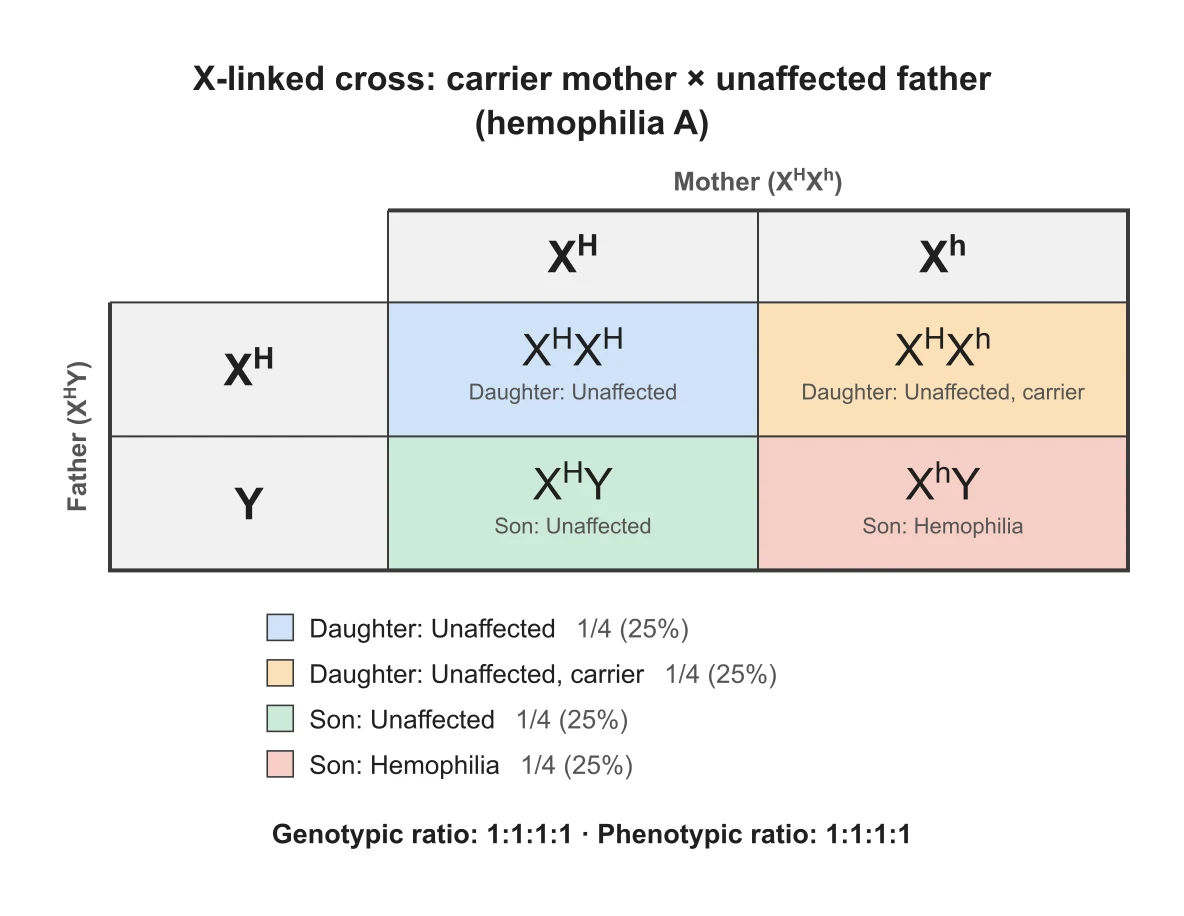
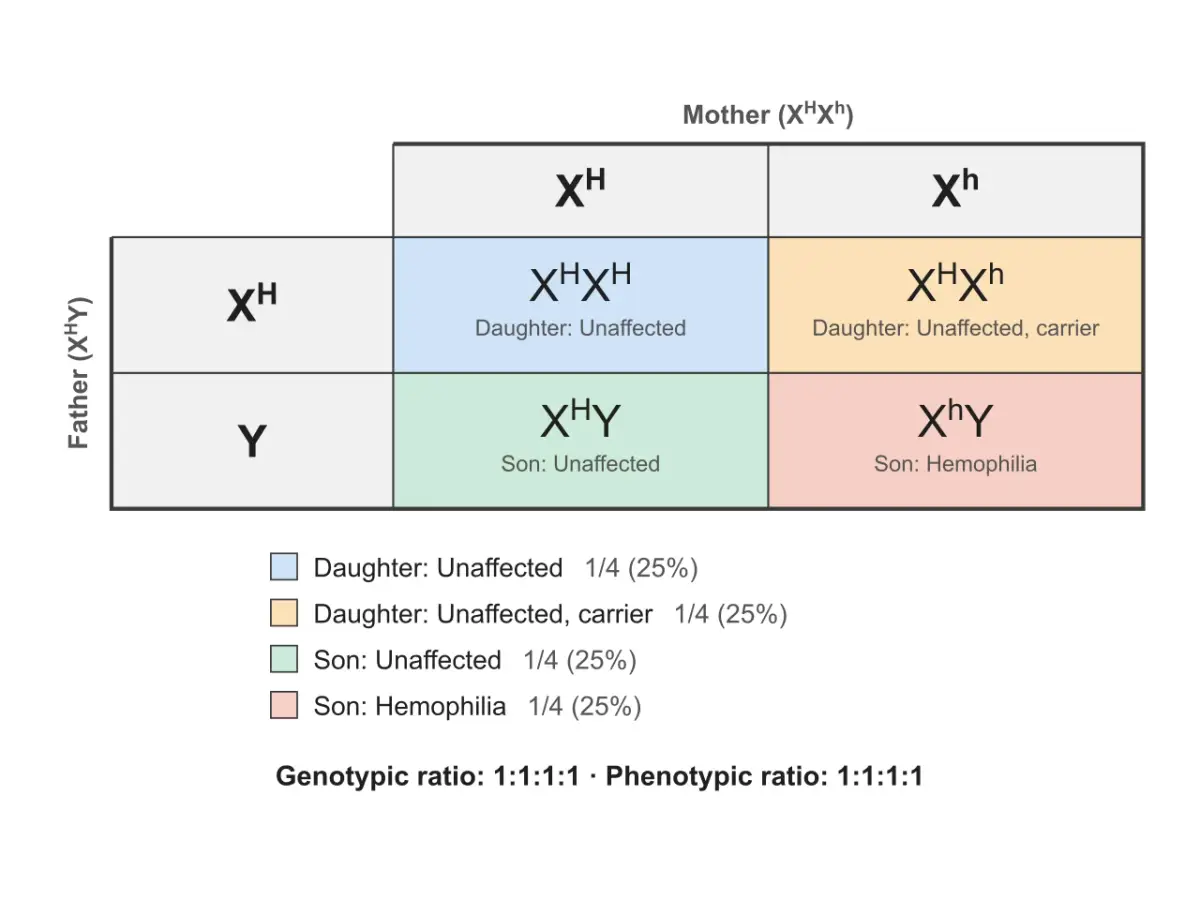
Hemophilia A, XHXh × XHY. Each daughter has a 1/2 chance of being a carrier and none are affected; each son has a 1/2 chance of having hemophilia. Across all children, each of the four outcomes is 1/4.
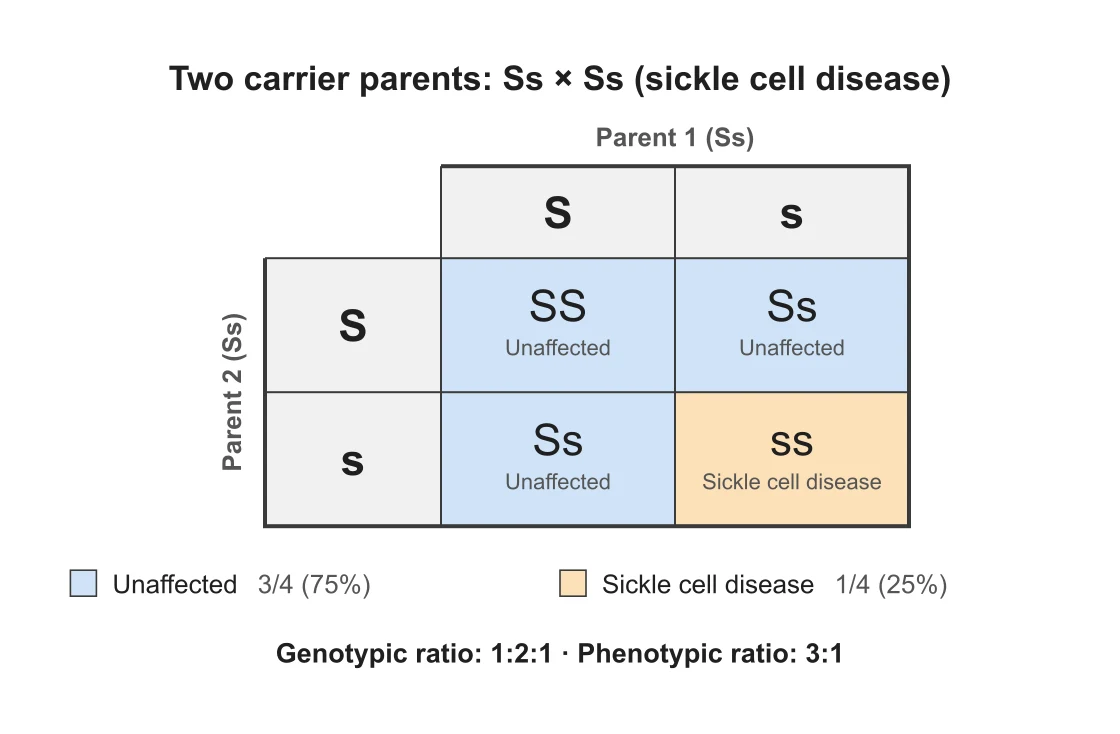
Each child has a 1/4 chance of sickle cell disease (ss) and a 3/4 chance of being unaffected. Two of those three unaffected boxes are Ss, carriers with sickle cell trait like the parents, so the chance a child is a carrier is 1/2; the genotype table lists them.
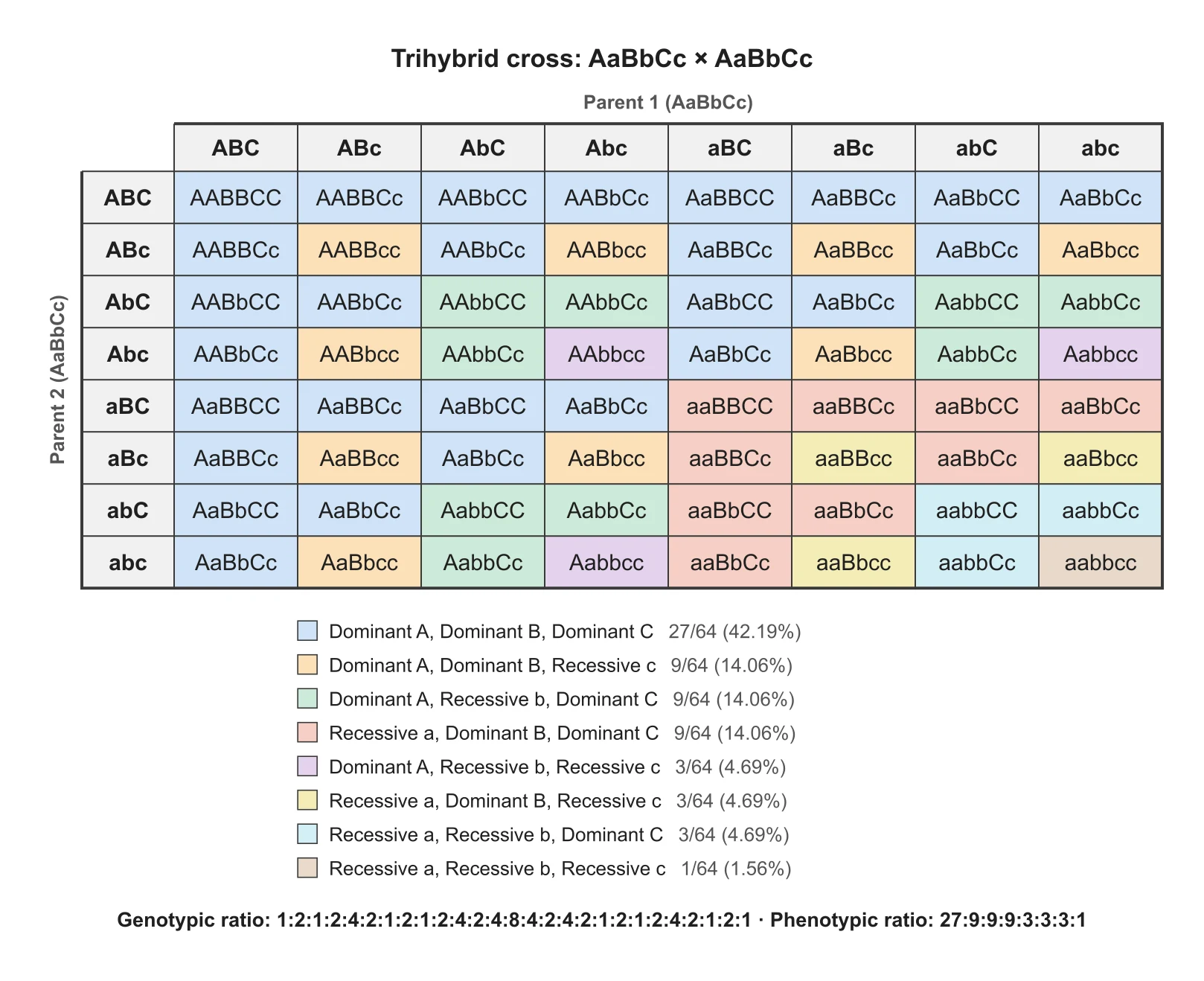
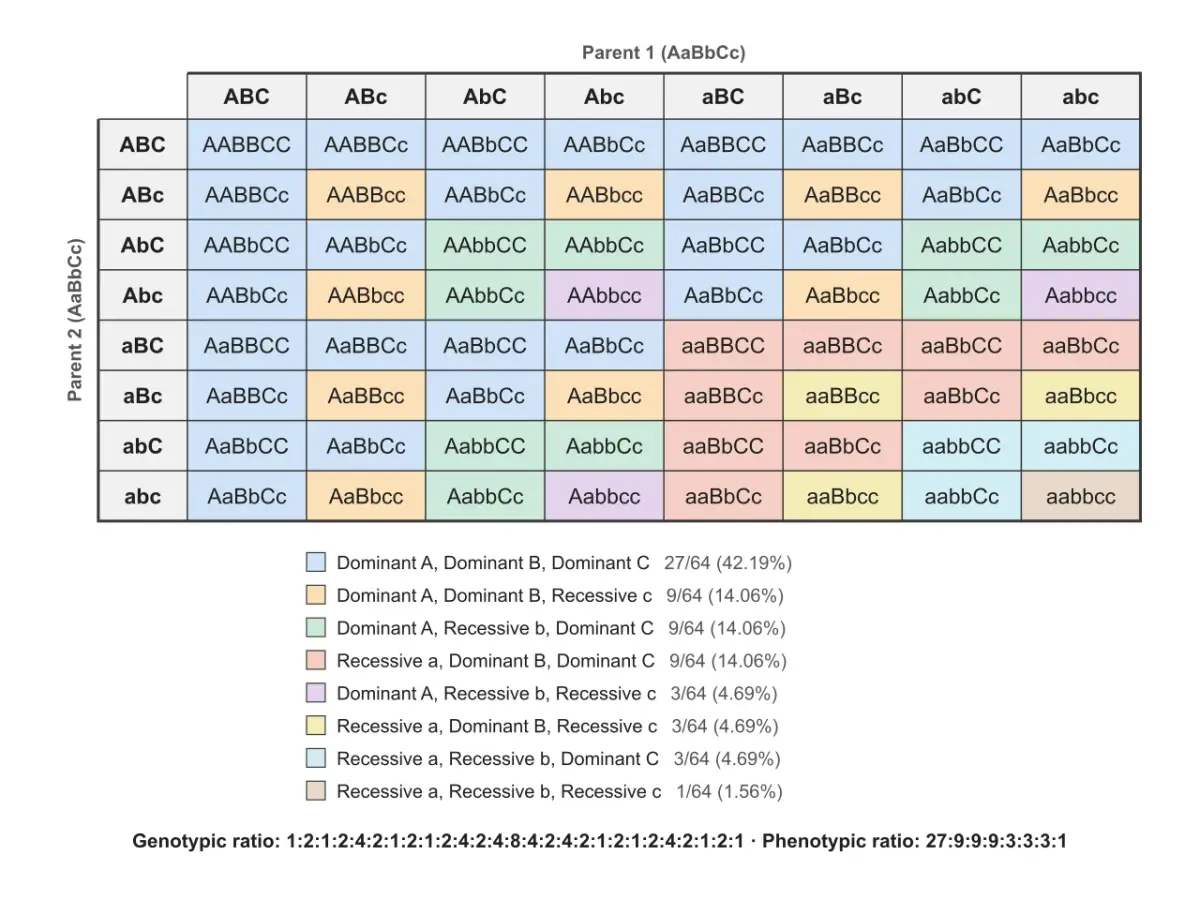
Three genes give 8 gametes per parent and an 8 × 8 square of 64 boxes, with 27 genotypes and the phenotypic ratio 27:9:9:9:3:3:3:1. Too large to fill by hand quickly, which is what the calculator is for.
A Punnett square is a grid that predicts the offspring of a genetic cross. The gametes (egg or sperm alleles) of one parent go across the top, the other parent's go down the side, and each box combines one allele from each to give a possible offspring genotype. Because every box is equally likely, counting boxes gives the probability of each genotype and phenotype.
The grid is named after the British geneticist Reginald C. Punnett, who developed it around 1905, about 40 years after Gregor Mendel published his pea plant experiments in 1866. A square shows expected probabilities, not a promise: a couple with a 1/4 chance has that same 1/4 chance for every child, whatever their earlier children inherited.
| Term | Meaning | Example |
|---|---|---|
| Allele | One version of a gene | T (tall), t (short) |
| Genotype | The pair of alleles an individual has | TT, Tt, tt |
| Phenotype | The trait you can observe | Tall, short |
| Homozygous | Two identical alleles | TT or tt |
| Heterozygous | Two different alleles | Tt |
| Gamete | Sex cell carrying one allele of each gene | T or t |
To calculate a Punnett square, list each parent's gametes, write one parent's across the top and the other's down the side, and fill each box with one allele from its row and one from its column. Every box is equally likely, so counting boxes gives the genotypic ratio, the phenotypic ratio and the probability of each offspring.
Here is the whole method on the classic example: two pea plants that are both heterozygous for height, Tt × Tt (T = tall, dominant; t = short, recessive). The same five steps work for any cross; with more genes there are just more gametes.
Each gamete gets one of the two alleles, so a Tt parent makes two kinds of gametes: T and t. For two genes, list every combination of one allele from each gene (the FOIL method): RrYy makes RY, Ry, rY and ry.
Draw one column per gamete of the first parent and one row per gamete of the second: two gametes each gives a 2 × 2 grid of 4 boxes. Write T and t across the top and T and t down the side.
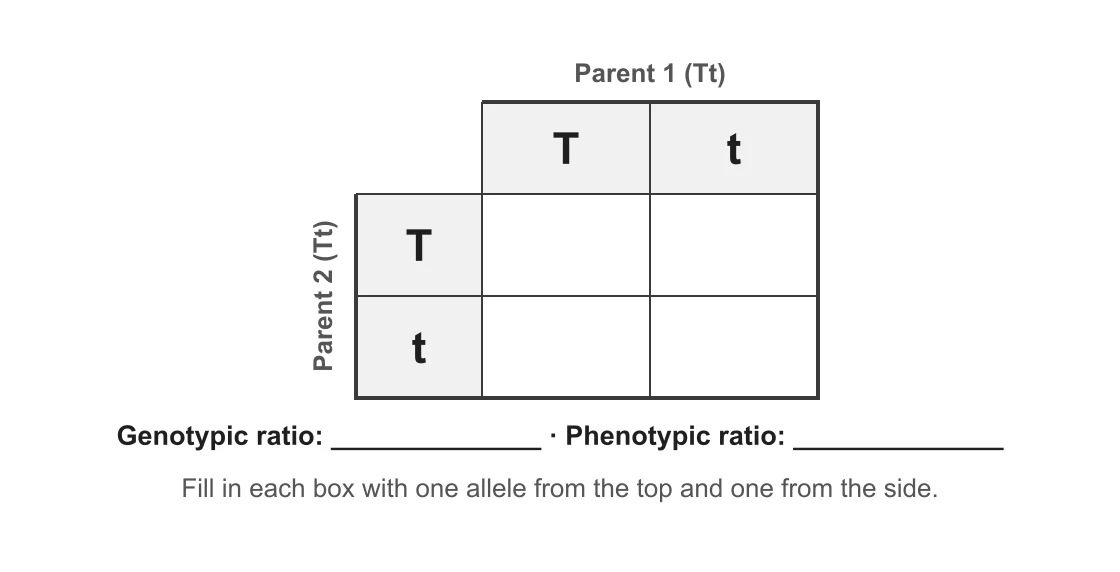
Each box gets the allele from its row plus the allele from its column, dominant allele first: T + T = TT, T + t = Tt, t + T = Tt, t + t = tt.
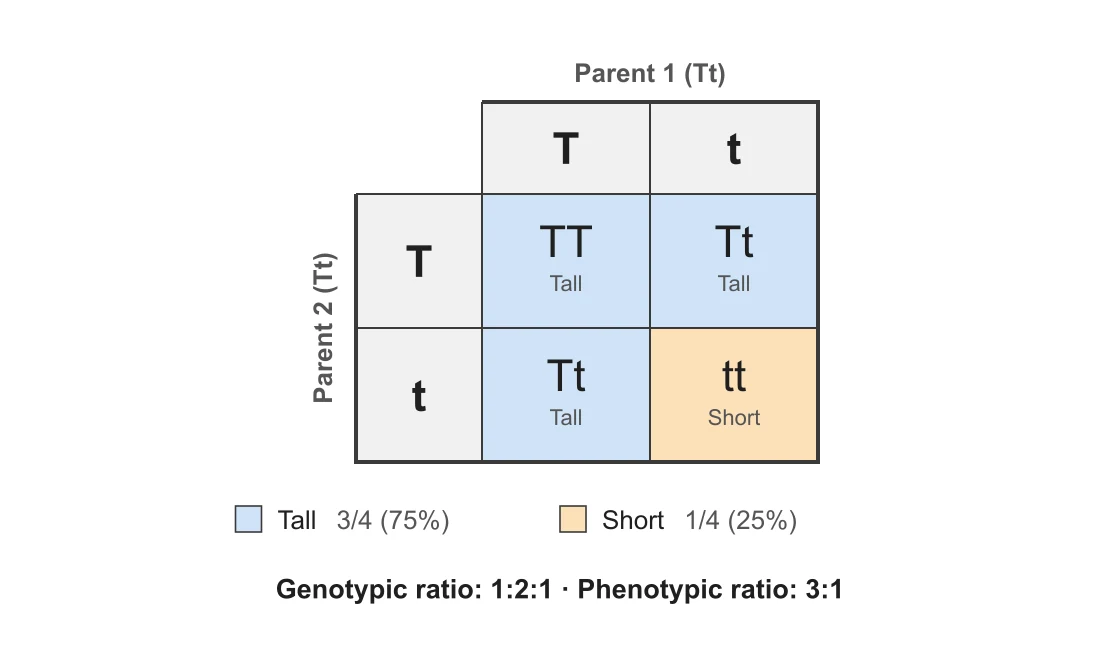
Count how many boxes hold each genotype: 1 TT, 2 Tt, 1 tt. The genotypic ratio is 1:2:1, so the probability of a Tt offspring is 2/4 = 1/2 (50%).
TT and Tt are both tall because T is dominant, so 3 of the 4 boxes are tall and 1 is short. The phenotypic ratio is 3:1: a 3/4 (75%) chance of a tall plant and a 1/4 (25%) chance of a short one.
Three steps in your browser
The square updates as you type, so you can change a parent and watch the ratios change. Use it as a Punnett square generator for class handouts or as a calculator to check homework.
Pick Standard, Blood type (ABO) or X-linked, then type the two genotypes: Tt and tt, RrYy and rryy, IAi and IBi, XHXh and XhY. Up to four genes. Have a word problem instead? Paste it into Read a word problem and AI fills in the genotypes.
Optionally type what each allele shows (Tall, Short; Round, Wrinkled), and set a gene to incomplete dominance or codominance with a name for the heterozygote, such as Pink or Roan. The square, the legend and the ratio tables use your names.
Read the genotype and phenotype tables with fractions and percentages, open Show the steps to compare with your own working, download a 300 DPI PNG or an editable SVG, or print a blank worksheet with the answer key on page 2.
To solve a 4 × 4 Punnett square, list the four gametes of each parent with the FOIL method (RrYy → RY, Ry, rY, ry), write one parent's gametes across the top and the other's down the side, fill all 16 boxes, then group the boxes by phenotype. The 9:3:3:1 rule is the result for RrYy × RrYy (seed shape and seed color in peas), and it is Mendel's law of independent assortment in action. The 16 boxes hold 9 different genotypes in the ratio 1:2:1:2:4:2:1:2:1.
The phenotypes come out 9:3:3:1: 9 dominant for both traits, 3 dominant for the first only, 3 dominant for the second only, 1 recessive for both. That ratio holds only when both parents are heterozygous for both genes, both genes show complete dominance, and the genes assort independently (they sit on different chromosomes, or far apart on the same one). Change any of those and the ratio changes; a test cross such as RrYy × rryy gives 1:1:1:1.
You can check a dihybrid answer without the square: multiply the single-gene probabilities. Round is 3/4 and yellow is 3/4, so round and yellow is 3/4 × 3/4 = 9/16.
A trihybrid cross such as AaBbCc × AaBbCc follows three genes. Each parent makes 8 gametes (ABC, ABc, AbC, Abc, aBC, aBc, abC, abc), so the square is 8 × 8 = 64 boxes, with 27 genotypes and the phenotypic ratio 27:9:9:9:3:3:3:1.
There is no 3 × 3 Punnett square for a standard cross: each extra gene doubles the gametes listed per parent, so the sides of the grid are 2, 4, 8 or 16. To check one outcome without the square, multiply: dominant for all three traits is 3/4 × 3/4 × 3/4 = 27/64.
The square is drawn the same way; only the step from genotype to phenotype changes, because the heterozygote looks different from both homozygotes.
| Incomplete dominance | Codominance | |
|---|---|---|
| Heterozygote | A blend of the two | Shows both traits fully |
| Classic example | Snapdragons: red × white gives pink | Roan cattle: red and white hairs; AB blood type |
| Heterozygote × heterozygote | 1 red : 2 pink : 1 white | 1 red : 2 roan : 1 white |
In both cases the phenotypic ratio equals the genotypic ratio, 1:2:1, instead of 3:1. In the calculator, set the gene's dominance to Incomplete or Codominant and type the heterozygote's name (Pink, Roan) so the square and the tables say it.
ABO blood type has three alleles: Iᴬ and Iᴮ are codominant with each other, and both are dominant over i. Each person has two of them, which makes six genotypes and four blood types.
| Blood type | Possible genotypes |
|---|---|
| A | IᴬIᴬ or Iᴬi |
| B | IᴮIᴮ or Iᴮi |
| AB | IᴬIᴮ |
| O | ii |
Type the genotypes as IAi, IBIB, ii and so on (AO, BO, AB and OO also work). Type O can be entered as O, but A and B cannot, because a type A person could be IᴬIᴬ or Iᴬi. A problem usually tells you which: a type A parent with a type O child or a type O parent must be Iᴬi.
Can two parents with blood types A and B have a type O child? Yes, if both carry i: Iᴬi × Iᴮi gives A, B, AB and O, each with a 1/4 chance. Two type O parents (ii × ii) can only have type O children. These squares cover the ABO alleles only; the Rh factor (positive or negative) is a separate gene.
For a gene on the X chromosome, write the allele as a superscript on the X: a female is XᴴXʰ (two X chromosomes), a male is XᴴY (one X and a Y that carries no copy of the gene). The mother's gametes are Xᴴ and Xʰ; the father's are Xᴴ and Y.
Read the square separately for daughters and sons. A son gets his only X from his mother and the Y from his father, so a father never passes an X-linked trait to his son. A son with one recessive allele shows the trait, while a daughter needs two to show it; with one she is a carrier.
Carrier mother × unaffected father (XᴴXʰ × XᴴY), for hemophilia A or red-green color blindness:
The calculator works this out from the genotypes and lists daughters and sons separately under Show the steps, which is how exam questions usually ask it ("what is the chance their son is color blind?").
Single-gene conditions are the most common real-life Punnett square questions. The square gives the chance for each pregnancy; it is not a diagnosis, and a genetic counselor works from test results and family history.
| Condition | Inheritance | Typical cross | Chance for each child |
|---|---|---|---|
| Sickle cell disease (HBB) | Autosomal recessive | Two carriers, Ss × Ss | 1/4 disease, 1/2 sickle cell trait, 1/4 neither |
| Cystic fibrosis (CFTR) | Autosomal recessive | Two carriers, Ff × Ff | 1/4 affected, 1/2 carriers, 1/4 neither |
| Huntington's disease (HTT) | Autosomal dominant | One affected parent, Hh × hh | 1/2 affected |
| Hemophilia A (F8) | X-linked recessive | Carrier mother, XᴴXʰ × XᴴY | Sons 1/2 affected; daughters 1/2 carriers |
| Red-green color blindness | X-linked recessive | Affected father, XᴮXᴮ × XᵇY | All daughters carriers; no sons affected |
For a dominant condition like Huntington's, the dominant allele is the disease allele, so type the affected parent as Hh and name H "Huntington's disease" and h "Unaffected".
Open the cystic fibrosis cross · Open the Huntington's cross
Worksheets often treat eye color as one gene with brown (B) dominant to blue (b). That model is fine for practicing the method, and the calculator draws it like any other cross: Bb × Bb gives 3 brown : 1 blue, Bb × bb gives 1:1.
Real eye color is controlled by at least eight genes, with a region of chromosome 15 that holds the OCA2 and HERC2 genes playing a major role, so it comes in a range of shades and does not follow the one-gene ratios. Two blue-eyed parents can, rarely, have a brown-eyed child, which the one-gene square says cannot happen. Hair color, height and skin color are also polygenic, so a single Punnett square cannot predict them. Use the square for single-gene traits, and treat eye color answers as practice only.
Every box in a Punnett square is equally likely, so:
Two probability rules cover most questions. The product rule: for independent events, multiply (the chance that two children are both short is 1/4 × 1/4 = 1/16). The sum rule: for outcomes that cannot happen together, add (the chance of TT or Tt is 1/4 + 1/2 = 3/4).
A test cross finds out whether an individual showing the dominant trait is homozygous or heterozygous: cross it with a homozygous recessive. All dominant offspring point to TT; about half recessive points to Tt (a 1:1 ratio). Small families rarely match the ratio exactly: four children from Tt × Tt can easily be all tall. To test whether a large set of real counts fits an expected ratio such as 3:1 or 9:3:3:1, AP Biology uses the chi-square test, with the Punnett square supplying the expected numbers.
Work each one by hand first, then open it in the calculator to check the square, the ratios and the steps. The Print worksheet + key button turns any cross into a blank square with the answer key on page 2.
The calculator follows Mendel's rules exactly, so it inherits their limits:
For anything a single Punnett square can answer, which covers the monohybrid, dihybrid, test cross and non-Mendelian topics in high school biology and AP Biology Unit 5 (Heredity), the calculator does the counting and shows its work.
Every box worked out by code
The square, the ratios and the steps are computed on this page from the genotypes you type, with no AI involved. AI is only used, if you choose, to read a word problem into genotypes.
 Crosses
Monohybrid to 16 × 16
Monohybrid, dihybrid, trihybrid and four-gene crosses, with gametes listed in FOIL order. Parents can differ (RrYy × rryy), and the genes can be typed in any order.
 Multiple alleles
IA, IB and i
Blood type mode knows that IA and IB are codominant and both dominant over i, and reports types A, B, AB and O with their probabilities.
 Sex-linked
Daughters and sons apart
Write the mother as XHXh and the father as XhY. The square labels each box as a daughter or son, marks carriers, and the steps give the chances for daughters and sons separately.
 Non-Mendelian
Your own trait names
Set each gene to complete, incomplete or codominant and name the heterozygote. Pink snapdragons and roan cattle get their own phenotype and the 1:2:1 ratio.
 For teachers
Print or save as PDF
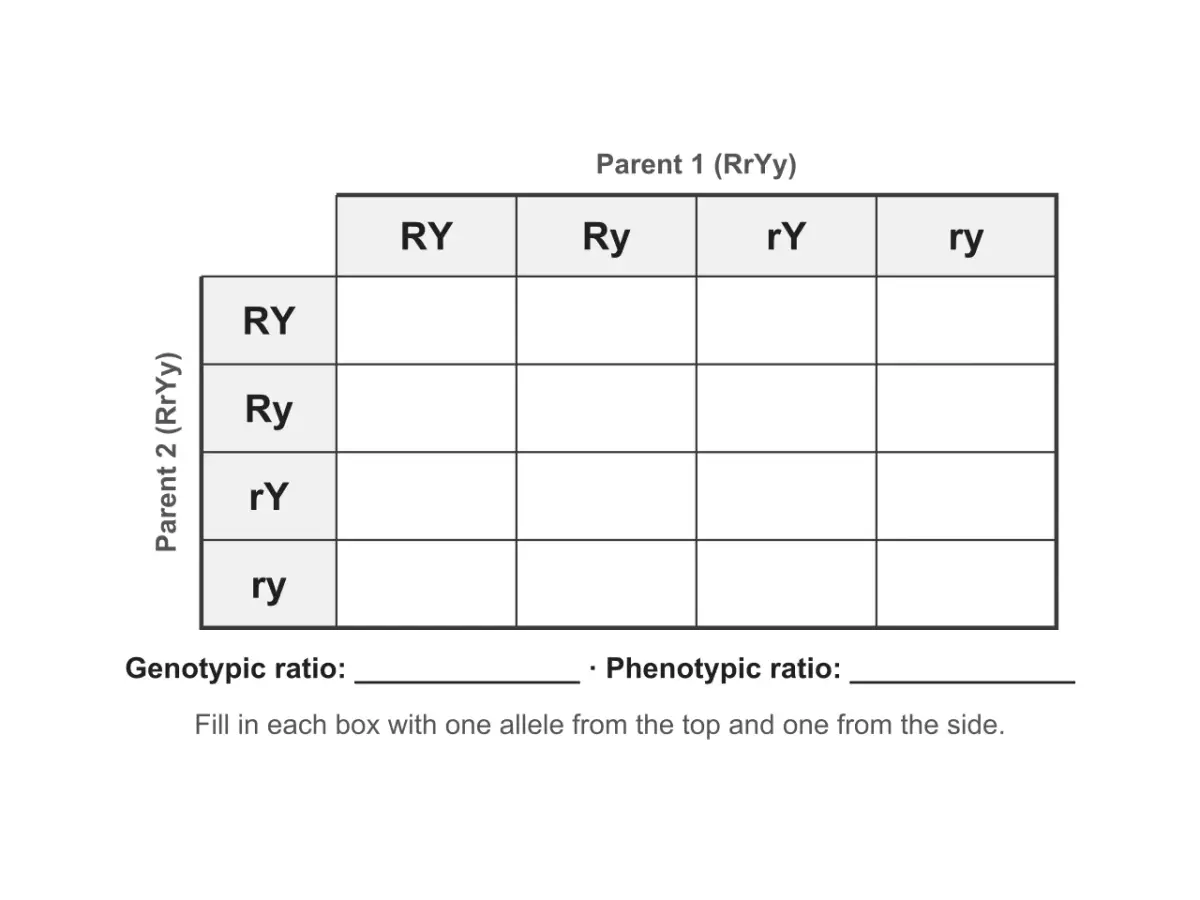
Leave the boxes blank, or the boxes and the gametes, for practice. Print worksheet + key puts the blank square and the filled answer on separate pages, with lines for the two ratios.
 Export
For slides and lab reports
Download a 300 DPI PNG for Google Docs or slides, or an SVG with real text you can edit in PowerPoint or Illustrator. Copy the genotype and phenotype tables straight into a spreadsheet.
FAQ
Type two genotypes and get the square, both ratios and the steps, then download it or print a blank worksheet with the key. Free, and worked out in your browser.
Explore more AI diagram tools across subjects — from the same discipline and beyond.
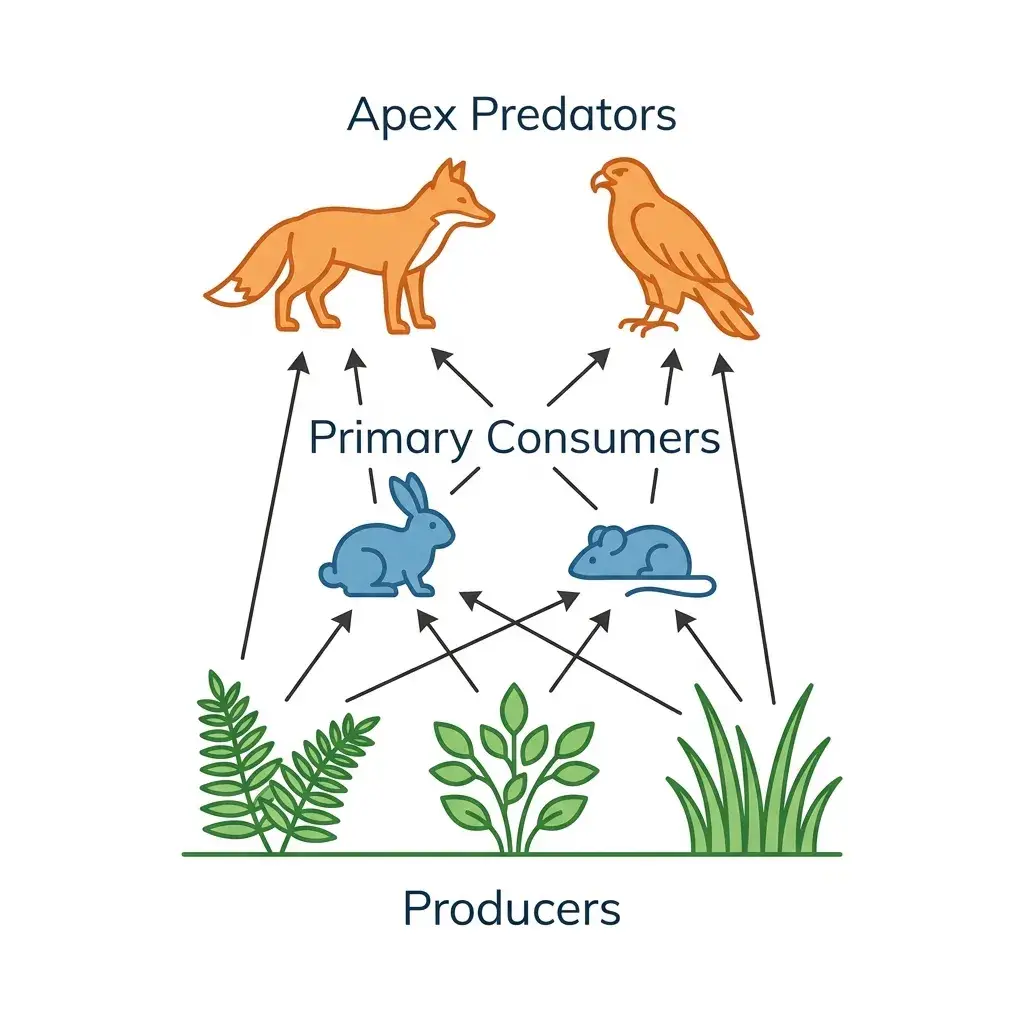 New
Create labeled food web diagrams for any ecosystem — ocean, forest, desert, freshwater, arctic, and more.
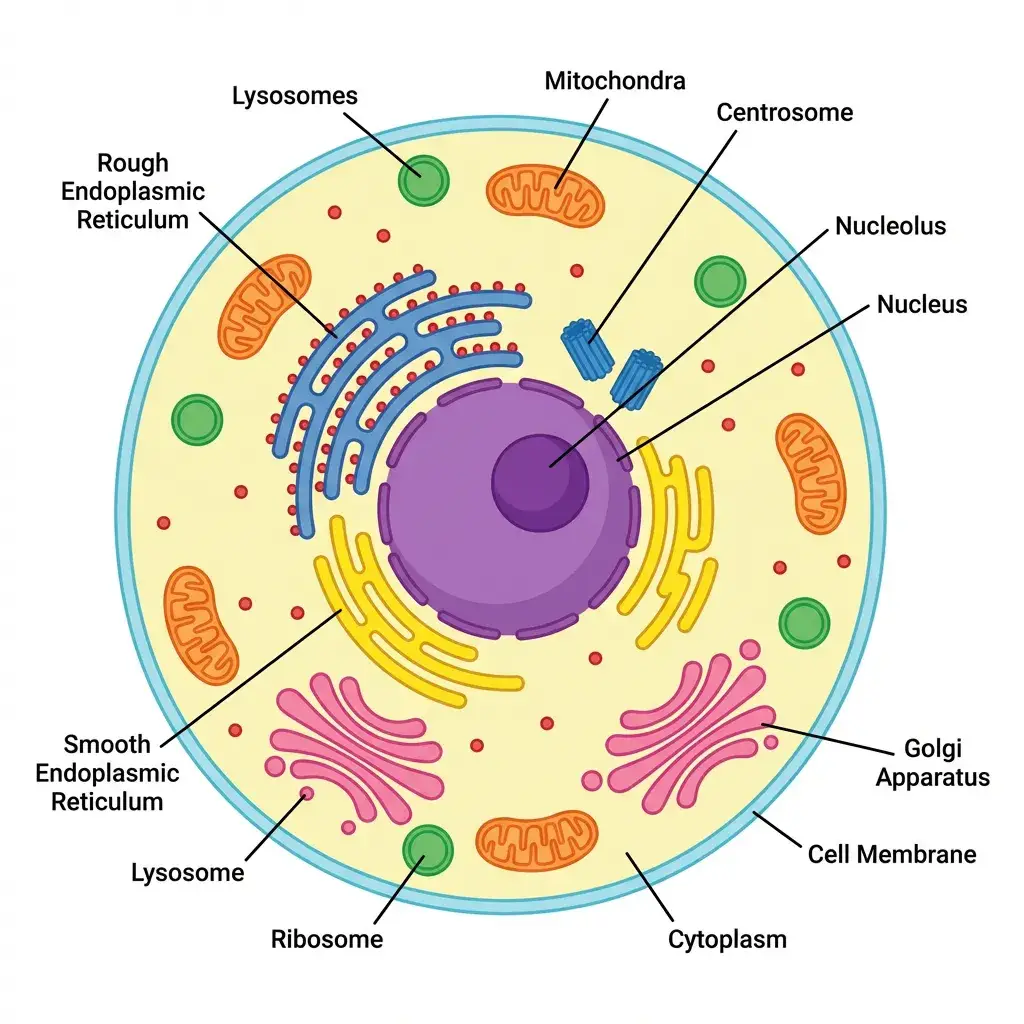
Generate labeled or blank animal cell diagrams for biology class, quizzes, and study guides.
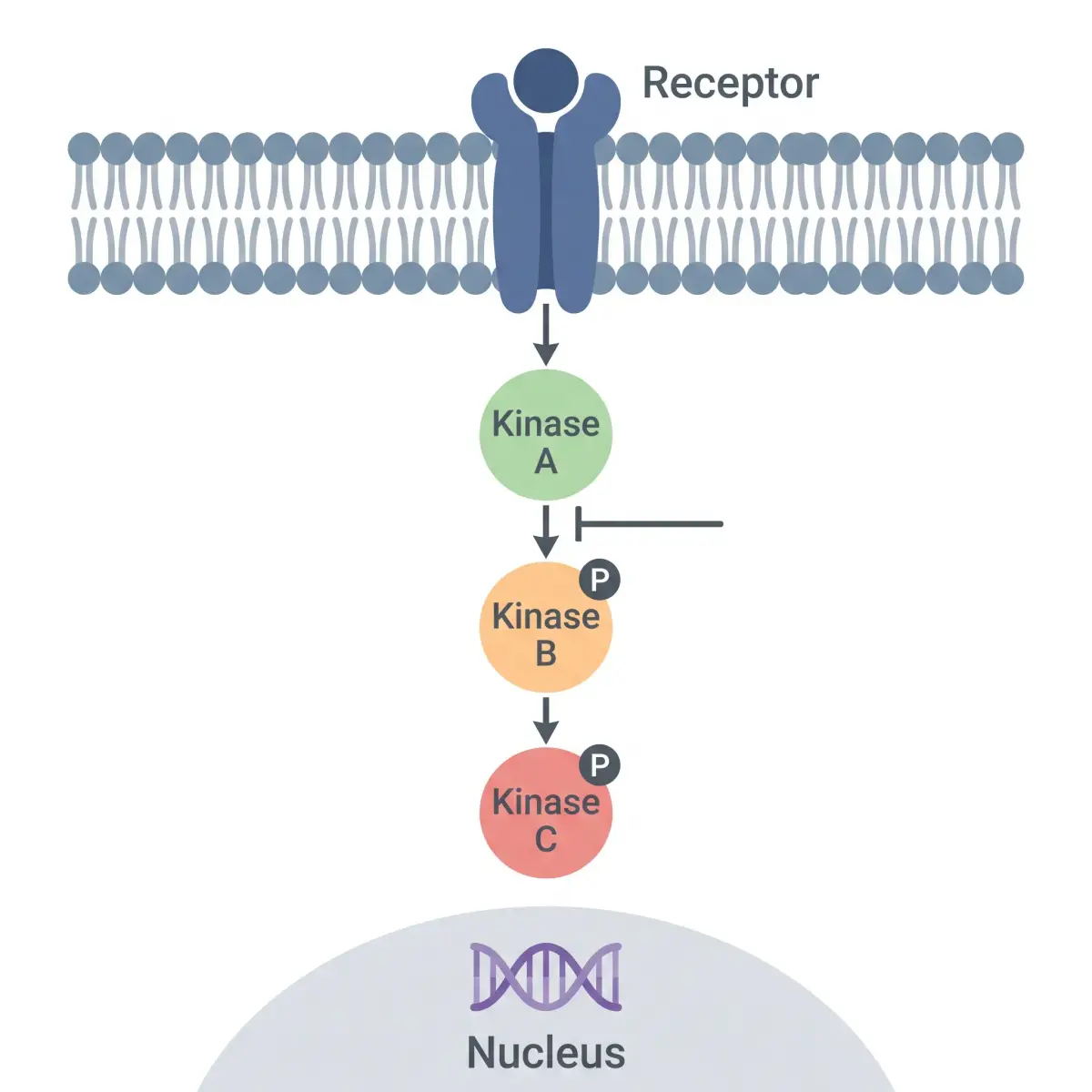 New
Describe a cascade like MAPK/ERK and get a labeled pathway figure with membranes, arrows and phosphorylation marks.
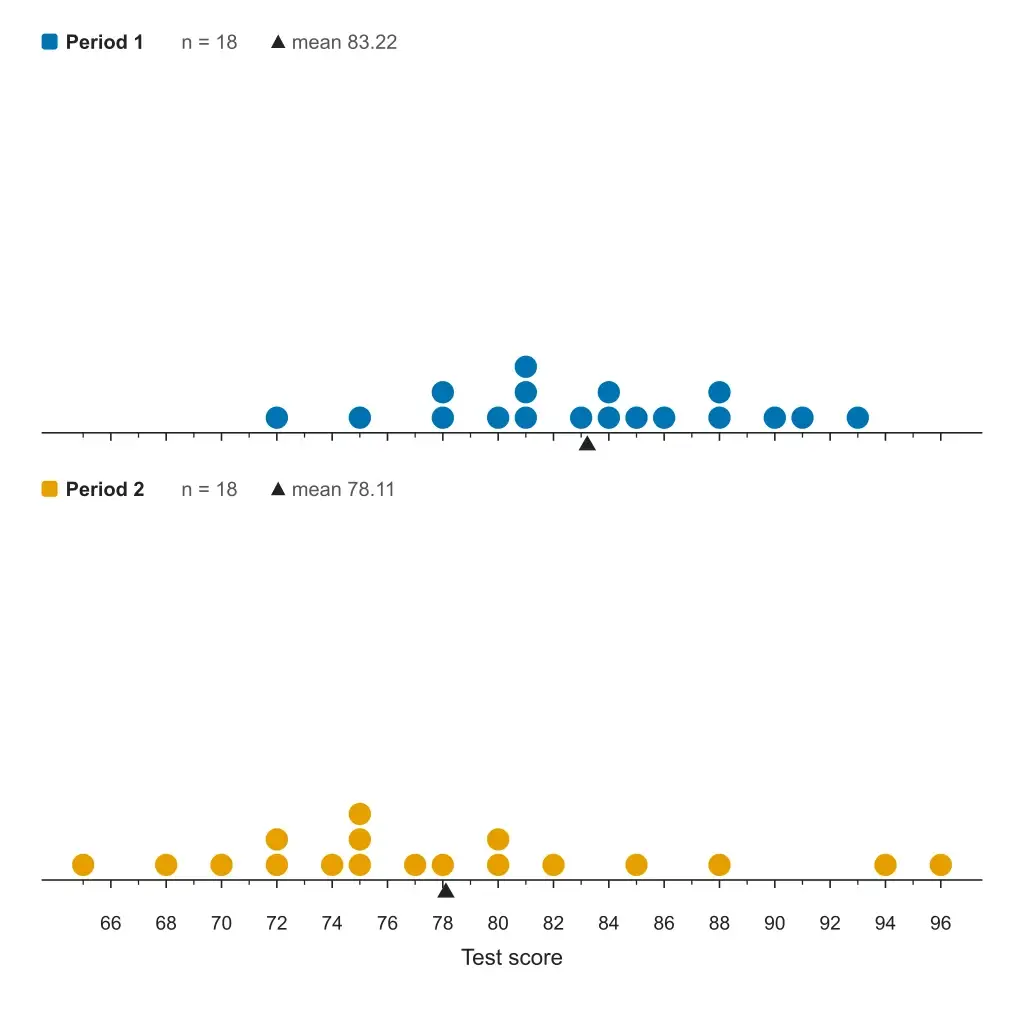 New
Paste a list of numbers or a frequency table and get a dot plot on a number line, with dots or X marks, mean and median markers, and the mean, median, mode and range worked out step by step. Export editable SVG or 300 DPI PNG. Free to paste and download.
 New
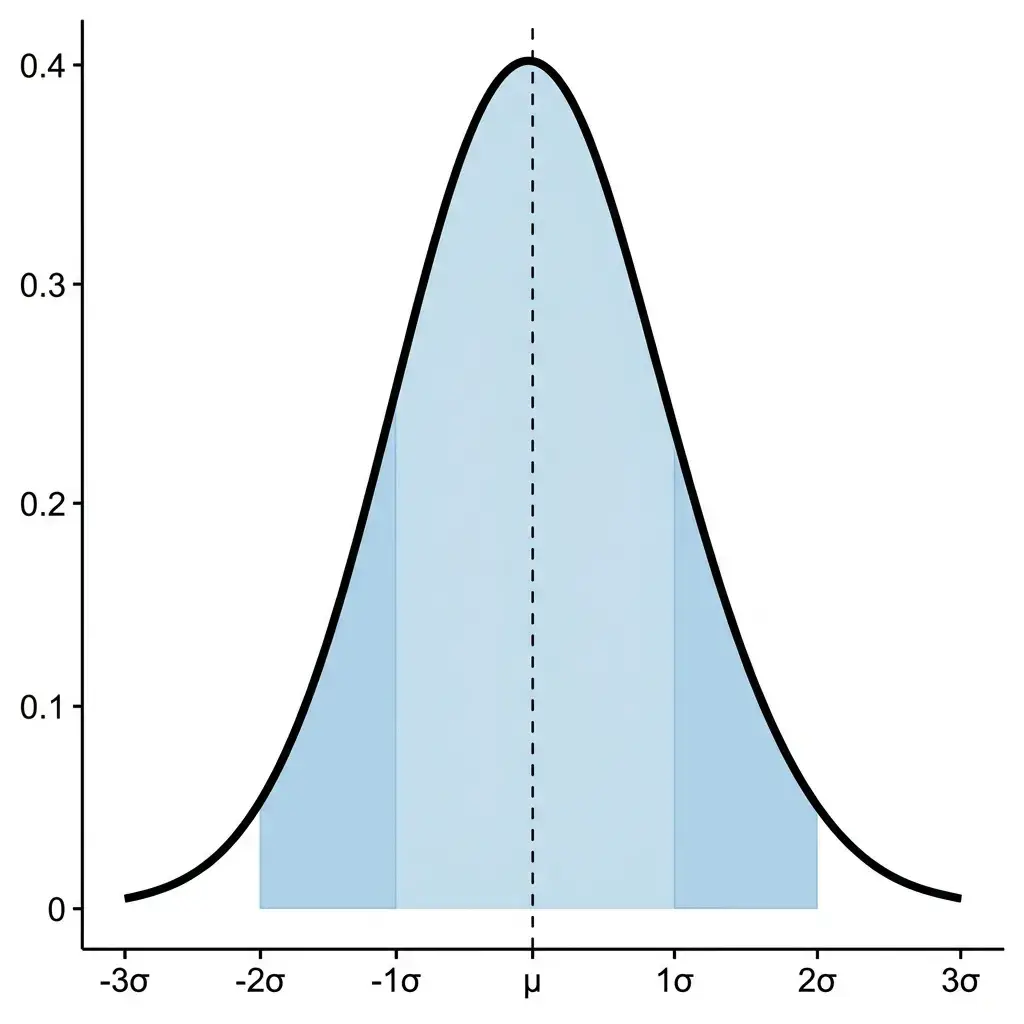
Type a mean and standard deviation, paste data, or set up a confidence interval or hypothesis test, and get an exact normal curve with the shaded area, its probability and the steps.
 New
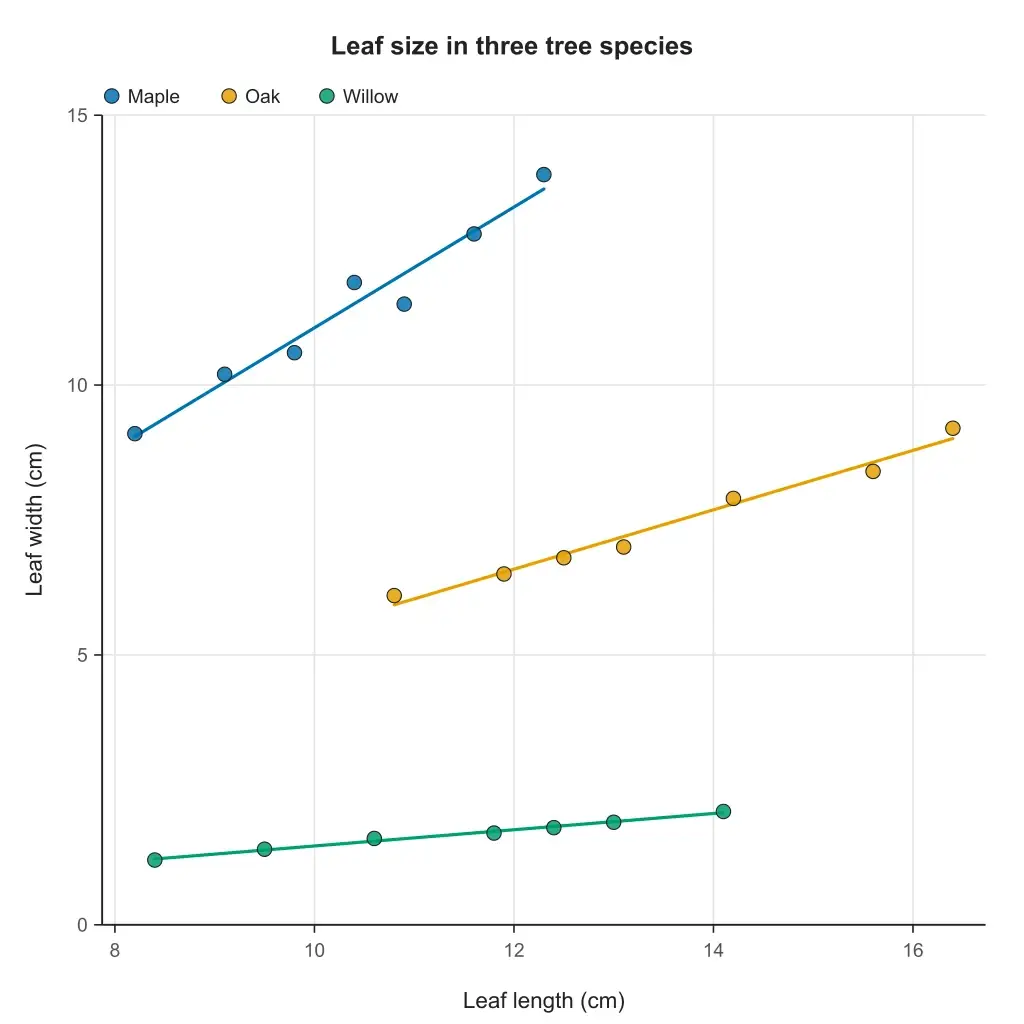
Paste two columns from Excel or a CSV and get a scatter plot with the line of best fit, its equation, r and R². Groups, point labels and step-by-step working; export editable SVG or 300 DPI PNG. Free to paste and download.
