

How to Write a Figure Legend: Journal Rules, Statistics & Examples
To master how to write a figure legend, open with one whole-figure title and walk through each panel in order. Define every symbol, scale bar, and non-standard abbreviation, then state exact sample sizes (n), error bars, statistical tests, and required disclosures so the figure stands alone.
Need code-typeset figures whose labels and counts match your caption? Build your study figure with Vizcept → Vizcept is an AI scientific figure generator for thesis writers and researchers: conceptual frameworks, CONSORT 2025 and PRISMA 2020 flow diagrams, and browser-based data plots are typeset by code so labels and counts stay aligned with your text.
What is a figure legend, and how does it differ from a caption or key?
A figure legend is the explanatory text paired with a scientific figure so readers can interpret it without flipping back to Results or Methods. Under the International Committee of Medical Journal Editors (ICMJE) recommendations, figures should stand alone, with titles and explanations in legends rather than crowded onto illustrations.
Publishers and style manuals define the terms differently:
- In journals like Science, "figure legend" and "figure caption" mean the same explanatory text. PLOS ONE requires a label (
Fig 1) and short title in the caption, with an optional legend after the title. - In Matplotlib, Excel, and American Psychological Association (APA) Style 7th Edition, a "legend" is only the visual key inside the figure border.
- In APA 7 papers and theses, the bold figure number and italicized title sit above the graphic, while explanatory text and statistics go in a "figure note" below it.
What should every scientific figure legend include?
A complete scientific figure legend covers five elements: a whole-figure title, sequential panel descriptions, minimal context, visual definitions, and microscopy scale or staining details when imaging is shown.
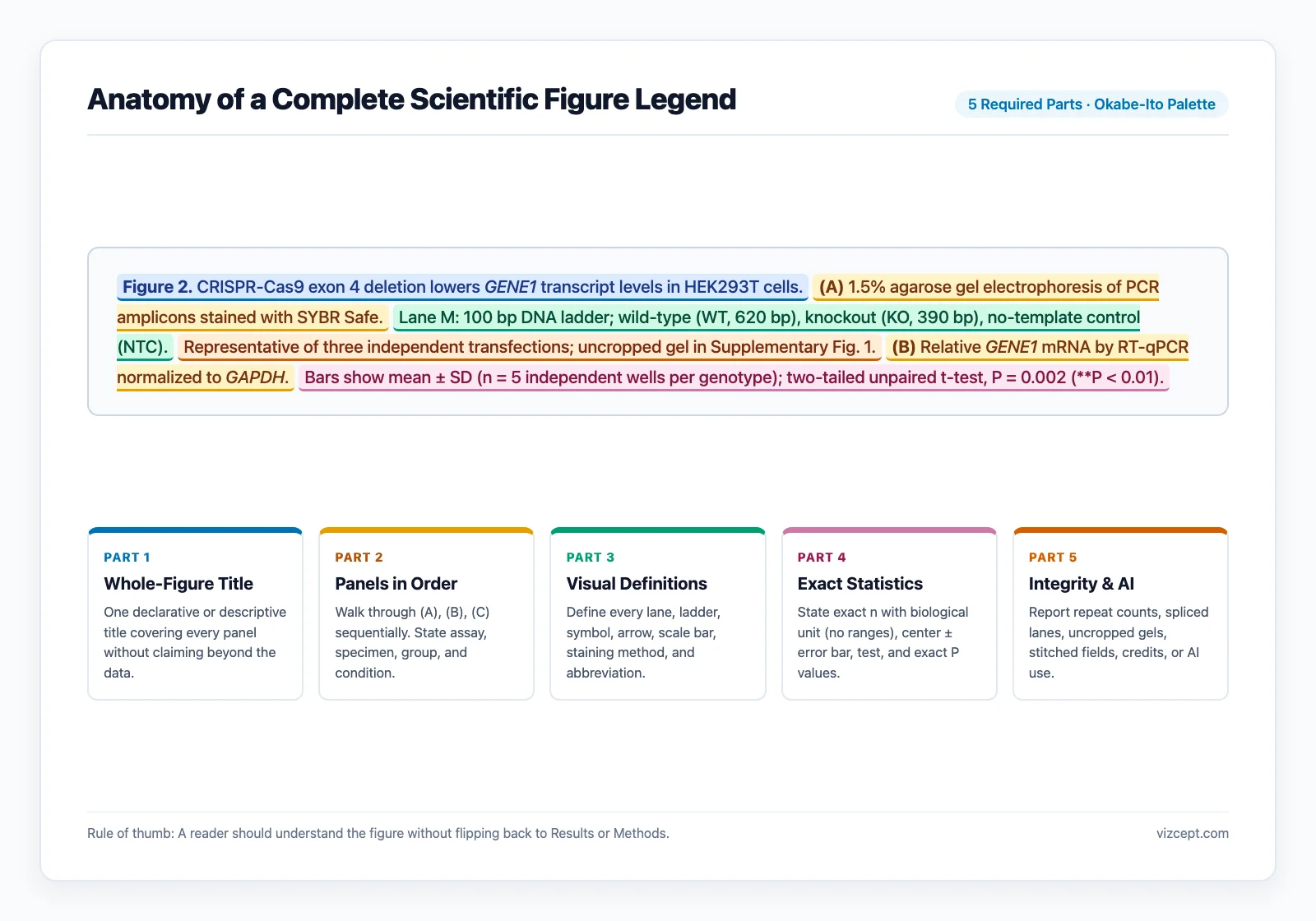
1. One title covering all panels
Start with one concise title spanning every panel. If no single title fits all panels, split the artwork into separate figures.
Use a declarative title stating the main finding ("CRISPR-Cas9 exon 4 deletion lowers GENE1 transcript levels in HEK293T cells") or a descriptive title stating what is plotted ("Agarose gel and RT-qPCR analysis of GENE1 exon 4 deletion in HEK293T cells"). Never claim beyond what the panels measure; Nature at initial submission asks authors to describe what is depicted rather than state results or methods.
2. Sequential panel descriptions
Walk through panels alphabetically (a, b, c or A, B, C) in artwork order. Science Research Articles bold panel letters like (A) at first mention, and American Heart Association and American Stroke Association (AHA/ASA) guidelines place uppercase letters in each panel's upper-left corner. State the assay, specimen or group, and condition in one or two sentences per panel.
3. Minimal context, visual definitions, and scale bars
Give only the context needed to read the plot (species, cell line, assay, or treatment), leaving full protocols in Methods; Nature omits methods from legends whenever a paper has a Methods section. Define every symbol, arrow, color, line style, and non-standard abbreviation unless an in-figure key explains it, replacing lab codes like Clone #14B with readable names like TP53-KO.
For photomicrographs, ICMJE recommends an internal scale marker plus scale value and staining method in the legend. EMBO Press requires scale bars instead of magnification factors ("40×"), with bar length in the legend rather than on the bar. Use past tense for completed procedures ("Cells were transfected for 48 h") and present tense for what the figure shows ("Dashed lines show 95% CI"). For representative images, Nature requires reporting how many independent times measurements were repeated.
How do journal and APA 7 figure legend rules differ?
Because length limits, placement rules, and Methods boundaries diverge across publishers, confirming your target venue before drafting prevents rewriting every caption before submission.
The table below compares current rules across seven widely used publisher and academic style guides (primary guidelines checked November 2026):
| Venue or style guide | Length limit | Methods in legend | Placement & label | Formatting notes |
|---|---|---|---|---|
| Nature (initial) | < 250 words | Omit results and methods | Same page as figure | Brief whole-figure title sentence |
| Nature (final) | < 300 words | Omit if Methods section exists | After reference list, separate from figures | Define all error bars & stats |
| Nature Communications | ≤ 350 words | Keep minimal; define stats/replicates | Follow journal submission layout | Title + sequential panels |
| Science (Research Articles) | ~200 words max | N, P, test in legend or text | Double-spaced after each figure; bold Fig. 1. | Bold (A), (B) at first mention |
| PLOS ONE | Title ≤ 15 words; legend optional | Keep legend concise | After first-citation paragraph (not in image); Fig 1 | No period; credits in last sentence |
| Cell Press (Cell Reports Sustainability) | Follow article limits | Bio/tech replicates, spread, tests | Separate from figure files | Map test & asterisks per panel |
| APA Style 7th Edition | Brief title; concise note | Details & stats in Figure Note | Bold Figure 1 + title above; note below | Italicize Title Case title |
Two takeaways stand out. First, APA Style 7 italicizes the Title Case figure title above the graphic, whereas journals like Science set upright legend prose with bold labels (Fig. 1.). Second, limits shift within one publisher: a 270-word legend fits Nature's final limit (<300 words) and Nature Communications (≤350 words), but violates Nature's initial cap (<250 words) and Science's ~200-word ceiling.
Thesis writers should follow their graduate handbook; guides like NC State University's ETD guide put figure captions below figures, table captions above tables, and require each caption to match its text entry.
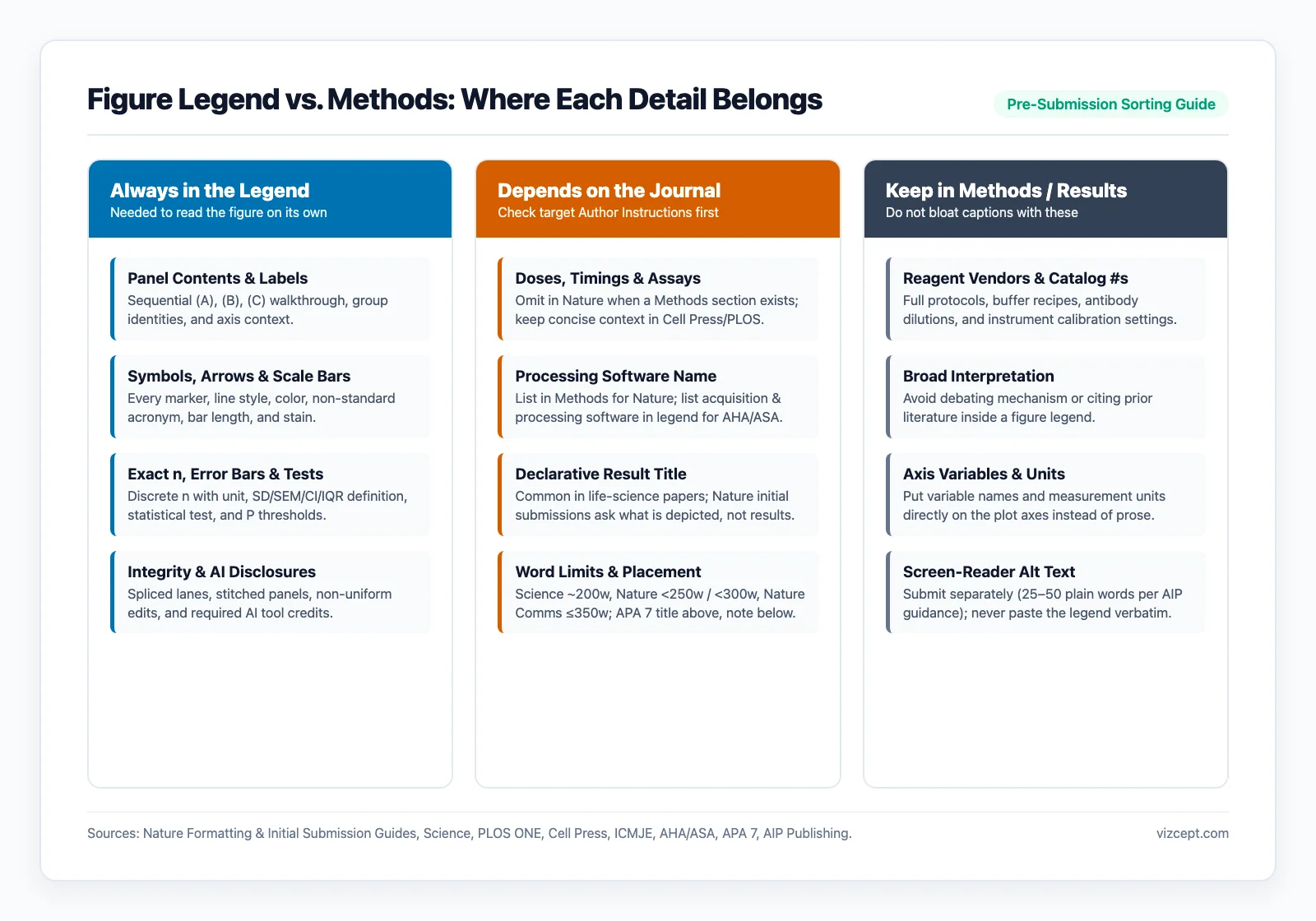
What statistical details must go in a figure legend?
Once your caption matches the target format, every quantitative figure legend must report exact sample size (n) with its unit, define center and error bars, name the statistical test per panel, and state exact P values or asterisk thresholds.
Four reporting rules recur across publisher checklists:
- Exact
nper group, never a range. Nature's initial-submission guidance and Nature Reporting Summary require a discretenand unit (n = 6 mice/group, notn = 4–6), listing each group's count when sizes vary. - Biological vs. technical replicates. EMBO Press and Cell Press (Cell Reports Sustainability) distinguish independent biological units from repeated measurements of one sample. Writing
n = 3alone hides whether points came from three wells or three independent animals. - Independent data for error bars and tests. Nature's editorial guidance on error bars restricts error bars and significance tests to independent data points, not technical repeats within one experiment. Always define center and spread: "mean ± standard deviation (SD)", "mean ± standard error of the mean (SEM)", or "median with interquartile range (IQR)".
- Tests, tails, and exact
Pvalues. Science requiresN,P, and the specific test; Nature requests exactPvalues for significant and non-significant results (with one- or two-tailed status in Methods); Cell Press ties each test and asterisk threshold (*P < 0.05,**P < 0.01) to specific panels.
How should you disclose image processing and AI-assisted figures?
Beyond statistics, disclose lane splicing, microscopy stitching, non-uniform image edits, or permitted AI assistance directly in the figure legend whenever your publisher requires it. Skipping caption disclosures delays screening even when noted in a cover letter.
Image-processing and splicing disclosures
Cell Press requires making removed gel lanes or consolidated blots apparent and disclosing lane edits or stitched microscopy panels in the legend; non-uniform contrast or brightness edits must be disclosed in both legend and Methods. Journals also split on software names: outlets that keep methods out of legends, such as Nature, place processing software in Methods, while AHA/ASA asks authors to list acquisition tools, processing software, and nonlinear adjustments in the legend.
AI-assisted figure disclosure by publisher
Policies on AI-assisted figures vary sharply by publisher:
| Publisher | Caption / figure disclosure rule |
|---|---|
| Elsevier | For permitted AI-created or AI-altered images, Elsevier's generative AI policy requires naming tool, version, and usage in each caption and the general AI declaration. |
| PLOS | PLOS ethical publishing practice requires disclosing any AI use for figure preparation in the relevant legend. |
| Nature Portfolio | Under Nature Portfolio's AI policy, generative-AI images are generally not permitted; exceptions must be labeled AI-generated inside the image field. |
For copy-ready publisher disclosure sentences, see Vizcept's journal AI figure policy guide.
Alt text vs. figure legends
Publishers increasingly collect screen-reader alt text separately from captions. Under AIP Publishing's alt-text guidelines, write 1–2 plain sentences (25–50 words) without copying or replacing the legend.
What do good figure legends look like across different figure types?
A strong legend adapts its structure to the figure type—whether a gel electrophoresis and RT-qPCR pair, a distribution plot, a meta-analysis forest plot, or a study flow diagram.
Weak gel & quantification draft rewritten line by line
Weak draft:
Figure 2. Gene knockout works. (A) Agarose gel. (B) RT-qPCR results. n = 5. **P < 0.01.
Five omissions invite reviewer pushback: "works" is vague; Panel A omits gel percentage, stain, DNA ladder, expected band sizes in base pairs (bp), and controls; Panel B omits the reference gene and error-bar definition; n = 5 lacks a unit; and no statistical test is named.
Stronger rewrite (81 words; fits Nature's <250-word and <300-word caps):
Figure 2. CRISPR-Cas9 exon 4 deletion lowers GENE1 transcript levels in HEK293T cells. (A) 1.5% agarose gel electrophoresis of PCR amplicons stained with SYBR Safe. Lane M: 100 bp DNA ladder; wild-type (WT, 620 bp), knockout (KO, 390 bp), no-template control (NTC). Representative of three independent transfections; uncropped gel in Supplementary Fig. 1. (B) Relative GENE1 mRNA by RT-qPCR normalized to GAPDH. Bars show mean ± SD (
n = 5independent wells/genotype); two-tailed unpaired t-test,P = 0.002(**P < 0.01).
For a Nature initial submission (<250 words), switch the title to descriptive ("Agarose gel and RT-qPCR analysis of GENE1 exon 4 deletion") and move gel-percentage and staining details to Methods.
Worked templates for data plots and study diagrams
- Box plot: "Figure 3. Serum CRP across three arms at Week 12. Center lines show medians, boxes span 25th–75th percentiles (IQR), whiskers extend to 1.5 × IQR, and dots mark outliers. Placebo (
n = 28patients), low-dose (n = 30), high-dose (n = 29). Kruskal-Wallis test with Dunn's correction (P = 0.004, high-dose vs. placebo)." - Forest plot: "Figure 4. Random-effects meta-analysis of 30-day readmission across eight trials (
N = 2,418). Squares show odds ratios (OR) sized by inverse-variance weight, lines show 95% confidence intervals (CI), and the dashed line marksOR = 1.0. Restricted maximum likelihood (REML) pooledOR = 0.78(95% CI,0.65–0.94;P = 0.009;I² = 24%; 95% prediction interval,0.58–1.05)." - PRISMA 2020 or conceptual framework: "Figure 1. Preferred Reporting Items for Systematic Reviews and Meta-Analyses (PRISMA 2020) flow for remote CBT trials through March 2026. Records from PubMed (
n = 640), Embase (n = 512), CENTRAL (n = 218);k = 19studies included. In conceptual frameworks, solid arrows (H1–H4) mark hypothesized paths; dashed arrows mark control variables."
Which figure legend mistakes trigger peer-review revisions?
Statistical review editors (PMC11378108) repeatedly flag four caption errors: non-self-contained legends, missing sample sizes or replicate types, undefined error bars, and unnamed statistical tests or comparisons.
Sometimes a long legend signals an artwork problem. Redraw the figure instead of expanding prose when the legend explains axis units (label axes directly), exceeds 300 words from crowded panels (split the figure), or tells readers which distant bars to compare (place compared groups adjacent).
Check every main and supplementary legend before uploading:
- Title covers every panel without claiming beyond measured data.
- Panel letters (
A,B,C) match artwork order with no orphan letters. - Symbols, colors, lines, arrows, gel ladders, and non-standard abbreviations are defined once.
- Micrographs carry internal scale bars with bar length and stain in the legend.
- Error bars, center measure, exact
nwith unit, replicate type, test, and exactPvalues or asterisk thresholds are stated. - Every
n,Pvalue, effect size, unit, and abbreviation matches artwork and Results (Science rule). - Spliced lanes, stitched fields, non-uniform edits, credits, or permitted AI assistance are disclosed.
- Word count, Methods boundary, and placement match your target journal or thesis guide.
Frequently asked questions
How do I put a figure legend in Word so figure numbers update automatically?
Right-click the figure, choose Insert Caption, select Figure, and type your legend below it. When citing it in text, open References → Cross-reference, choose Figure, and select Only label and number so numbering updates automatically. For vector artwork, see our SVG in Word guide.
Do figure legends count toward a manuscript or thesis word limit?
Many journals exclude legends from main-text word limits, though rules vary. Biomedical guides often count body text separately from display items, while some society journals and thesis departments include captions in total limits—check target rules before trimming.
How do you write a figure legend for a table?
Tables take a bold number and table title above the table, plus explanatory notes below, rather than a figure legend. Under APA Style 7 table guidelines and NCSU's ETD guide, table titles go above and figure captions below.
Should you embed the figure legend inside the image file?
No. Keep legends as editable manuscript text, never flattened inside artwork. PLOS ONE places captions after the first-citation paragraph (never in figure files), and Nature collects editable legends after references at acceptance.
Sources
- Nature Formatting · Nature Initial Submission · Nature Comms · Nature Reporting Summary · Nature Error Bars · Nature AI Policy
- Science Authors · PLOS ONE Figures · PLOS Ethics · ICMJE · APA 7 Figures · APA 7 Tables
- Elsevier AI Policy · Cell Press Figures · Cell Reports Sustainability · EMBO Press · AHA/ASA · AIP Alt Text · PMC11378108 · NCSU ETD
Table of Contents
Author
Categories
Tags
More Posts

How to Make Scientific Diagrams for Research Papers
A practical workflow for turning research ideas into clear, journal-ready scientific diagrams without rebuilding every figure from scratch.
10 Color Palettes for Scientific Publication (with Hex Codes & Examples)
A practical guide to the ten color palettes most used in Nature, Science, and Cell research papers — with hex codes, journal compatibility, and Matplotlib/R snippets you can paste in.
How to Make Multi-Panel Figures for Nature & Science (2026)
A 2026 playbook for composing Nature- and Science-grade multi-panel figures — from the editorial spec sheet to a panel-as-sentence narrative grid and a rejection-proof self-audit.
Newsletter
Join the community
Subscribe to our newsletter for the latest news and updates
