
How to Use These Sentence Diagramming Exercises
Treat each set as a short quiz: diagram the sentences, then check yourself one at a time.
- Diagram the sentence on paper first. Find the verb, then its subject, then anything that completes the verb (an object or a predicate word). Everything else hangs below.
- Stuck? Open the hint. It shows the empty frame for that sentence: the baseline, the slants and the dashed lines, with no words. Knowing the shape is often enough to place every word.
- Check the answer and score yourself. The answer diagram comes with a short note on the one or two decisions that sentence is testing. Click Got it or Not yet; each set keeps a running score in your browser (no account needed), so you can come back to the ones you missed.
- Try your own sentence. The link under each question opens the sentence diagram generator with that sentence filled in. Change a word and watch the lines move.
The sets get harder as you go and the questions are numbered 1–39 straight through, so a teacher can assign "questions 9–16" or a single set. If you are new to the rules, read how to diagram a sentence first; it walks through every line type with examples.
Every answer diagram on this page was drawn by our sentence diagram generator from the sentence as written, then checked by hand. Grammar books disagree on a few conventions, such as whether a one-word participle gets the bent participle line and where the modifiers of an appositive phrase hang. If your textbook draws one differently, follow your textbook.
Set 1: Subjects, Verbs and Modifiers
Start here if diagramming is new. Each sentence has one subject and one verb on the baseline, split by a vertical line that crosses it. Articles, adjectives and adverbs go on slanted lines under the word they describe; articles never go on the baseline. Find the verb first, then ask who or what does it: that word is the simple subject.
Printable version of this skill: worksheet · answer key.
- 1.
Horses gallop.
Simple subject and verb
Hint: show the empty frame
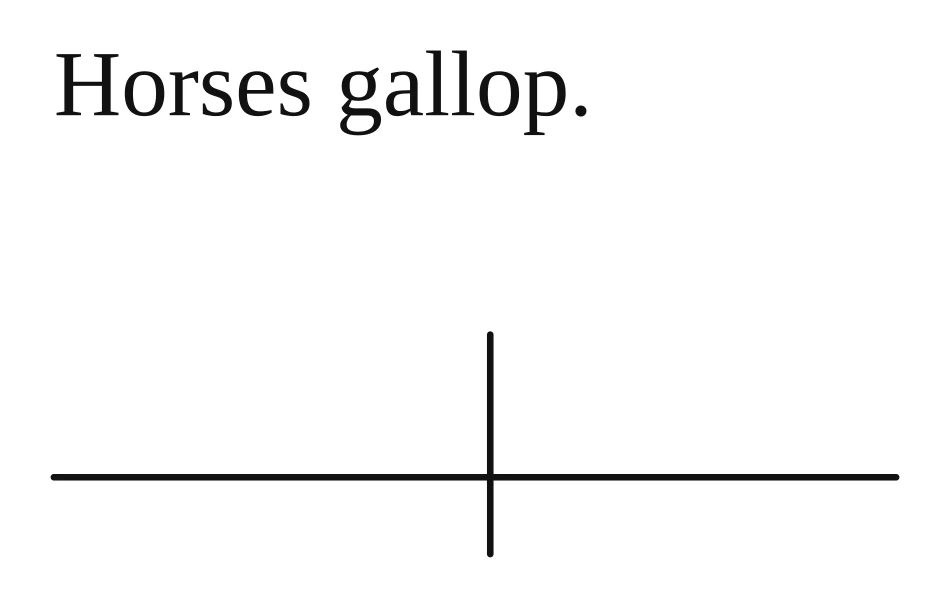
The lines are drawn for you. Copy the frame and fill in the words.
Show the answer

Two words, two jobs: gallop is the verb (the action), and Horses is who gallops, so it is the subject. The vertical line that crosses the baseline separates them.
Did you get it right?Diagram this sentence in the generator → - 2.
The old clock ticked loudly.
Adjective and adverb
Hint: show the empty frame
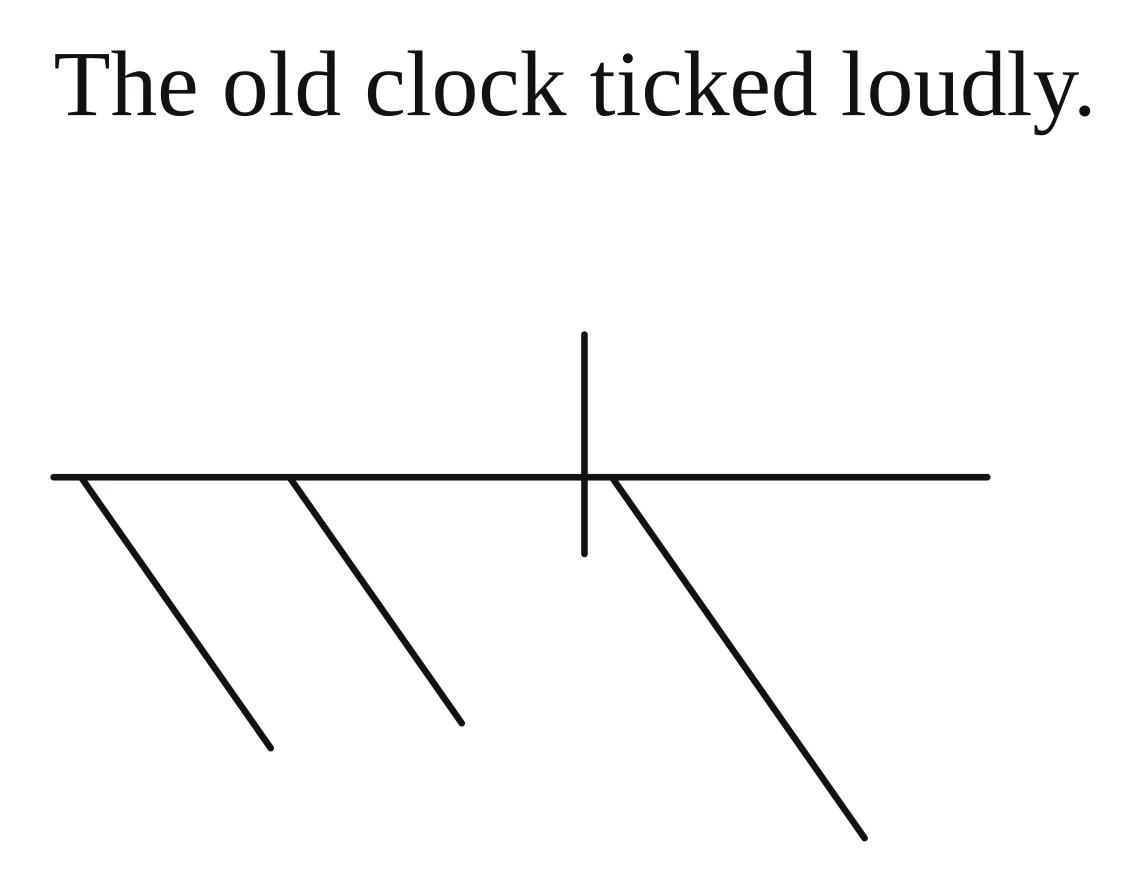
The lines are drawn for you. Copy the frame and fill in the words.
Show the answer
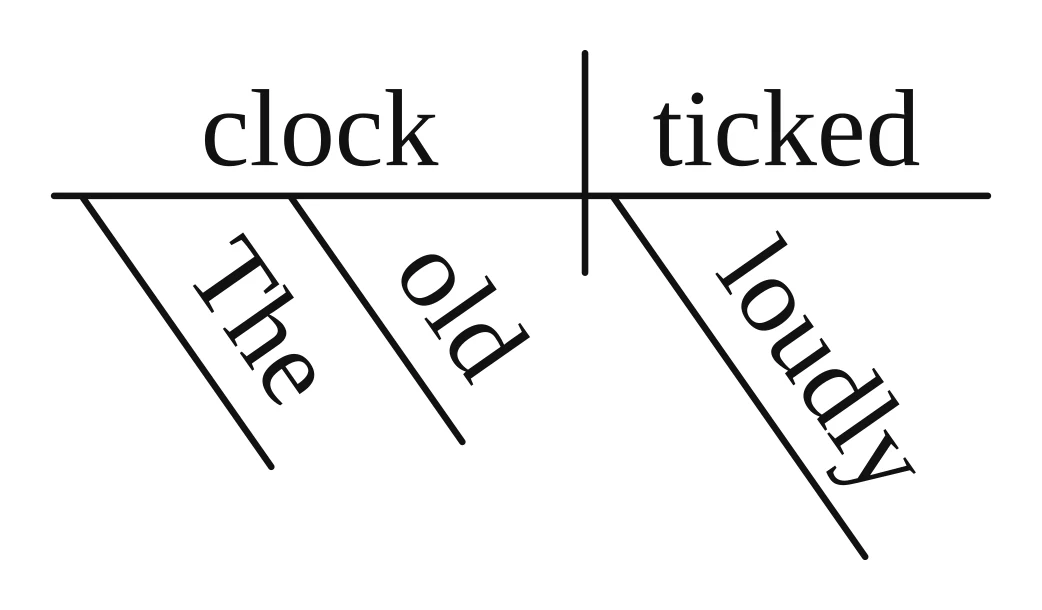
Ticked is the verb and clock its subject. The and old describe the clock, so they hang on slants under clock; loudly tells how it ticked, so it hangs under ticked.
Did you get it right?Diagram this sentence in the generator → - 3.
A small boat drifted slowly.
Article, adjective, adverb
Hint: show the empty frame
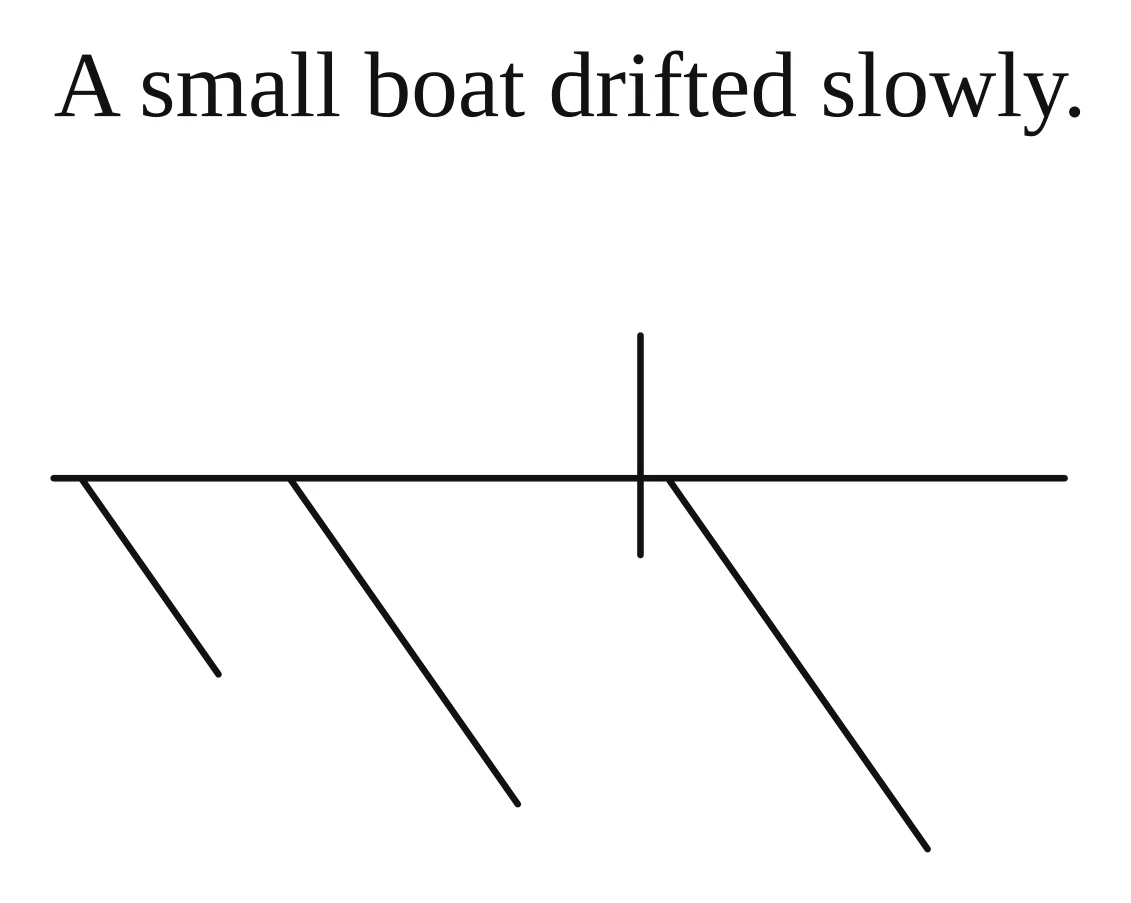
The lines are drawn for you. Copy the frame and fill in the words.
Show the answer
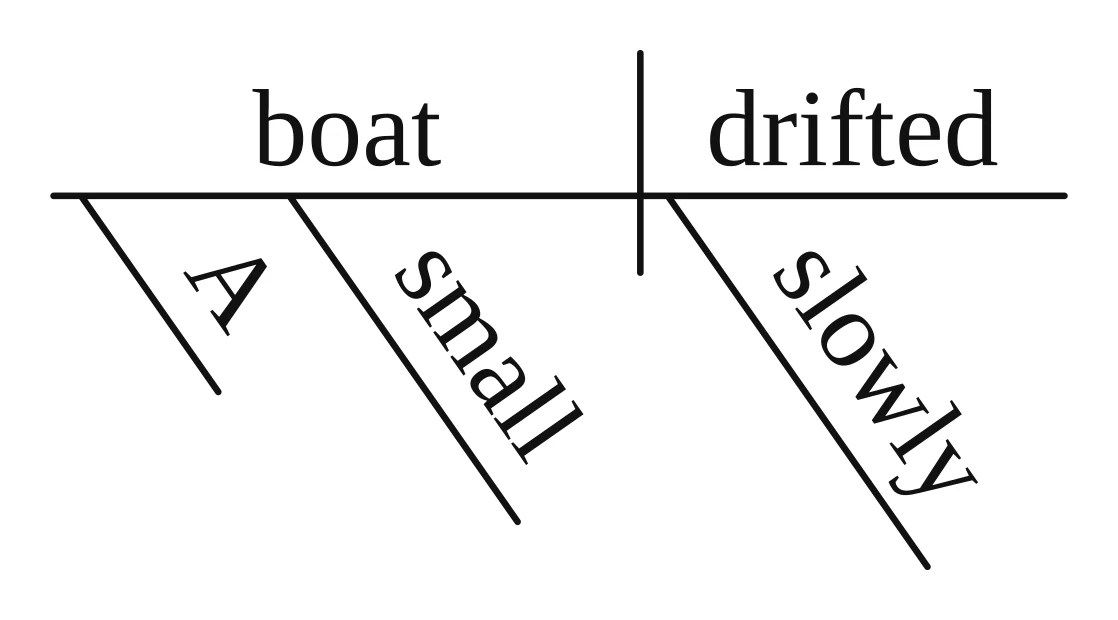
A and small describe boat and go under the subject; slowly answers how did it drift? and goes under the verb drifted.
Did you get it right?Diagram this sentence in the generator → - 4.
The happy children cheered.
Two words describing the subject
Hint: show the empty frame
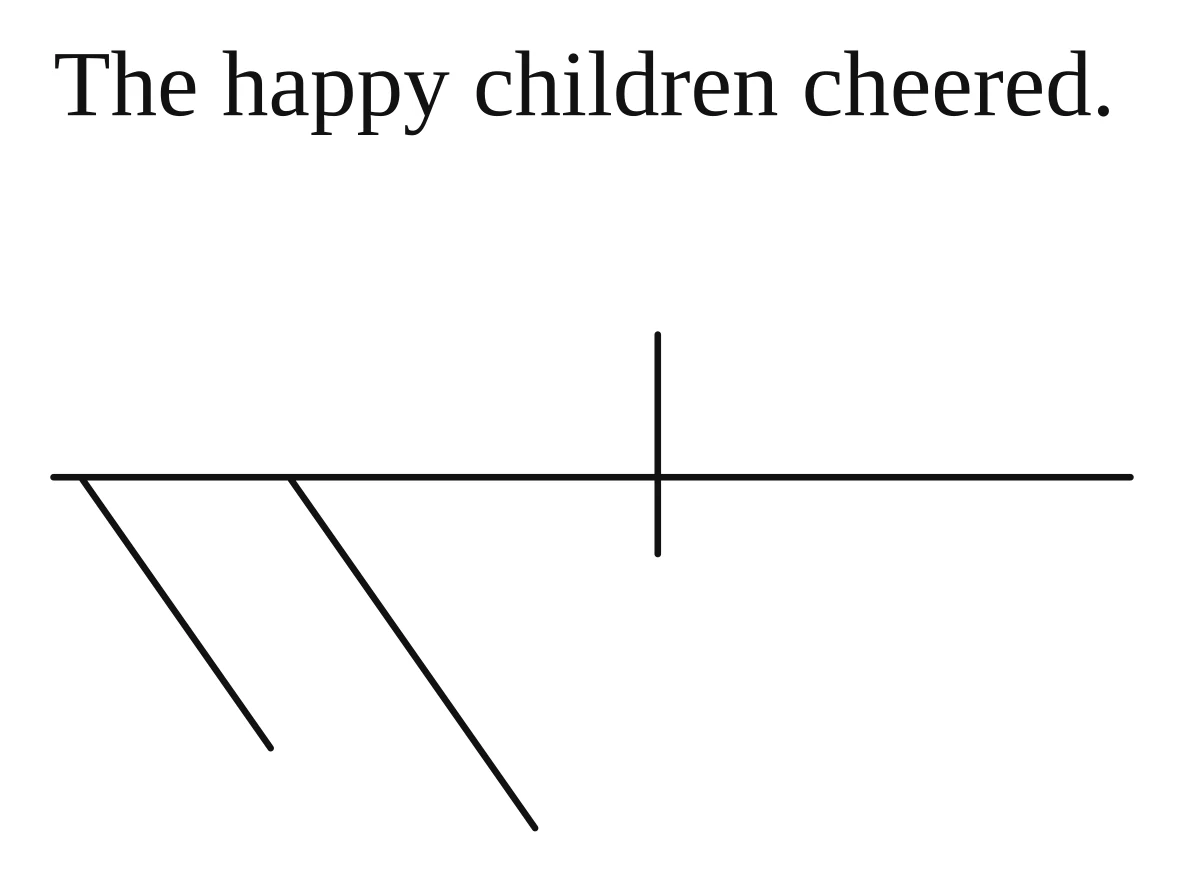
The lines are drawn for you. Copy the frame and fill in the words.
Show the answer
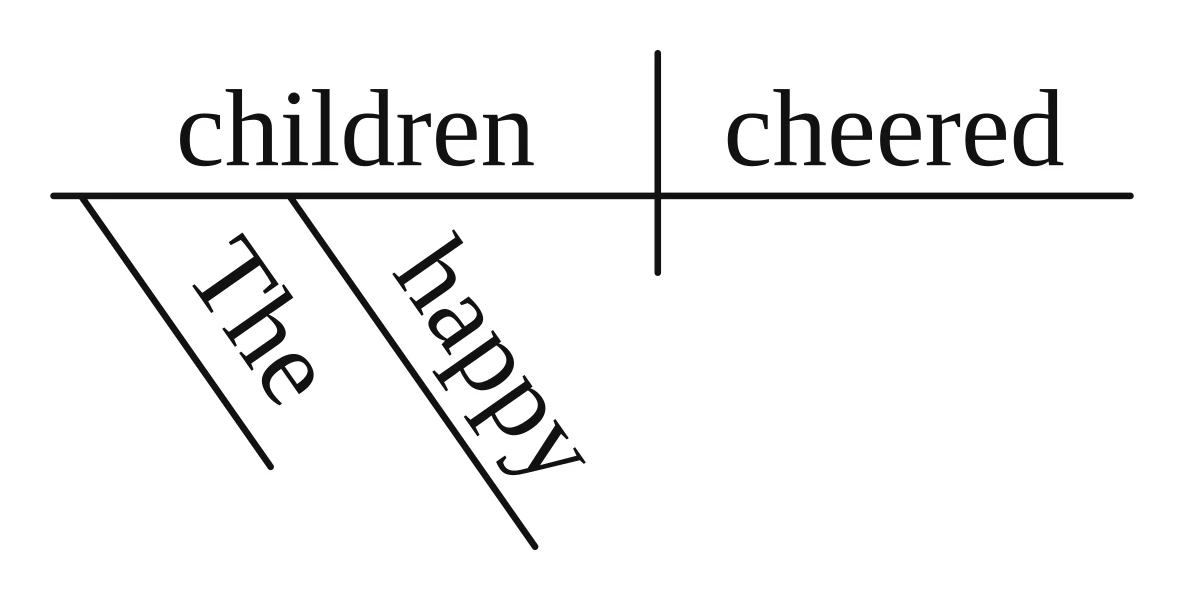
Nothing follows the verb cheered, so the baseline stops there. The and happy both describe children and hang under it in the order they appear.
Did you get it right?Diagram this sentence in the generator →
Set 2: Linking Verbs, Predicate Nouns and Predicate Adjectives
A linking verb (is, was, seems, looks, becomes) does not take a direct object. The word after it renames or describes the subject, so it sits on the baseline behind a line that slants back toward the subject. Test a verb like looks, seems or becomes: if you can swap it for is (or, before a noun, equals) and keep the meaning, it is linking.
Printable version: worksheet · answer key.
- 5.
The soup was cold.
Predicate adjective
Hint: show the empty frame
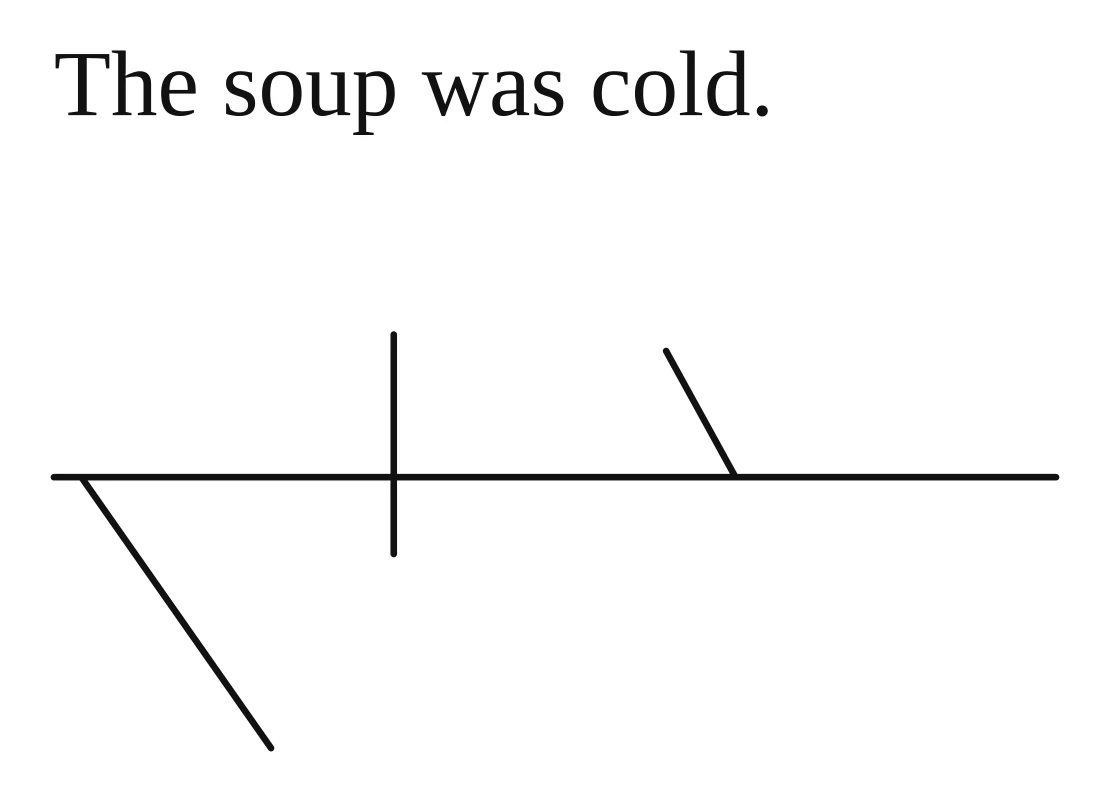
The lines are drawn for you. Copy the frame and fill in the words.
Show the answer
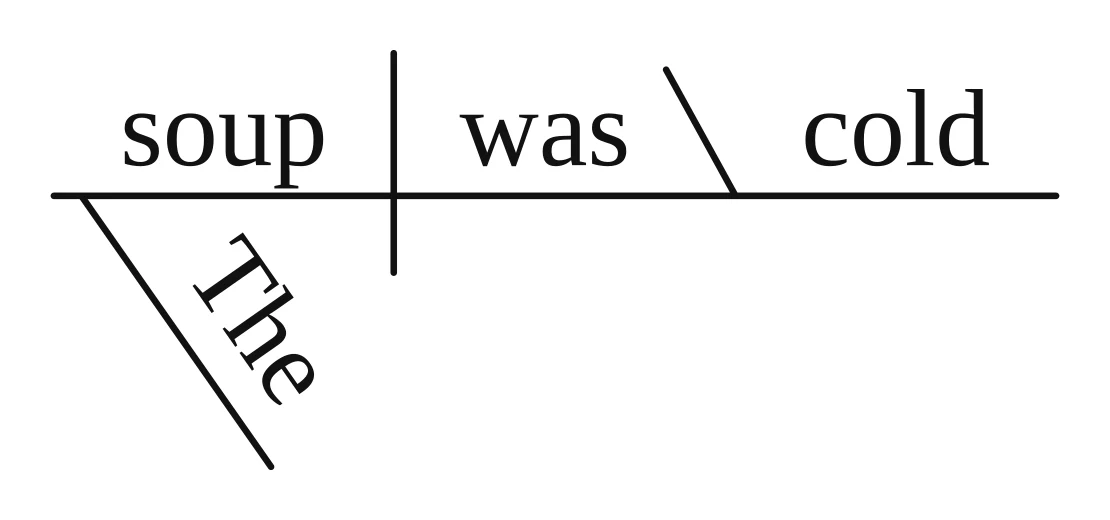
Was is a linking verb, so cold is not an object: it describes the subject. It sits on the baseline after a line that slants back toward soup, and it does not hang under soup.
Did you get it right?Diagram this sentence in the generator → - 6.
My grandfather was a sailor.
Predicate noun
Hint: show the empty frame
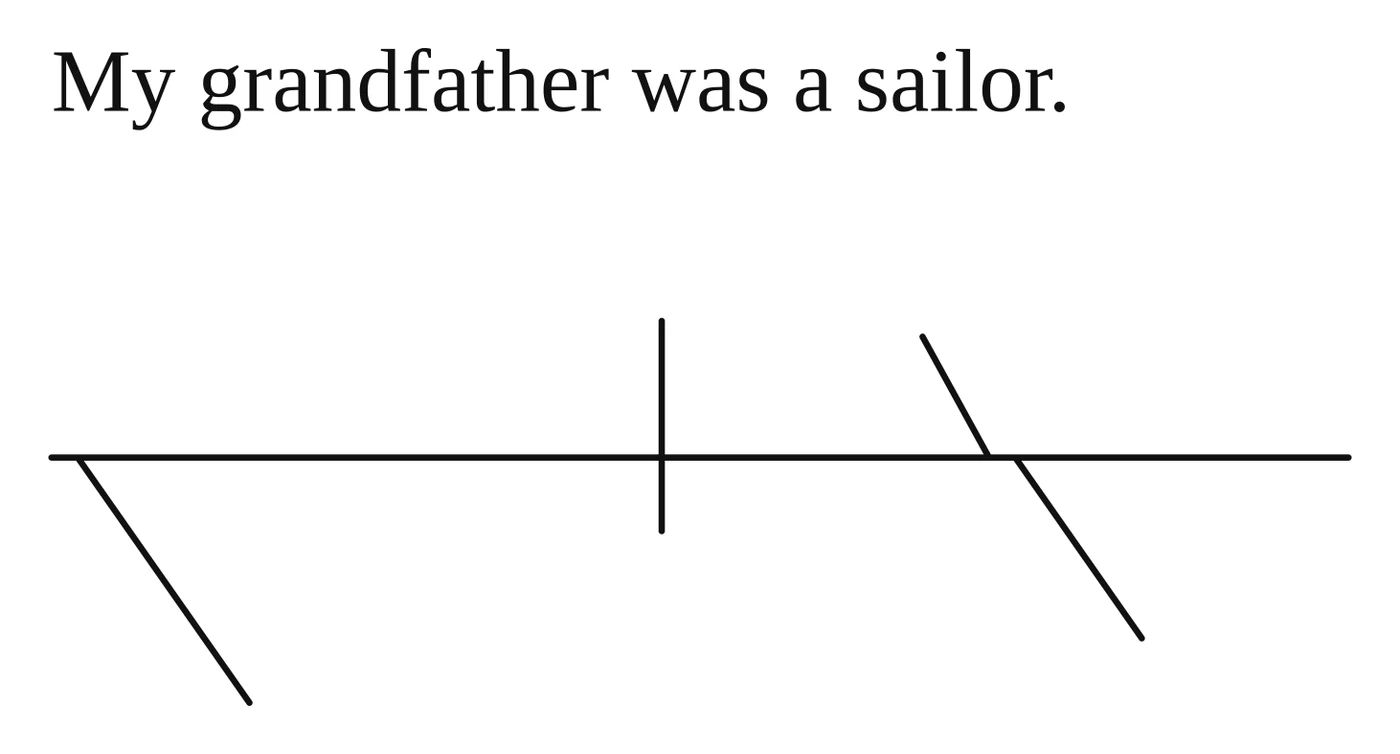
The lines are drawn for you. Copy the frame and fill in the words.
Show the answer
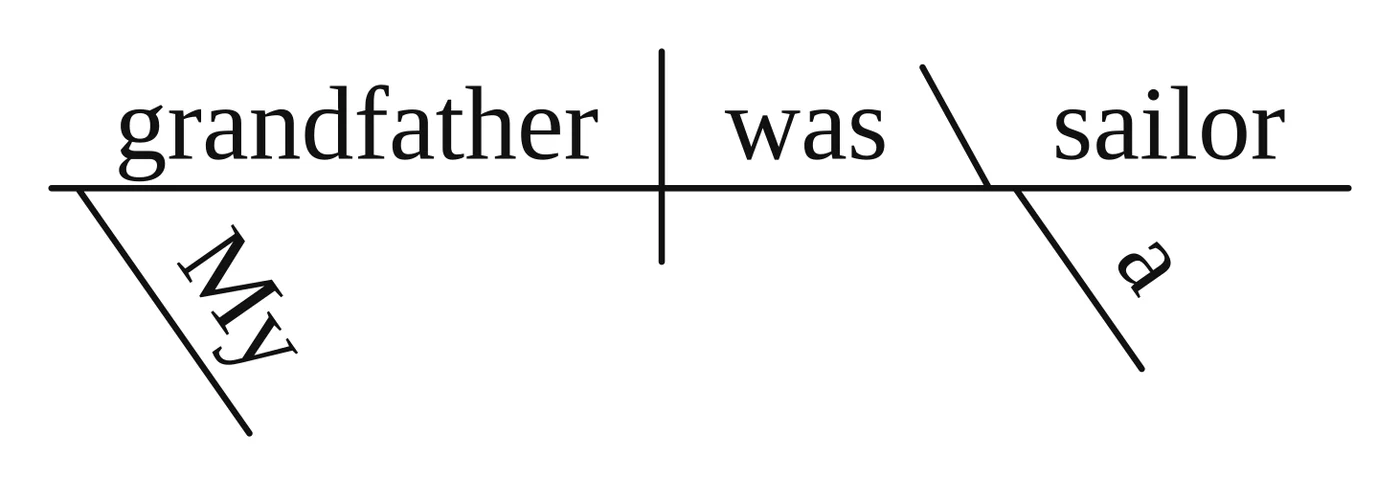
Sailor renames grandfather (grandfather = sailor), so it is a predicate noun on the baseline behind the slanted line. My hangs under grandfather and a under sailor.
Did you get it right?Diagram this sentence in the generator → - 7.
The garden looks beautiful.
Sense verb used as a linking verb
Hint: show the empty frame
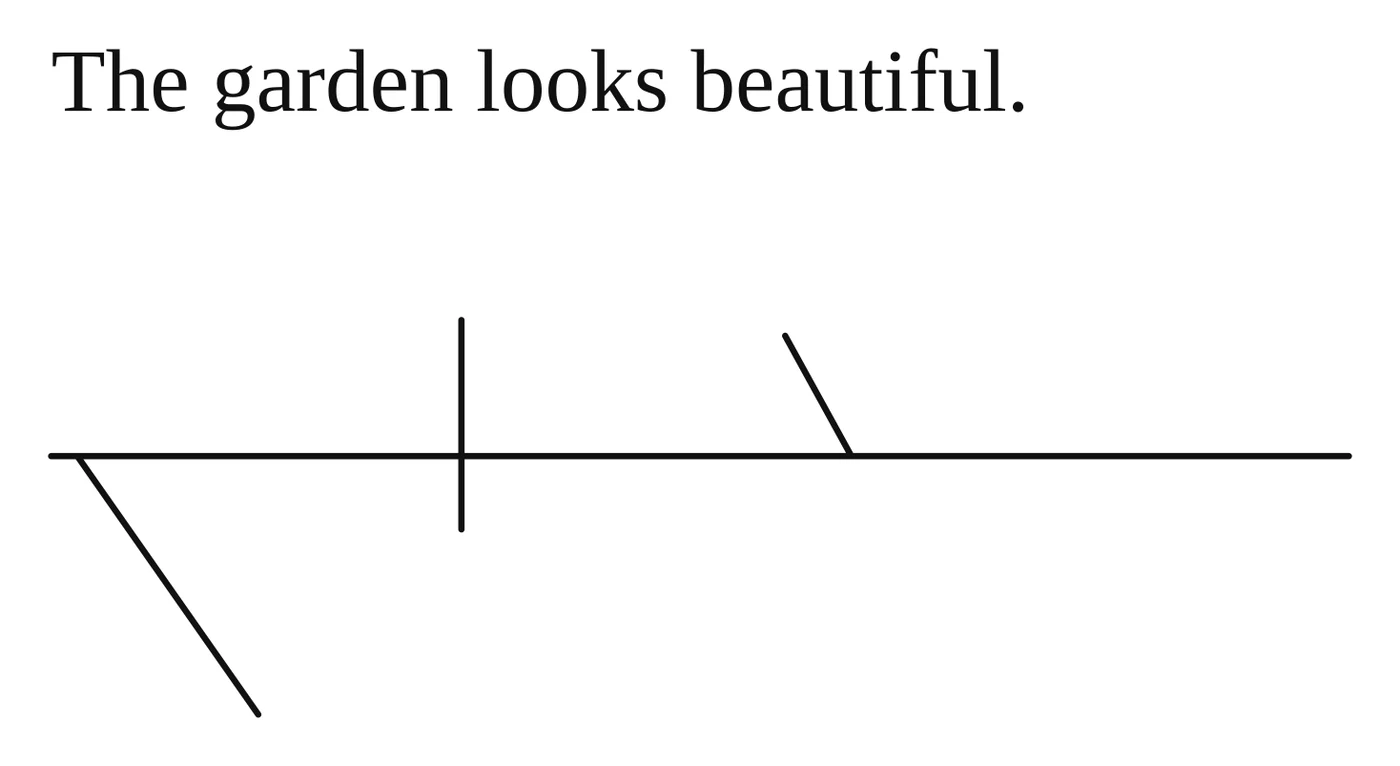
The lines are drawn for you. Copy the frame and fill in the words.
Show the answer
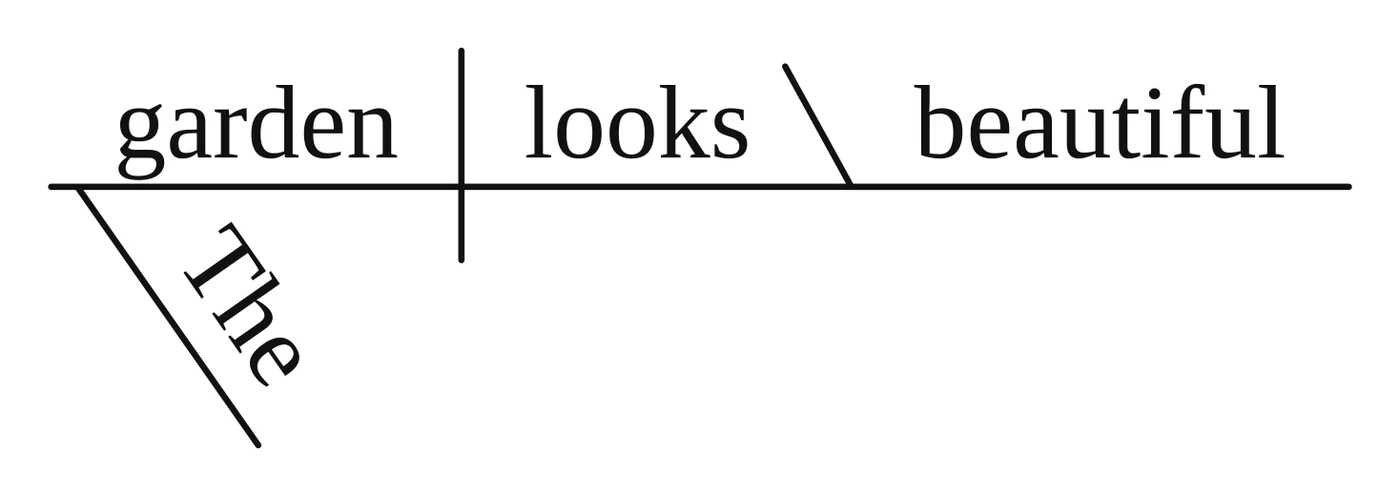
Looks here means seems, not looks at something, so it is a linking verb and beautiful is a predicate adjective behind the slanted line. Swap in is to test it: The garden is beautiful keeps the meaning.
Did you get it right?Diagram this sentence in the generator → - 8.
Her brother is the class president.
Predicate noun with modifiers
Hint: show the empty frame
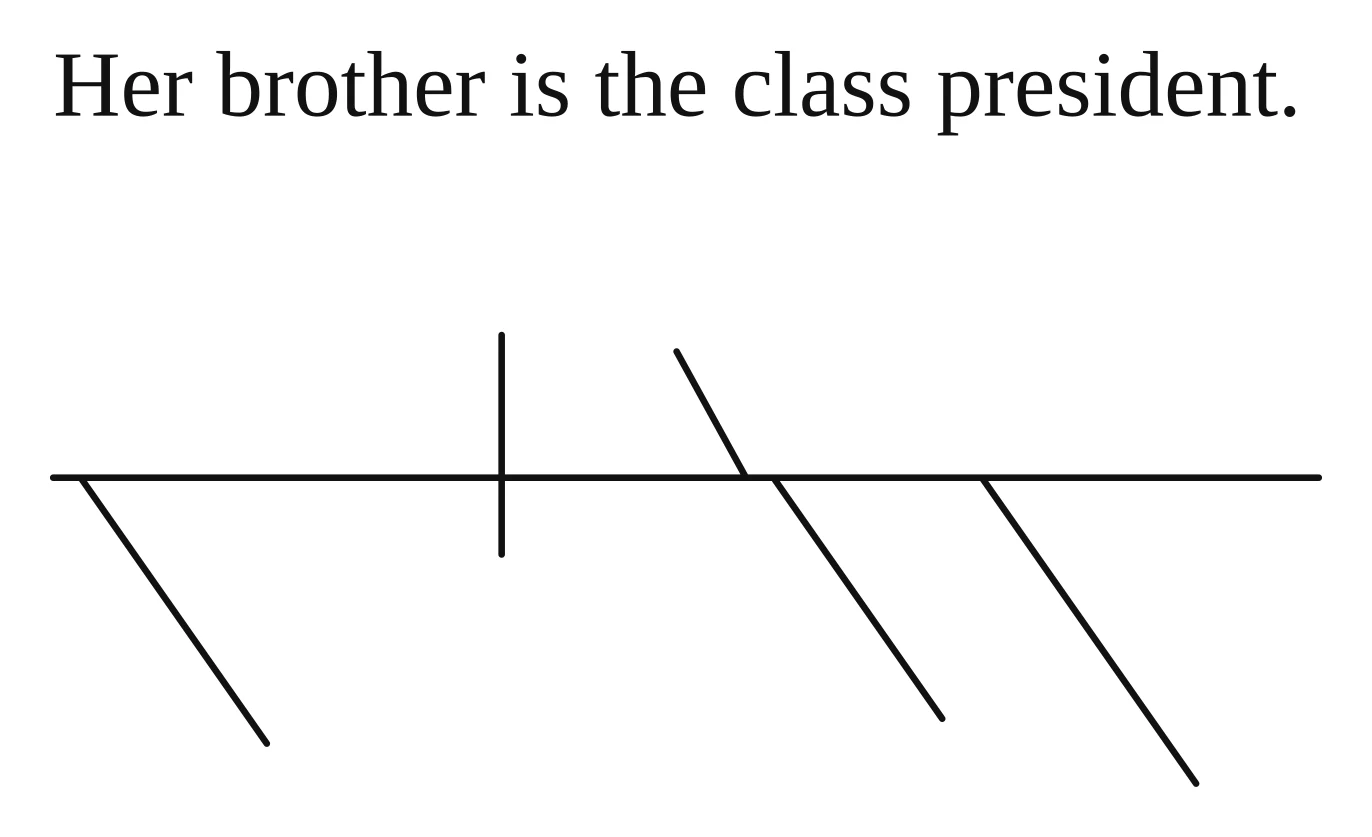
The lines are drawn for you. Copy the frame and fill in the words.
Show the answer
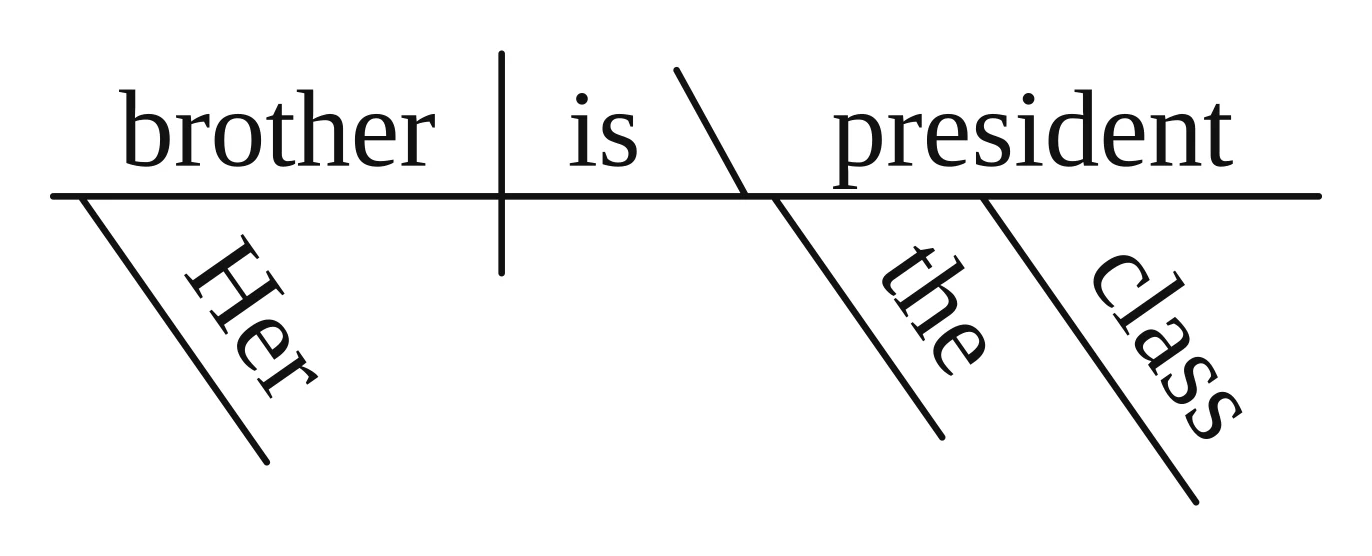
President renames brother after the linking verb is. The and class both tell which president, so they hang under it; class is a noun working as an adjective here.
Did you get it right?Diagram this sentence in the generator →
Set 3: Direct and Indirect Objects
Ask verb what? to find the direct object; it goes on the baseline after a short vertical line that stops at the baseline. Then ask to whom or for whom: an indirect object hangs on a line under the verb, as if it had an invisible to or for. The full rules are in how to diagram direct and indirect objects.
Printable version: worksheet · answer key.
- 9.
Lena painted a picture.
Direct object
Hint: show the empty frame
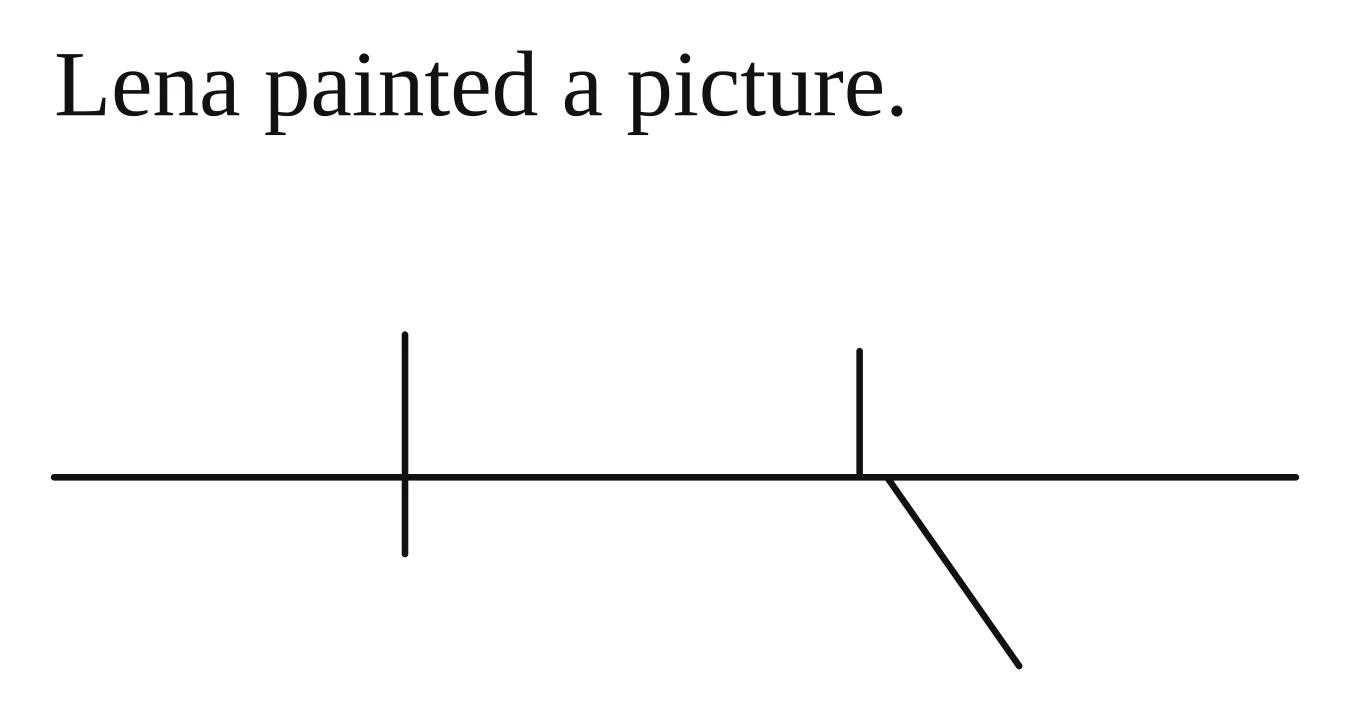
The lines are drawn for you. Copy the frame and fill in the words.
Show the answer
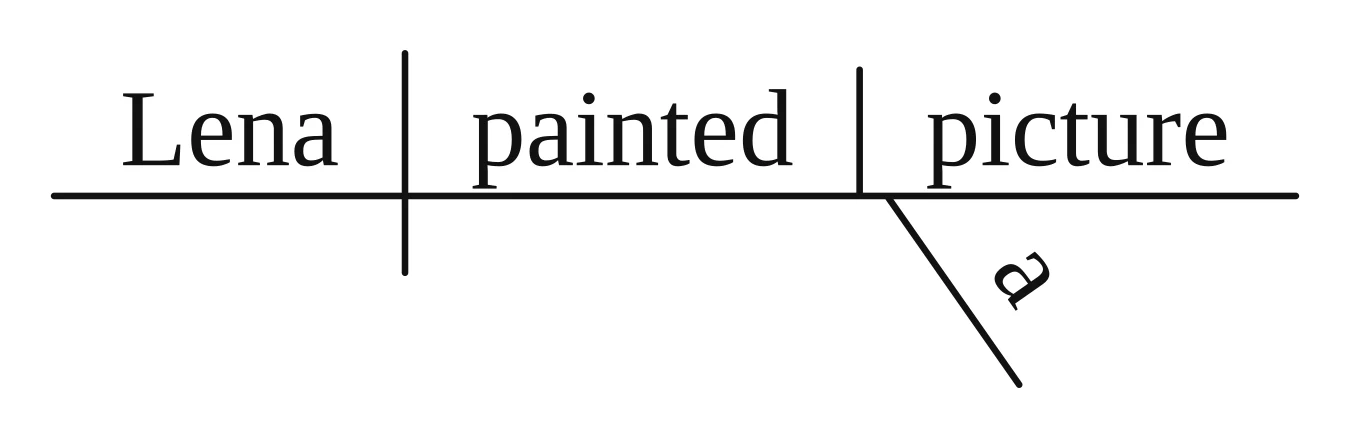
Painted what? A picture. Picture is the direct object, so it goes on the baseline after a short vertical line that stops at the baseline (it does not cross it the way the subject–verb line does).
Did you get it right?Diagram this sentence in the generator → - 10.
The farmer fed the hungry goats.
Direct object with an adjective
Hint: show the empty frame
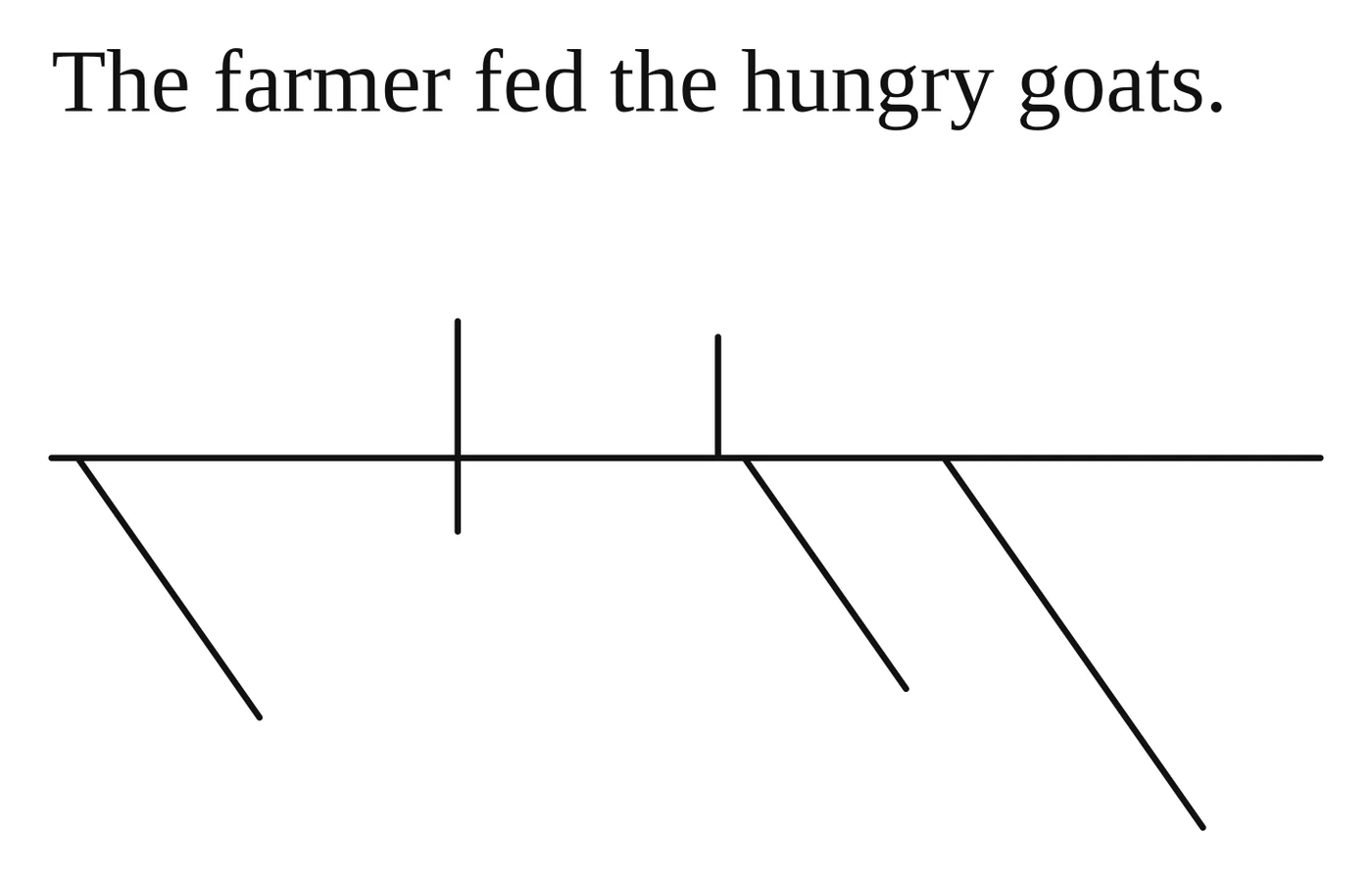
The lines are drawn for you. Copy the frame and fill in the words.
Show the answer
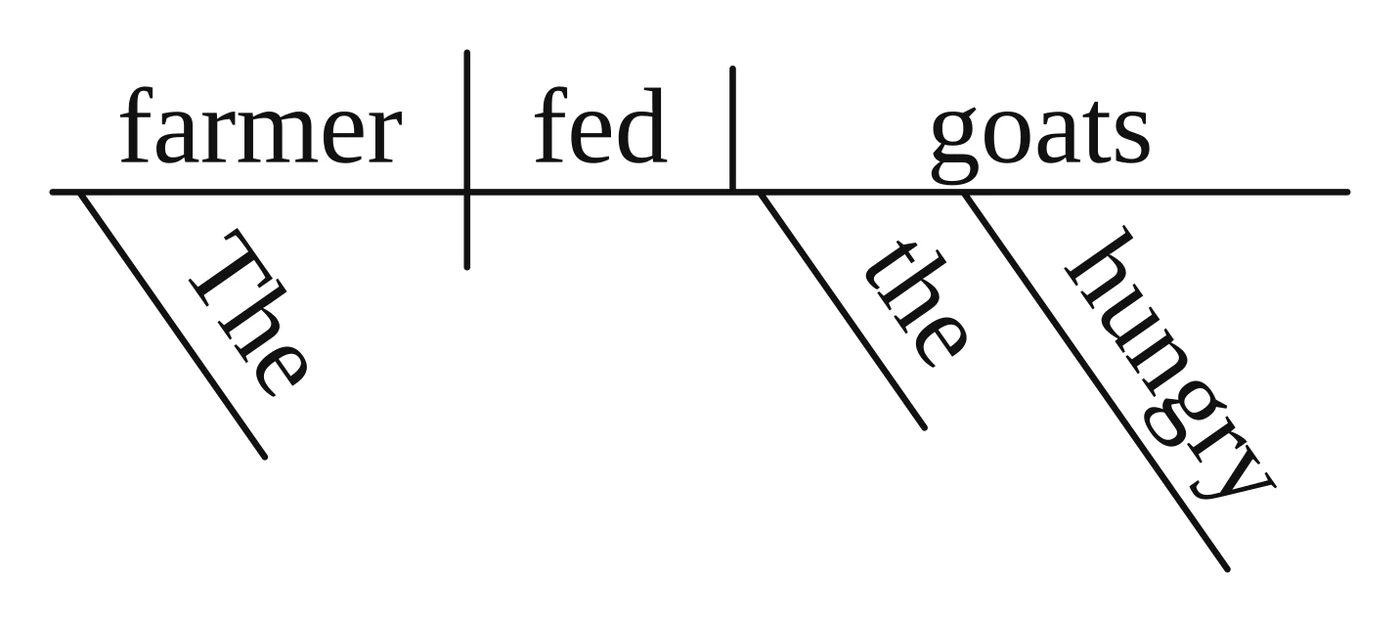
Fed what? Goats, the direct object. The and hungry describe the goats, so they hang under goats, not under the verb.
Did you get it right?Diagram this sentence in the generator → - 11.
Our coach bought the team pizza.
Indirect object
Hint: show the empty frame
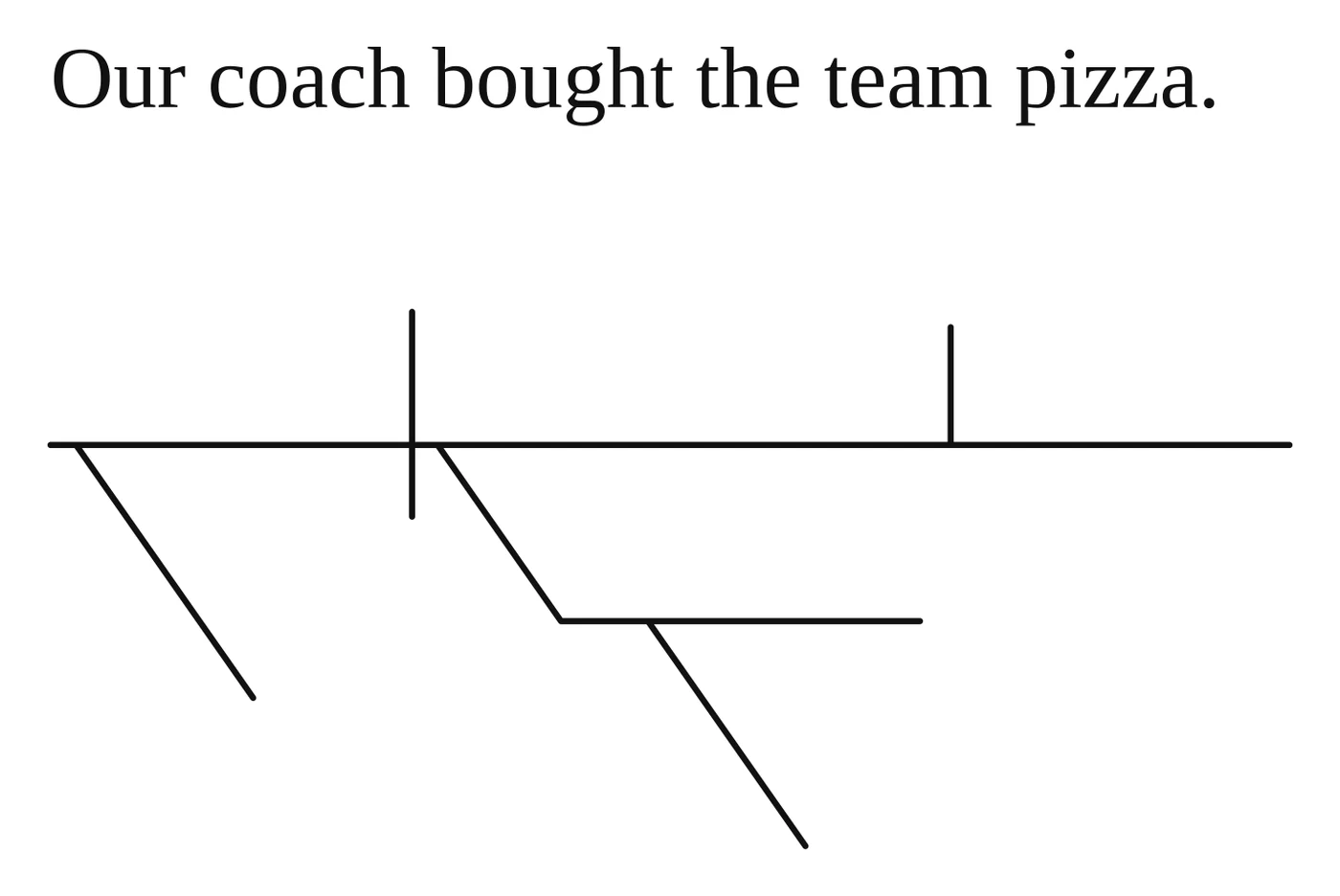
The lines are drawn for you. Copy the frame and fill in the words.
Show the answer
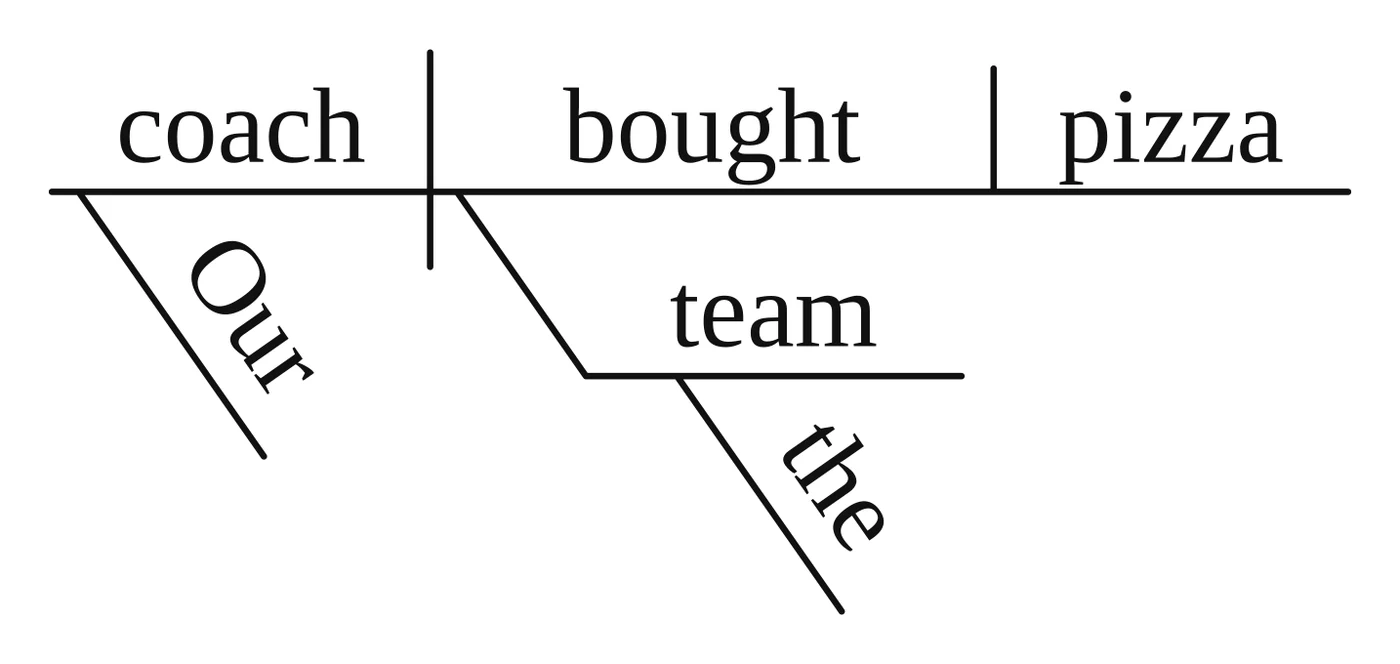
Bought what? Pizza (direct object). Bought it for whom? The team, the indirect object, which goes on a flat line under the verb, joined by a slant. Test: bought pizza for the team means the same.
Did you get it right?Diagram this sentence in the generator → - 12.
The librarian showed us a new book.
Pronoun as indirect object
Hint: show the empty frame
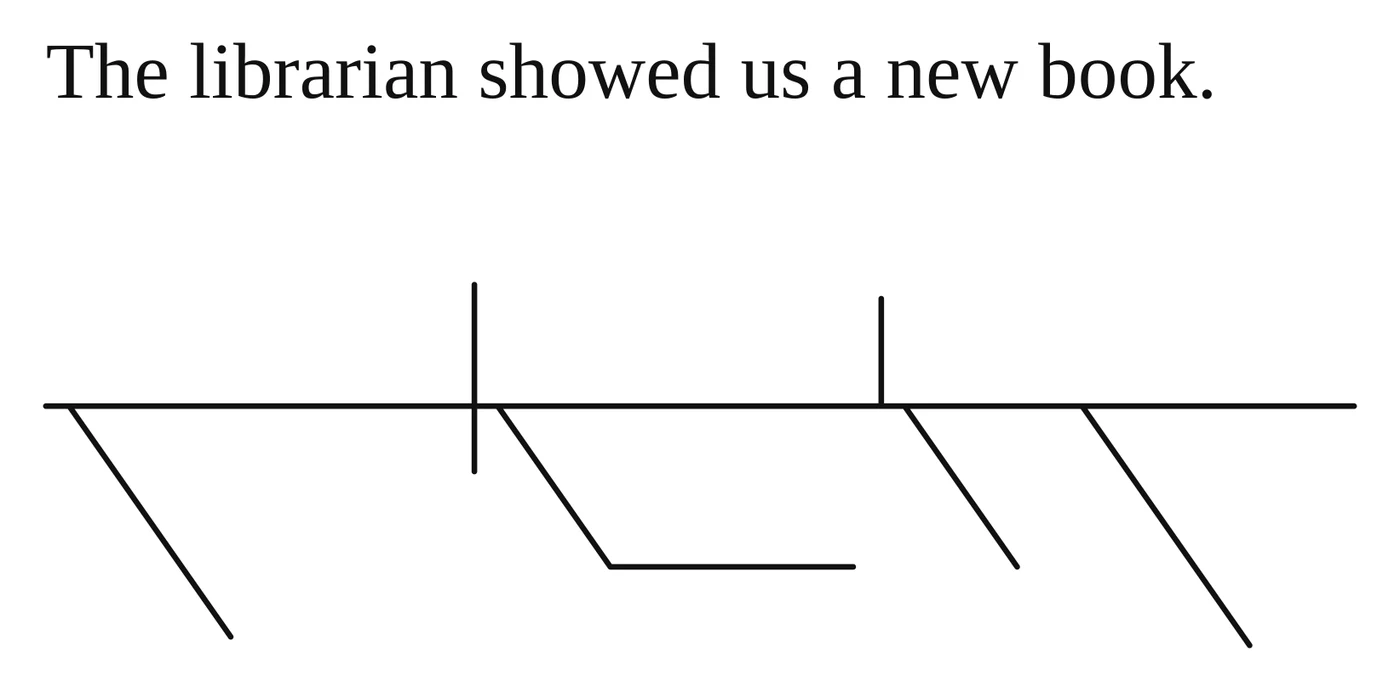
The lines are drawn for you. Copy the frame and fill in the words.
Show the answer
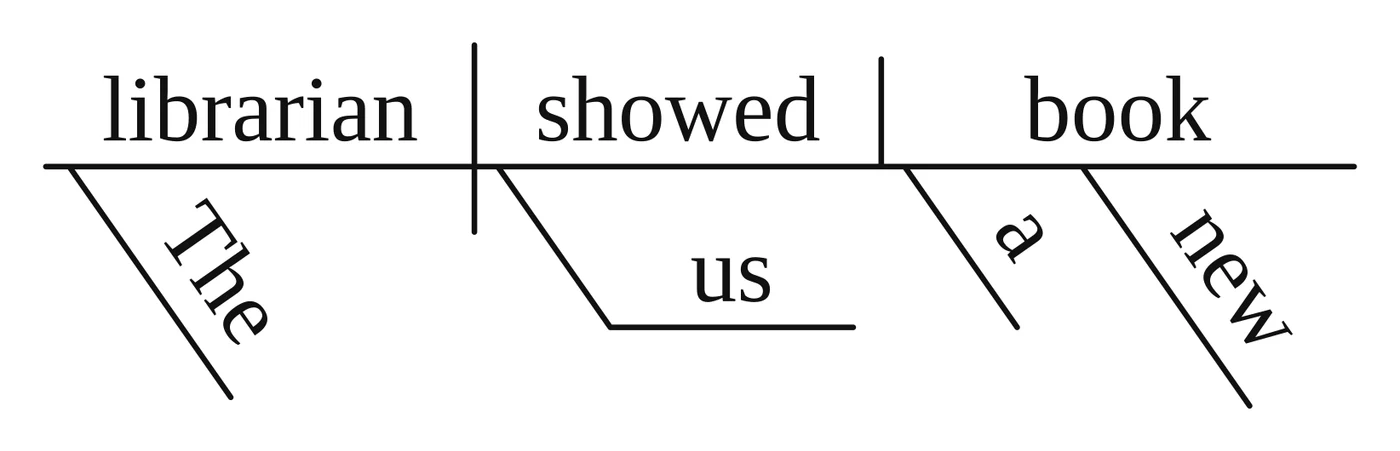
Showed what? A new book (direct object). Showed it to whom? Us, the indirect object, under the verb. A and new hang under book.
Did you get it right?Diagram this sentence in the generator →
Set 4: Prepositional Phrases
Every prepositional phrase hangs under the word it describes: the preposition on a slant, its object on a flat line. Decide which word the phrase tells you about. If it answers which one, it hangs under a noun; if it answers where, when or how, it hangs under the verb. More cases are in how to diagram prepositional phrases.
Printable version: worksheet · answer key.
- 13.
The keys are under the mat.
Prepositional phrase after be (tells where)
Hint: show the empty frame
The lines are drawn for you. Copy the frame and fill in the words.
Show the answer
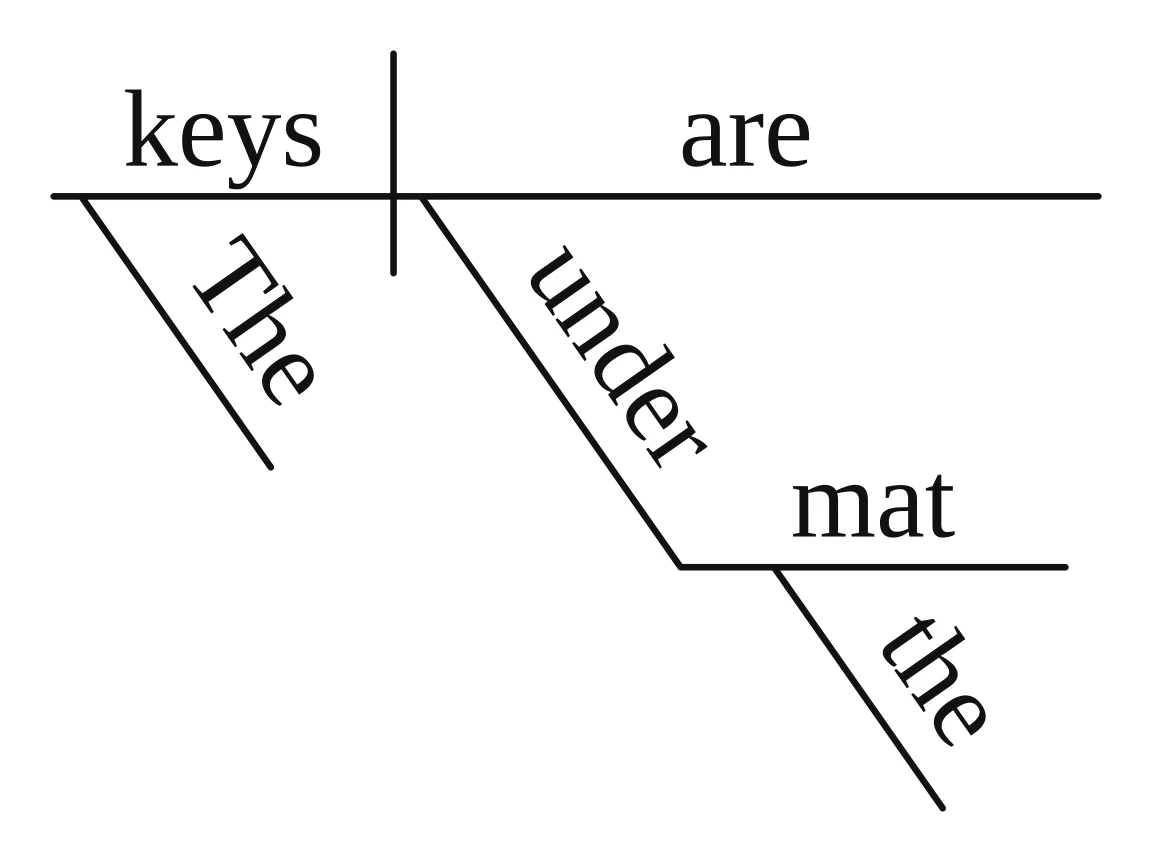
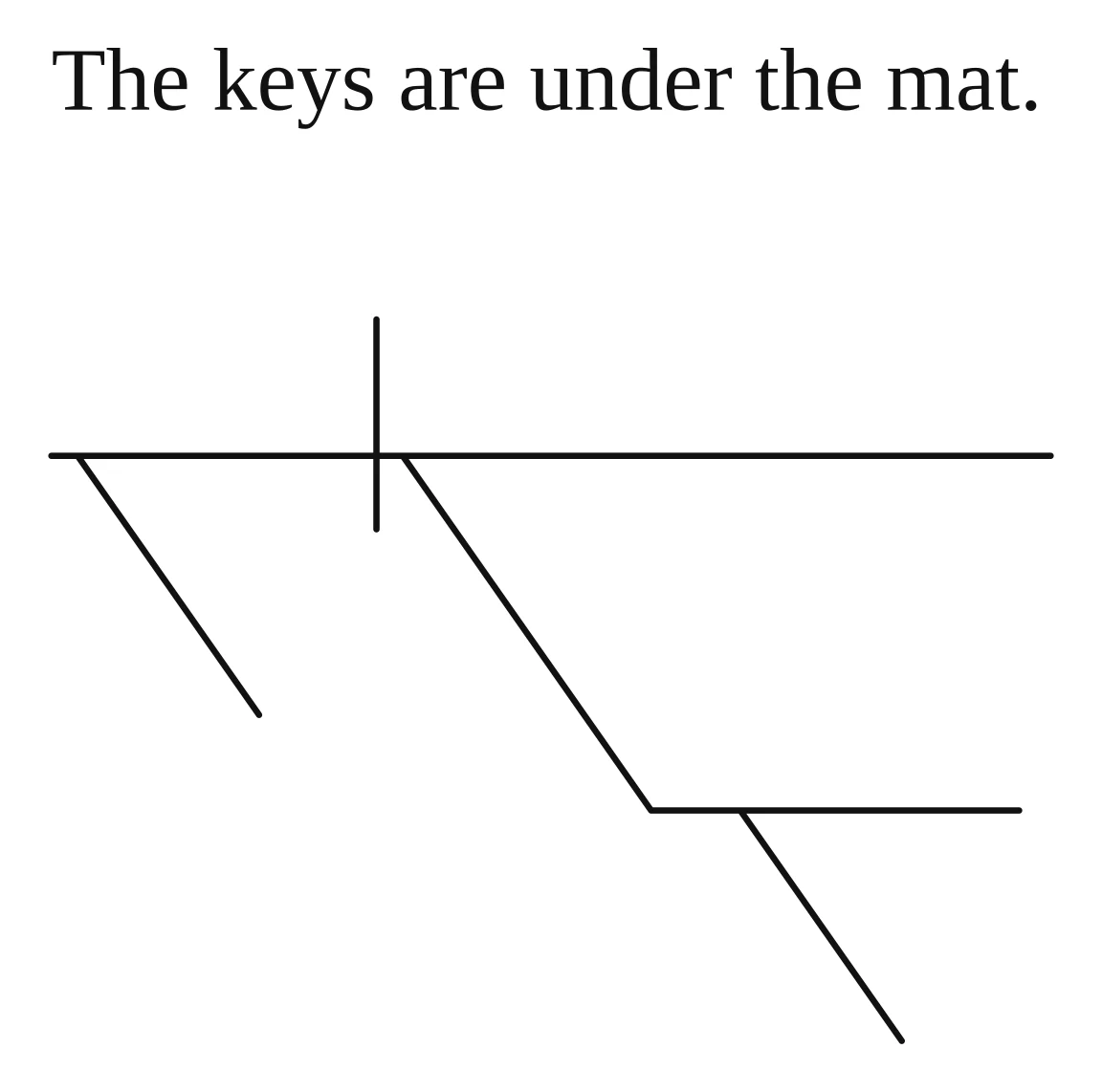
Are here means are located, and under the mat tells where, so the phrase hangs under the verb: under on the slant, mat on the flat line, the under mat.
Did you get it right?Diagram this sentence in the generator → - 14.
A girl with red boots splashed through the puddles.
One adjective phrase, one adverb phrase
Hint: show the empty frame
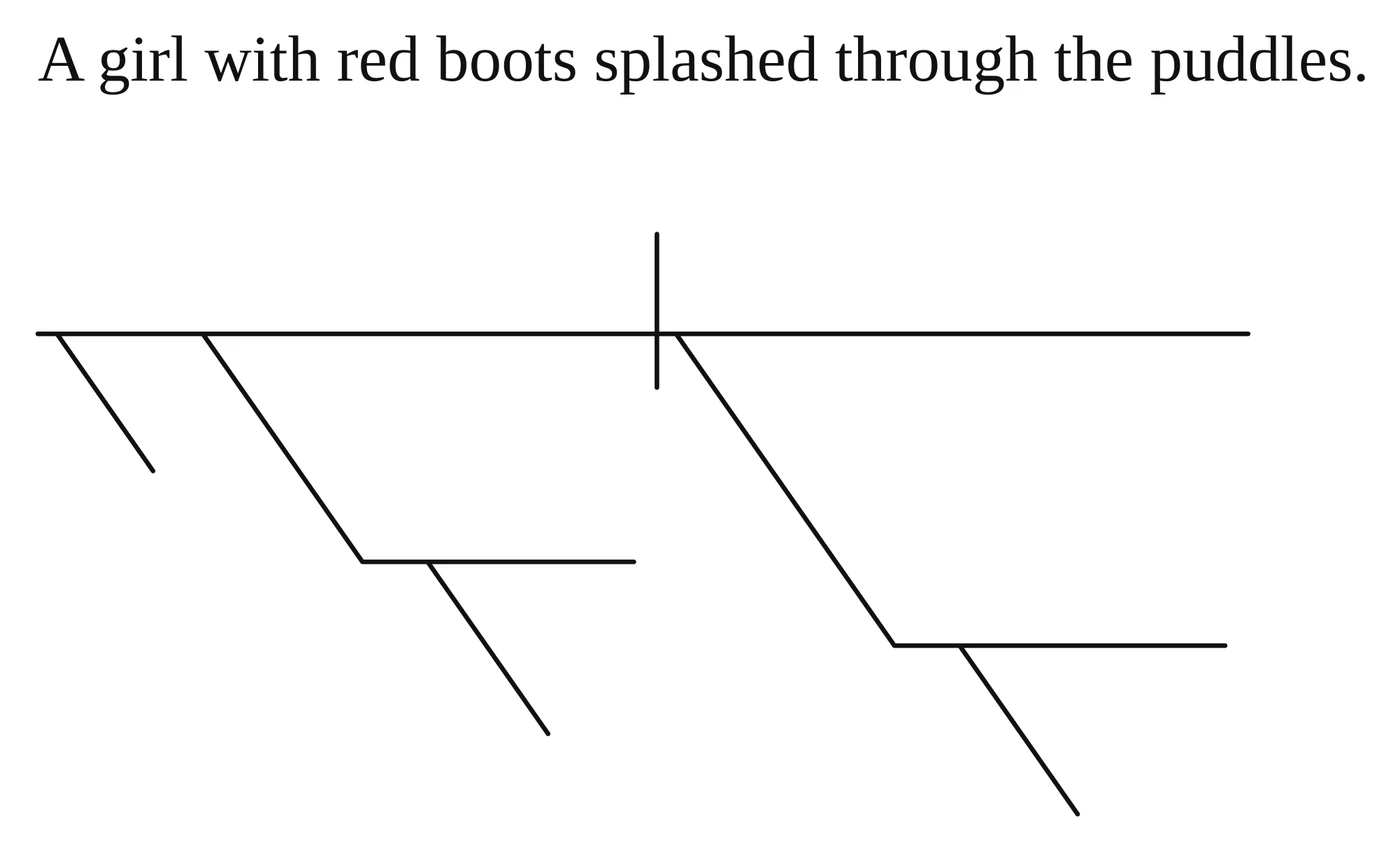
The lines are drawn for you. Copy the frame and fill in the words.
Show the answer
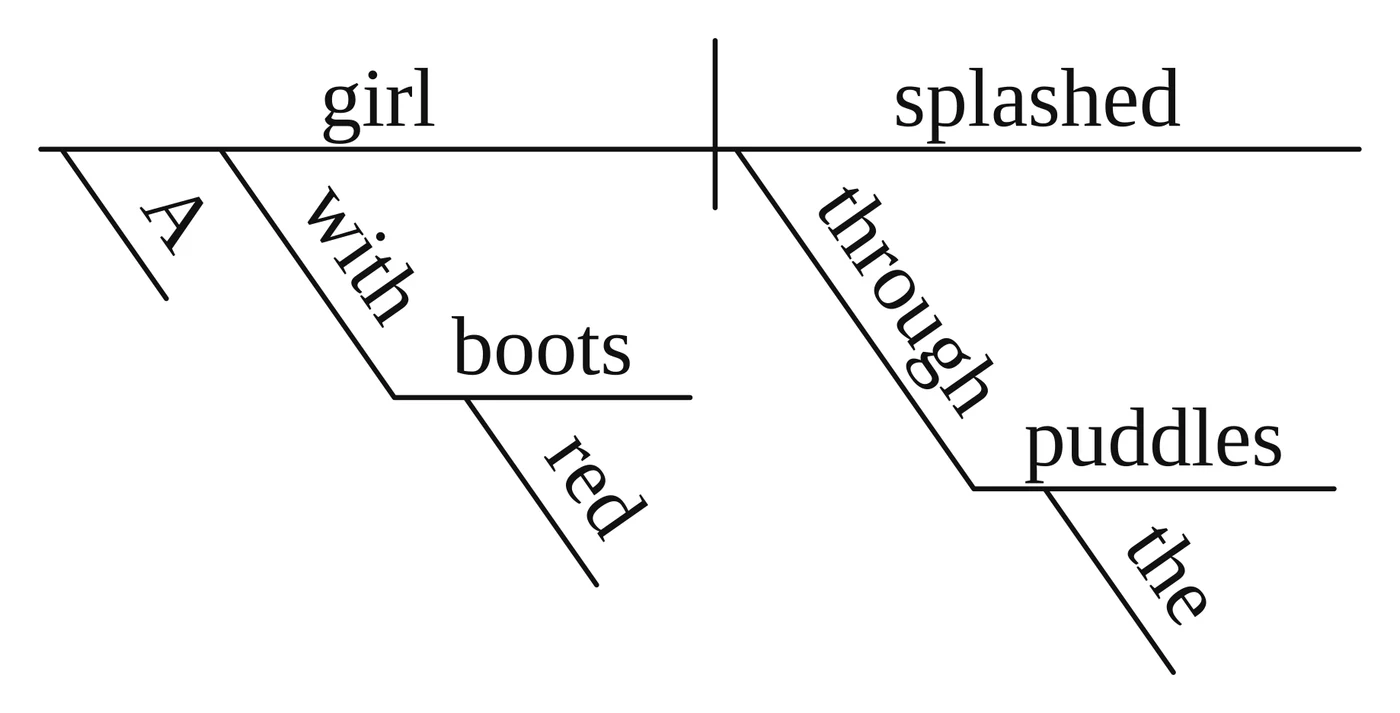
With red boots tells which girl, so it hangs under girl. Through the puddles tells where she splashed, so it hangs under splashed. Each phrase's own adjective (red, the) hangs under its object.
Did you get it right?Diagram this sentence in the generator → - 15.
After lunch, we played outside.
Opening phrase and a one-word adverb
Hint: show the empty frame
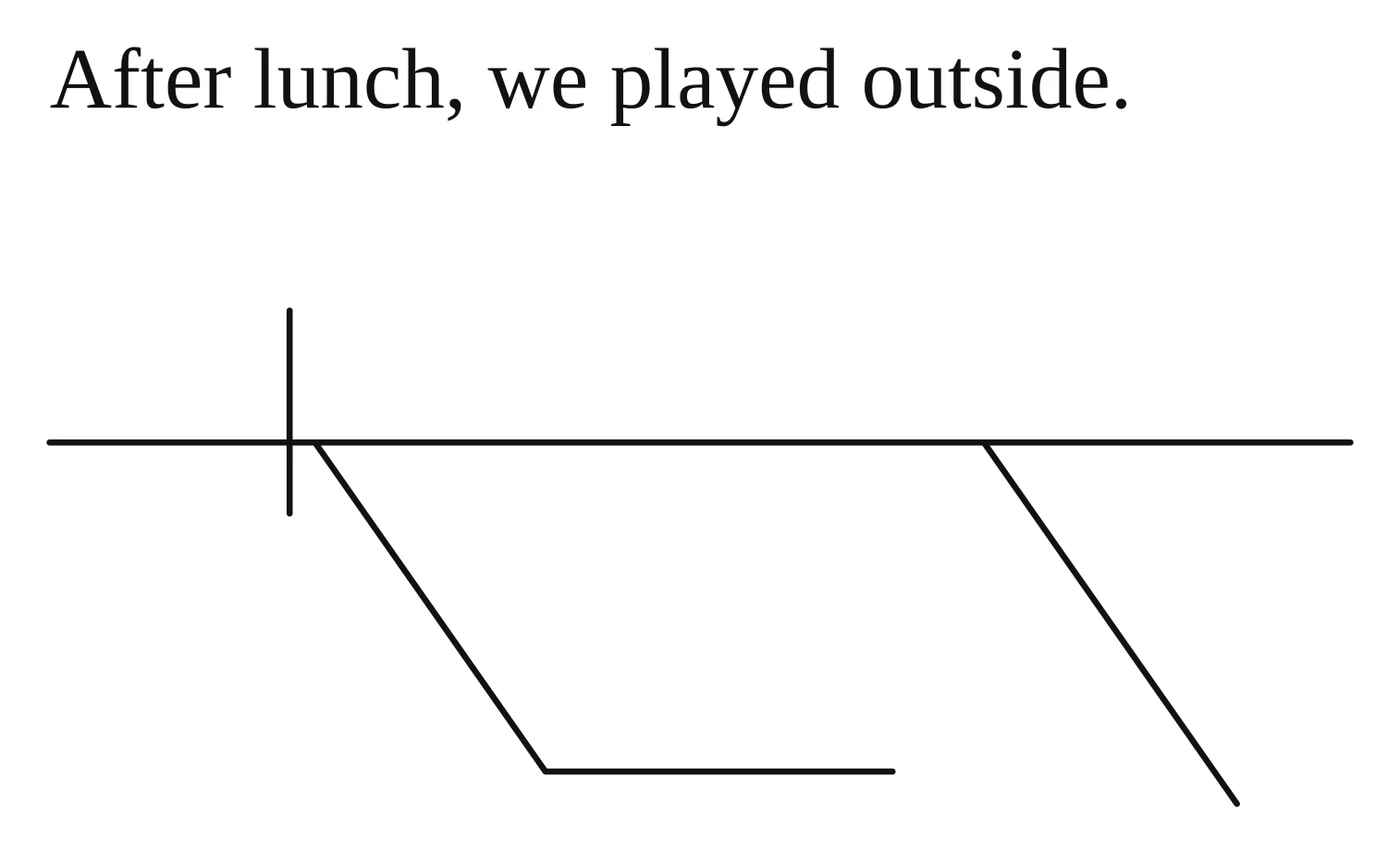
The lines are drawn for you. Copy the frame and fill in the words.
Show the answer
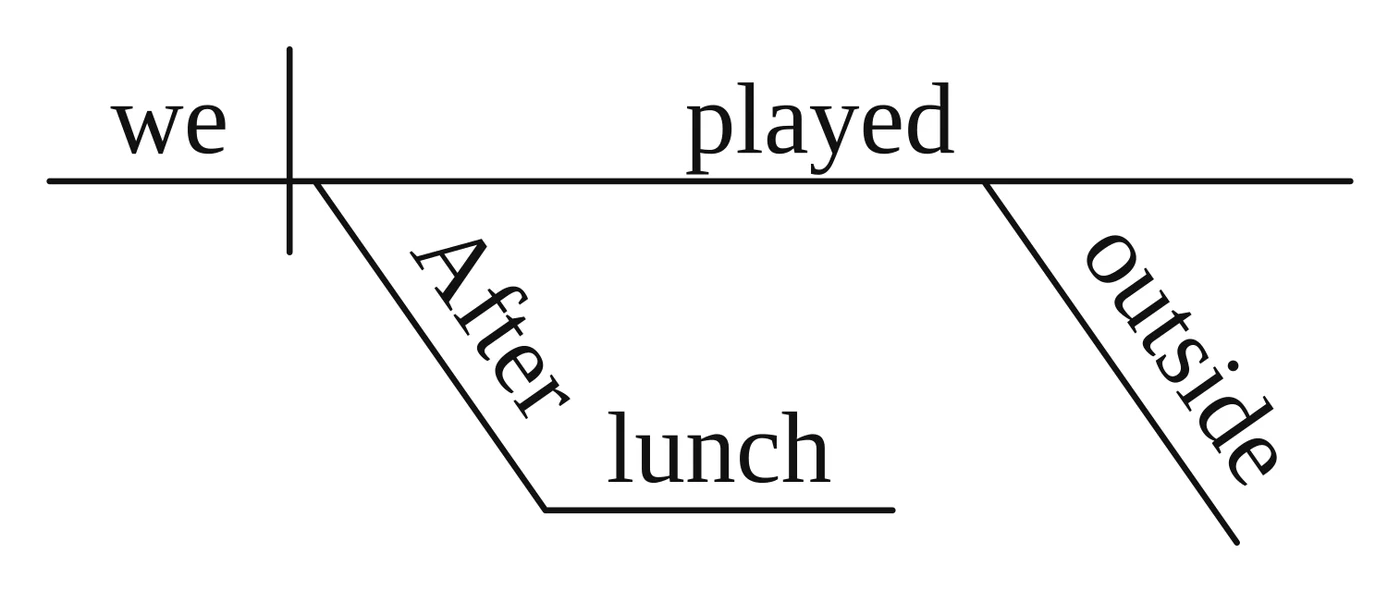
After lunch opens the sentence but still tells when we played, so it hangs under played. Outside has no object, so it is an adverb on a plain slant, not a prepositional phrase.
Did you get it right?Diagram this sentence in the generator → - 16.
The book on the shelf belongs to my aunt.
Phrase under the subject
Hint: show the empty frame
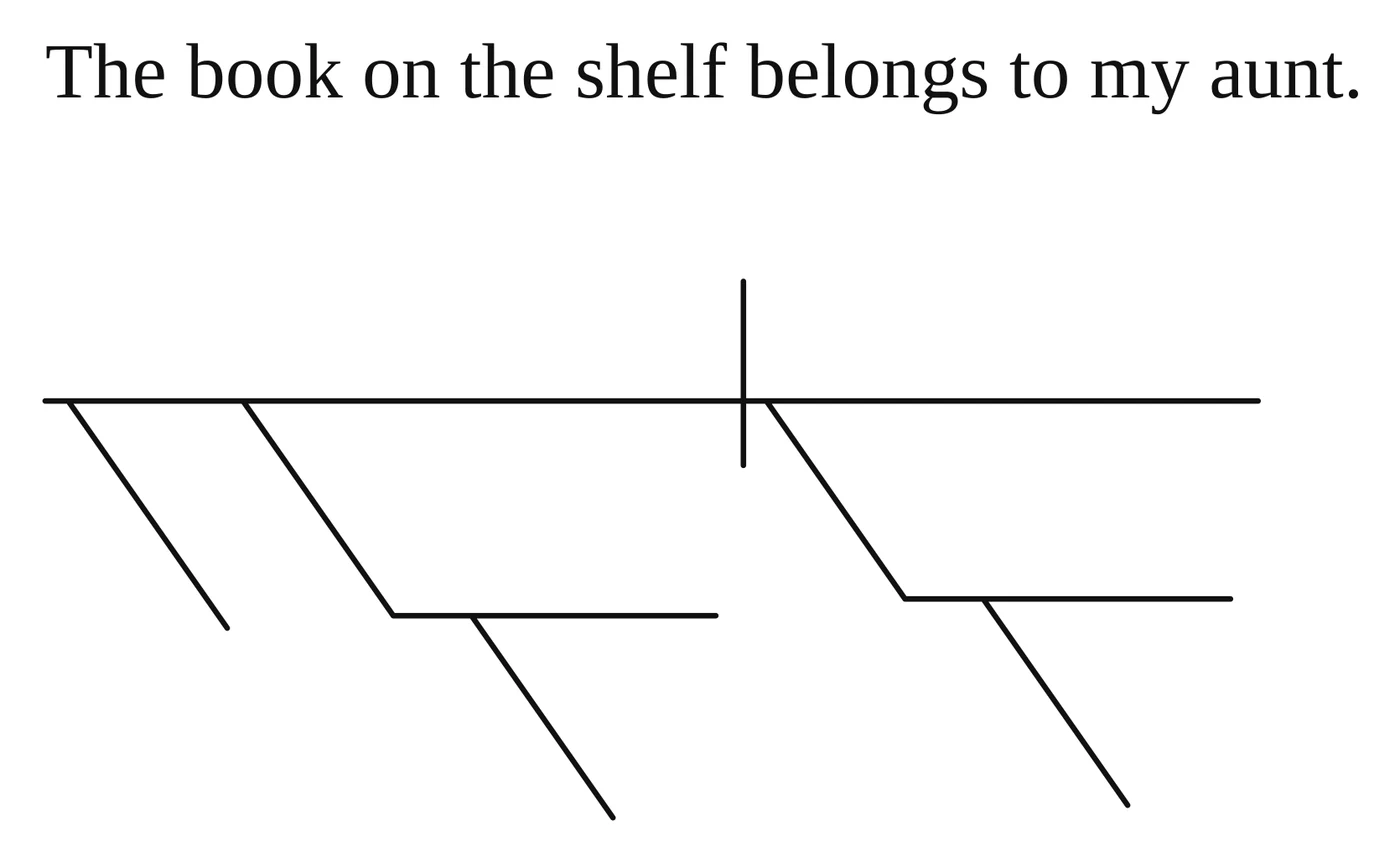
The lines are drawn for you. Copy the frame and fill in the words.
Show the answer
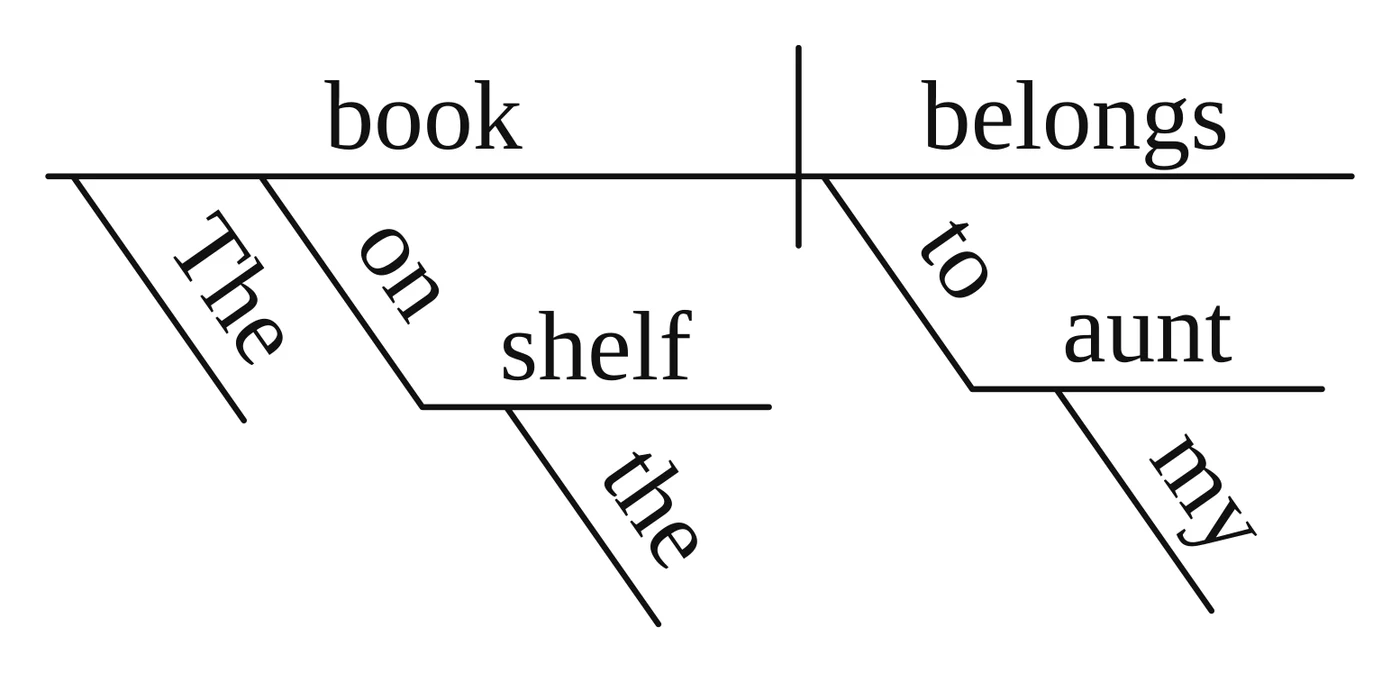
On the shelf tells which book, so it hangs under the subject book. To my aunt goes with belongs, so it hangs under the verb.
Did you get it right?Diagram this sentence in the generator →
Set 5: Compound Subjects, Compound Verbs and Compound Sentences
Two or more subjects (or verbs) split the baseline into parallel lines joined by a dashed line with the conjunction on it. A compound sentence is two full baselines, one above the other, joined at the verbs by a dashed line that steps across, with and, but or or written on the step. See compound and complex sentences for longer examples.
Printable version: worksheet · answer key.
- 17.
Cats and dogs make good pets.
Compound subject
Hint: show the empty frame
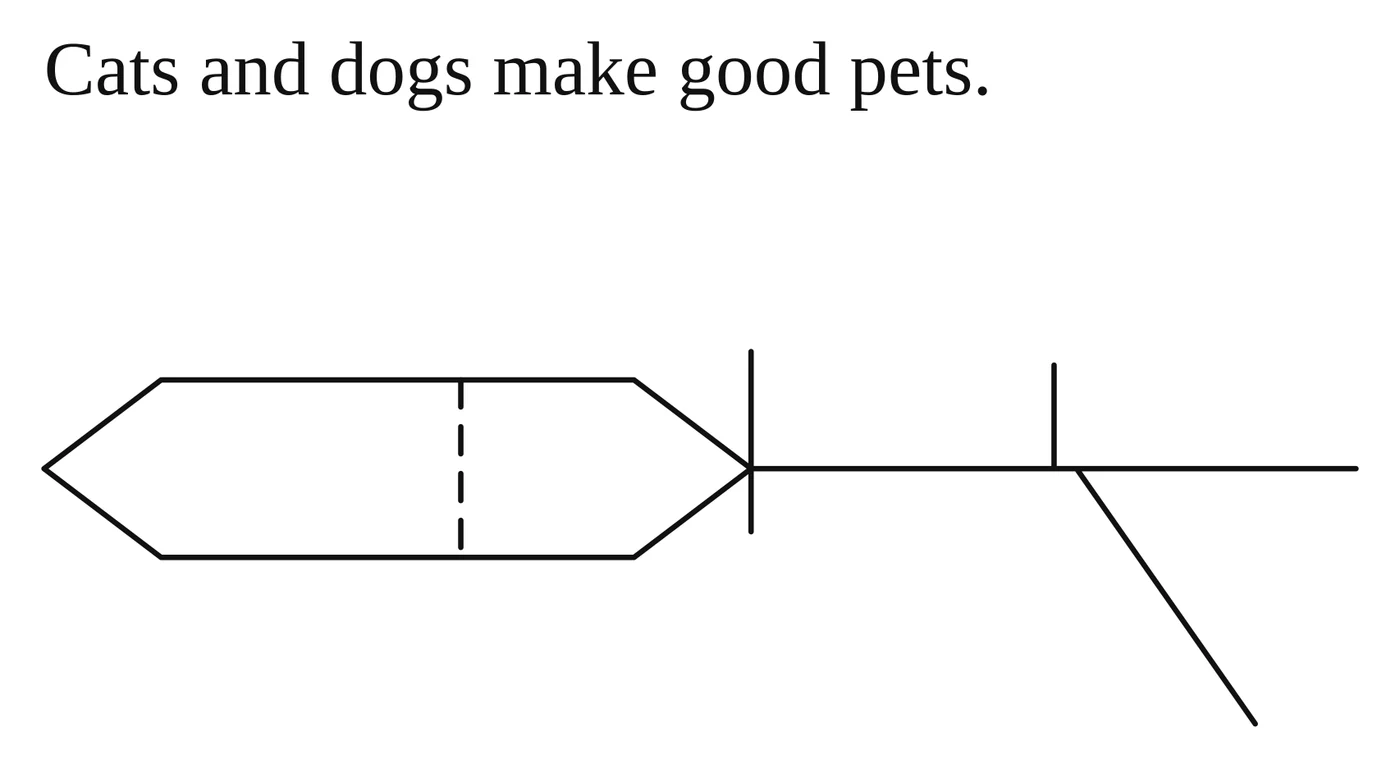
The lines are drawn for you. Copy the frame and fill in the words.
Show the answer
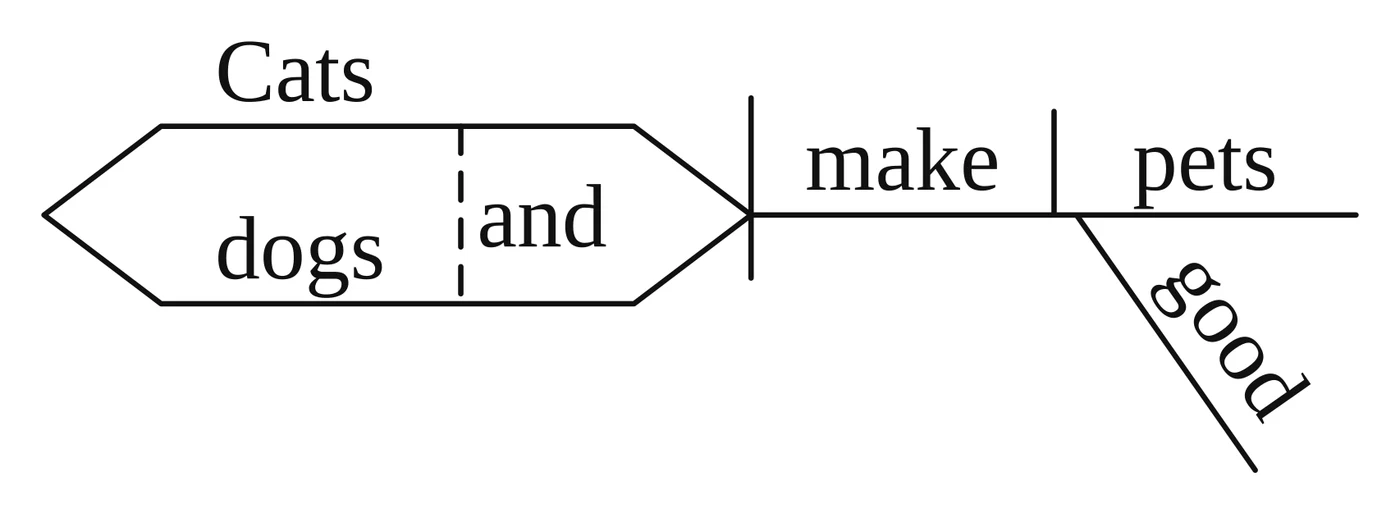
Cats and dogs are two subjects of one verb, so the subject part of the baseline splits into two lines that rejoin before make; and sits on the dashed line between them. Pets is the direct object and good hangs under it.
Did you get it right?Diagram this sentence in the generator → - 18.
The children laughed and sang.
Compound verb
Hint: show the empty frame
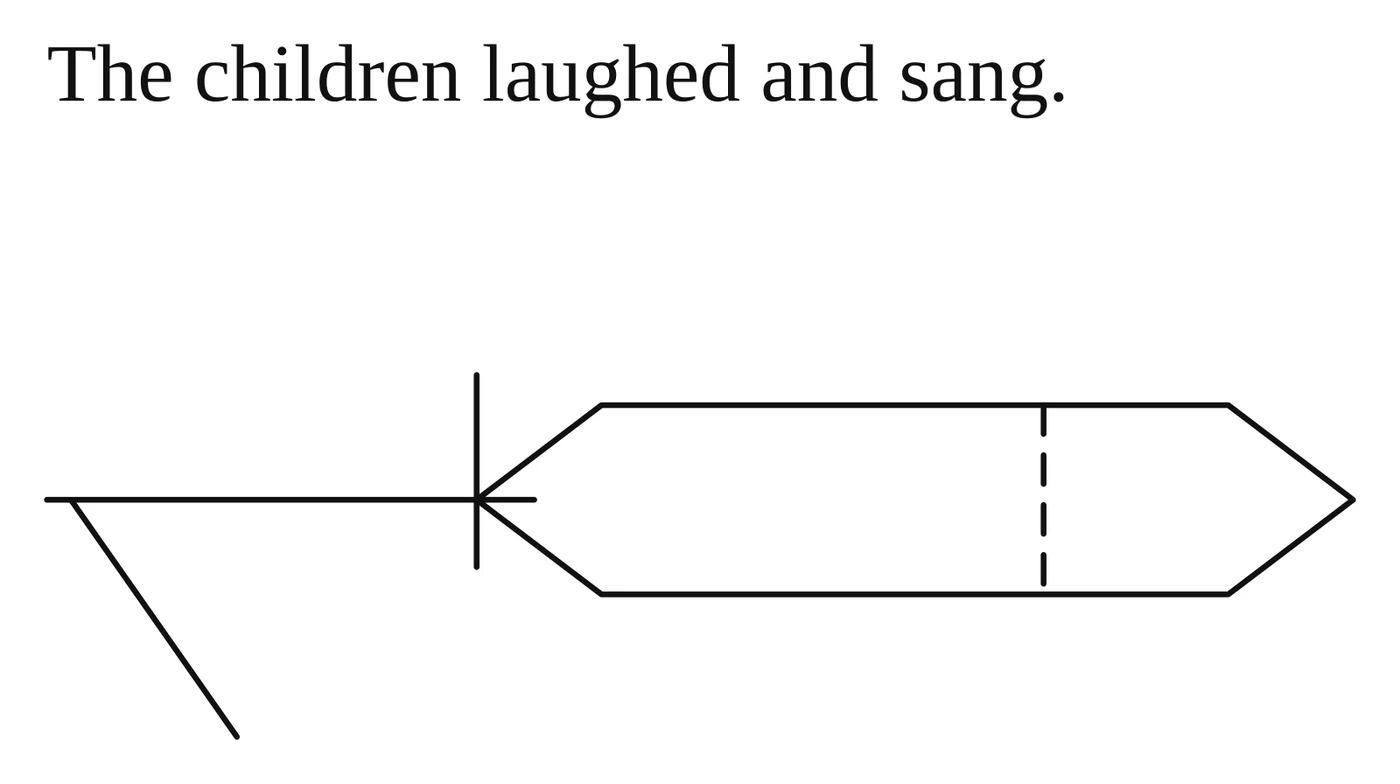
The lines are drawn for you. Copy the frame and fill in the words.
Show the answer
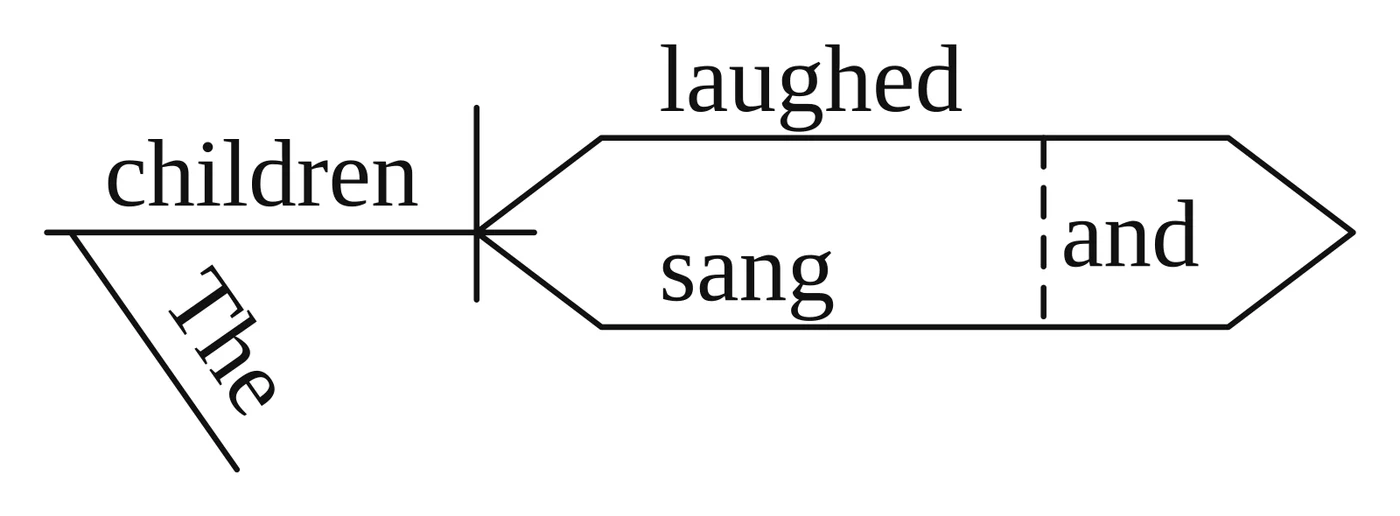
One subject, two verbs: laughed and sang. After the subject–verb line the verb part splits into two lines, one for each verb, with and on the dashed line between them. The still hangs under children.
Did you get it right?Diagram this sentence in the generator → - 19.
Mia likes tea, but her brother prefers coffee.
Compound sentence
Hint: show the empty frame
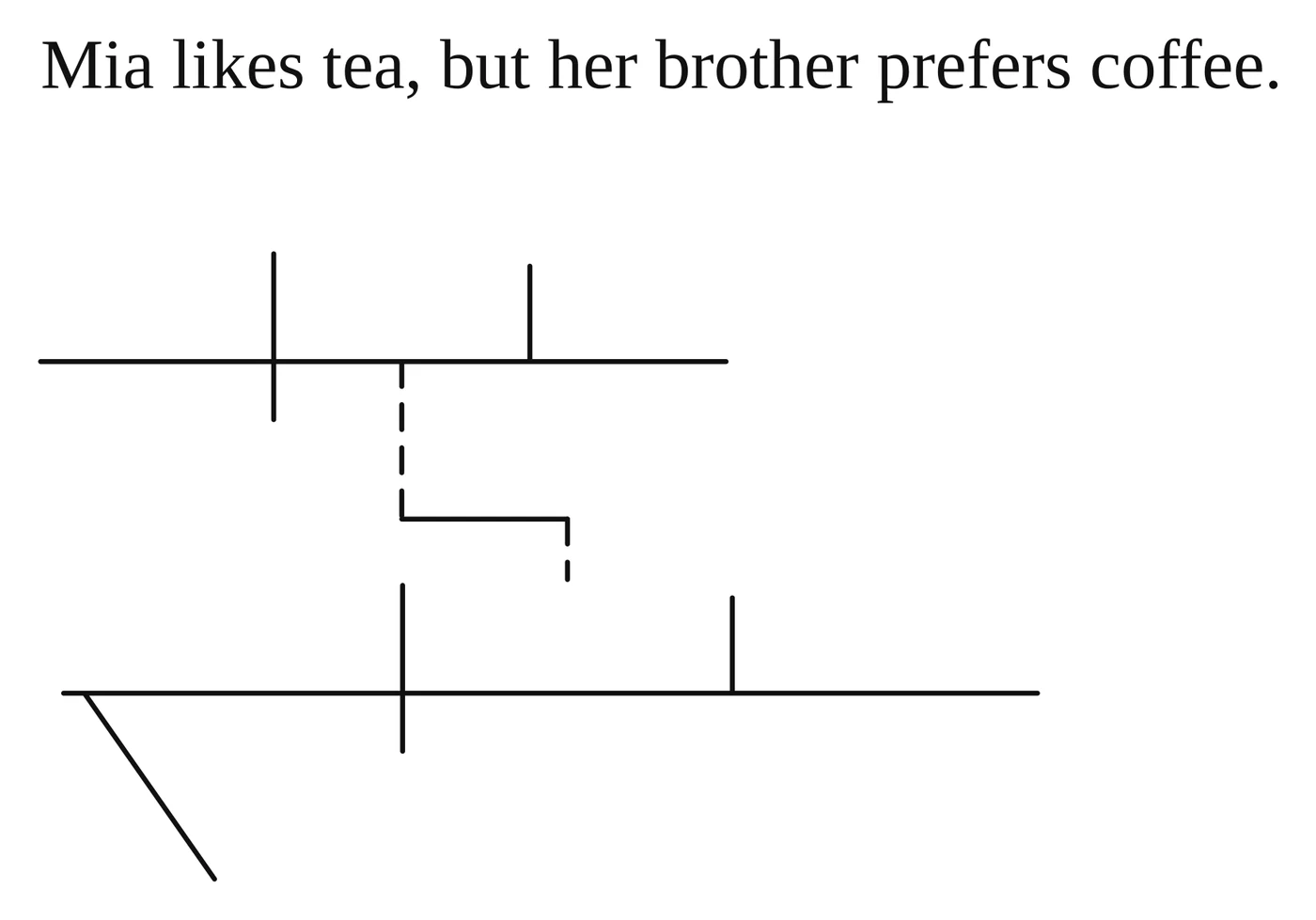
The lines are drawn for you. Copy the frame and fill in the words.
Show the answer
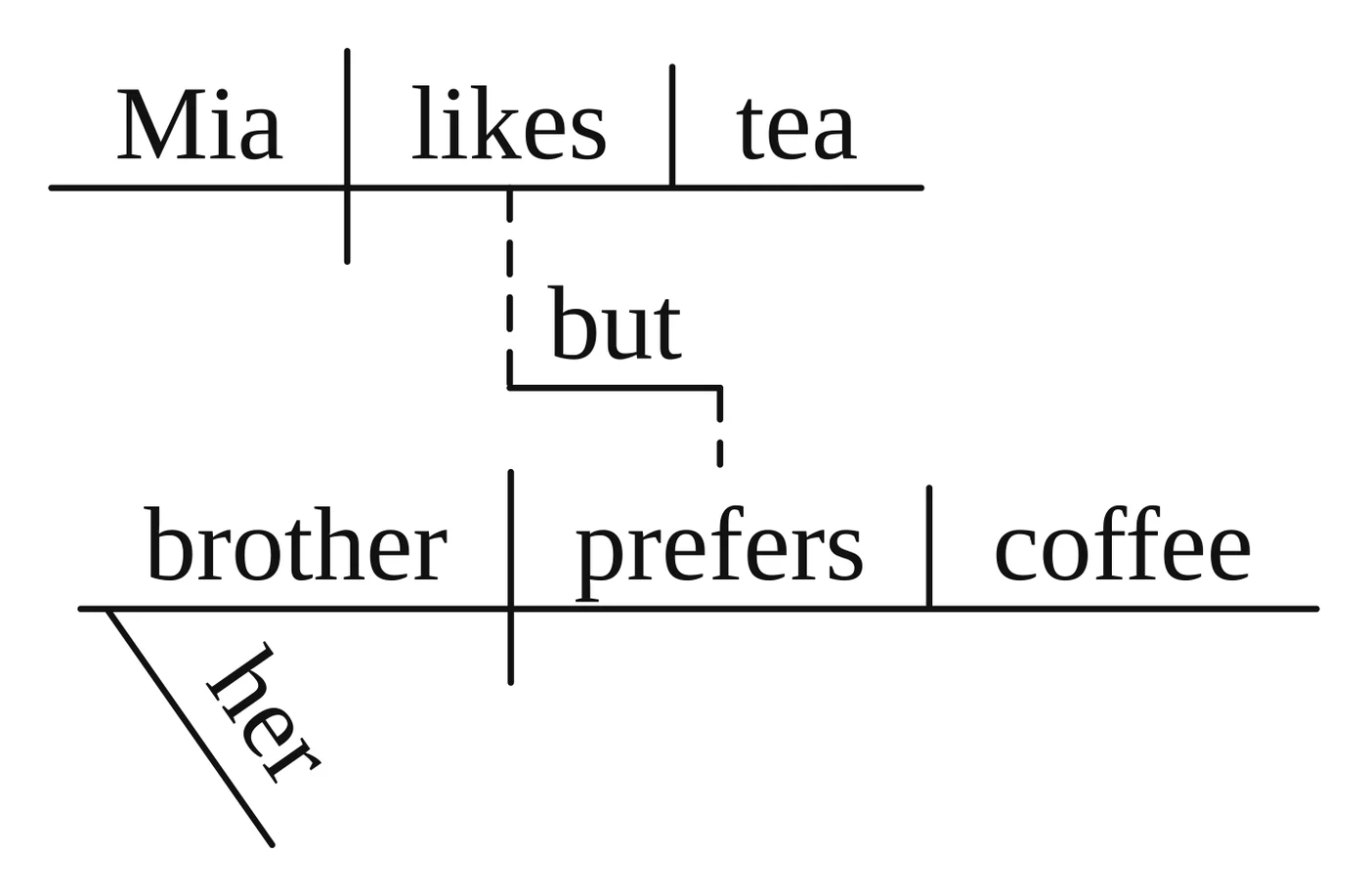
Two complete clauses, so two baselines, one under the other. A dashed line drops from the first verb (likes) to the second (prefers), with but written on the step between them.
Did you get it right?Diagram this sentence in the generator → - 20.
Dad washed and dried the dishes.
Compound verb with a shared object
Hint: show the empty frame
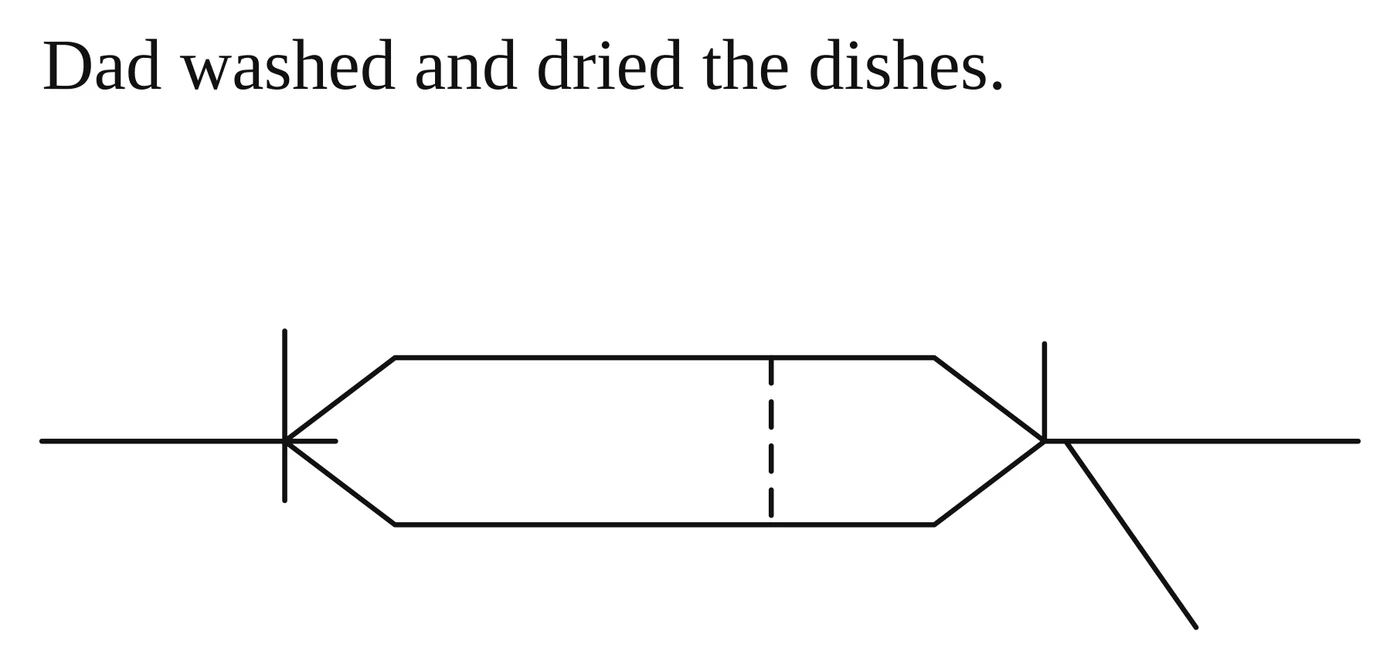
The lines are drawn for you. Copy the frame and fill in the words.
Show the answer
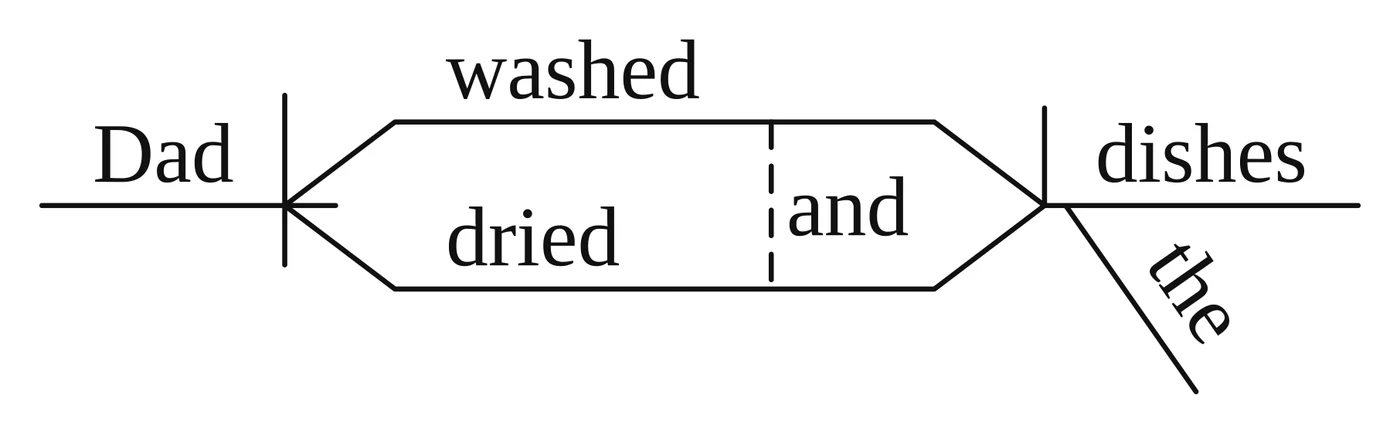
Washed and dried are a compound verb, and both act on the same thing, so the two verb lines rejoin before the direct object dishes; and sits on the dashed line. Test it: Dad washed the dishes and Dad dried the dishes.
Did you get it right?Diagram this sentence in the generator →
Set 6: Helping Verbs, Questions, Commands and Interjections
Helping verbs stay on the baseline with the main verb (have finished). For a question, put it back in statement order before you draw (you did feed the fish). A command has the understood subject (you) in parentheses. An interjection floats on its own line above the diagram.
Printable versions: helping verbs and questions (answer key) · interjections and commands (answer key).
- 21.
The students have finished their projects.
Helping verb
Hint: show the empty frame
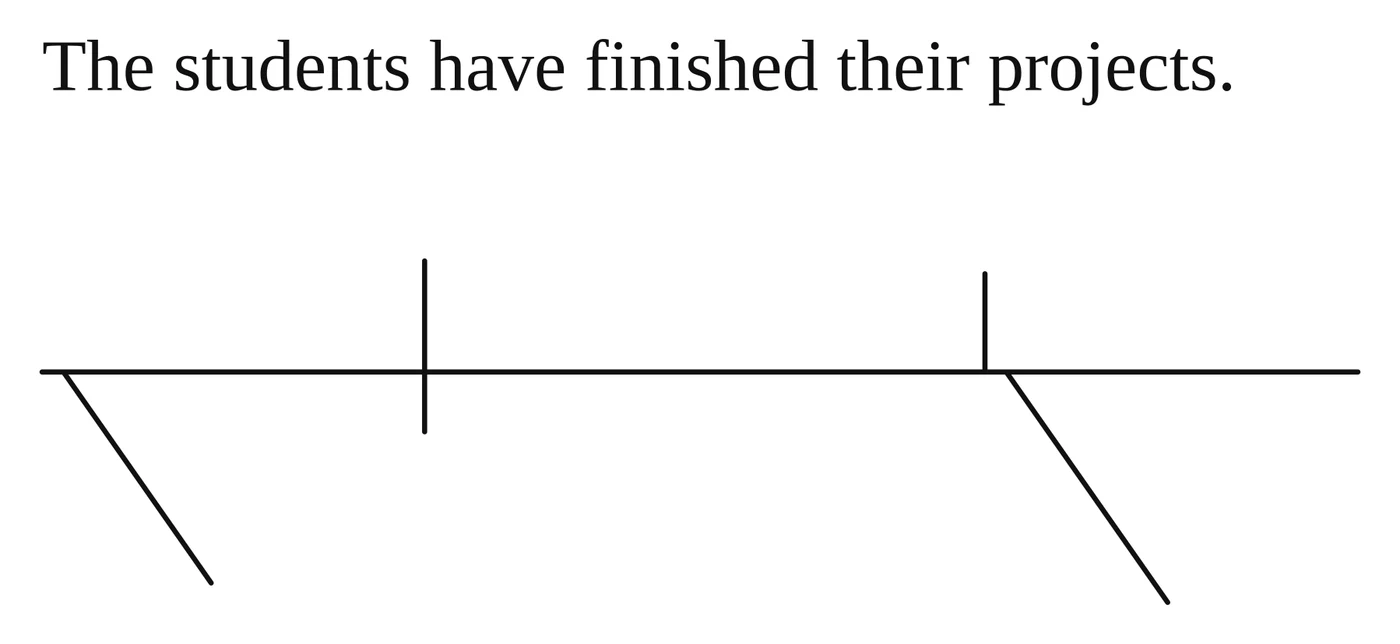
The lines are drawn for you. Copy the frame and fill in the words.
Show the answer
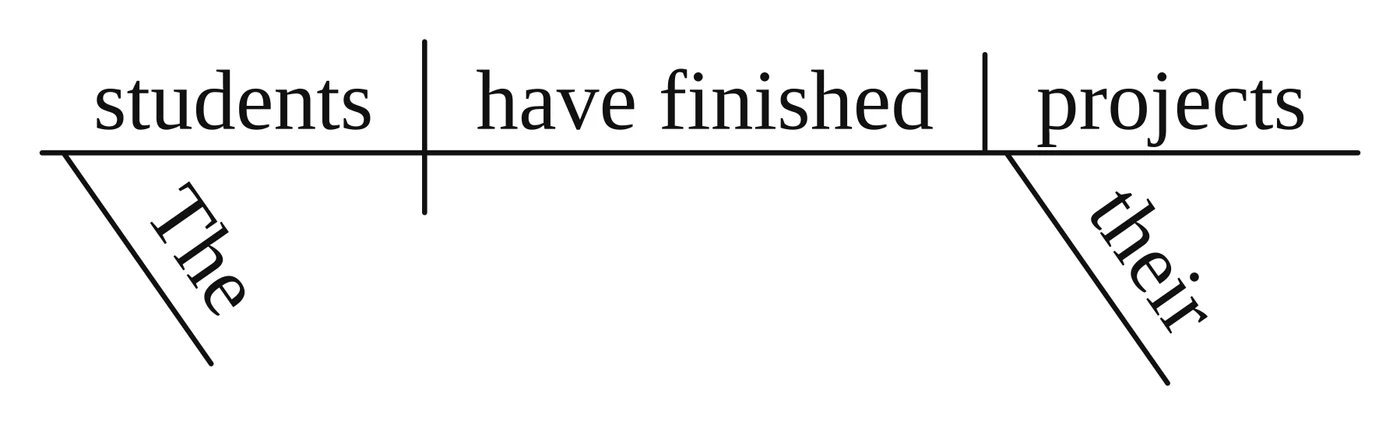
Have finished is one verb phrase, so both words stay together on the baseline after the subject–verb line. Projects is the direct object; their hangs under it.
Did you get it right?Diagram this sentence in the generator → - 22.
Did you feed the fish?
Question
Hint: show the empty frame
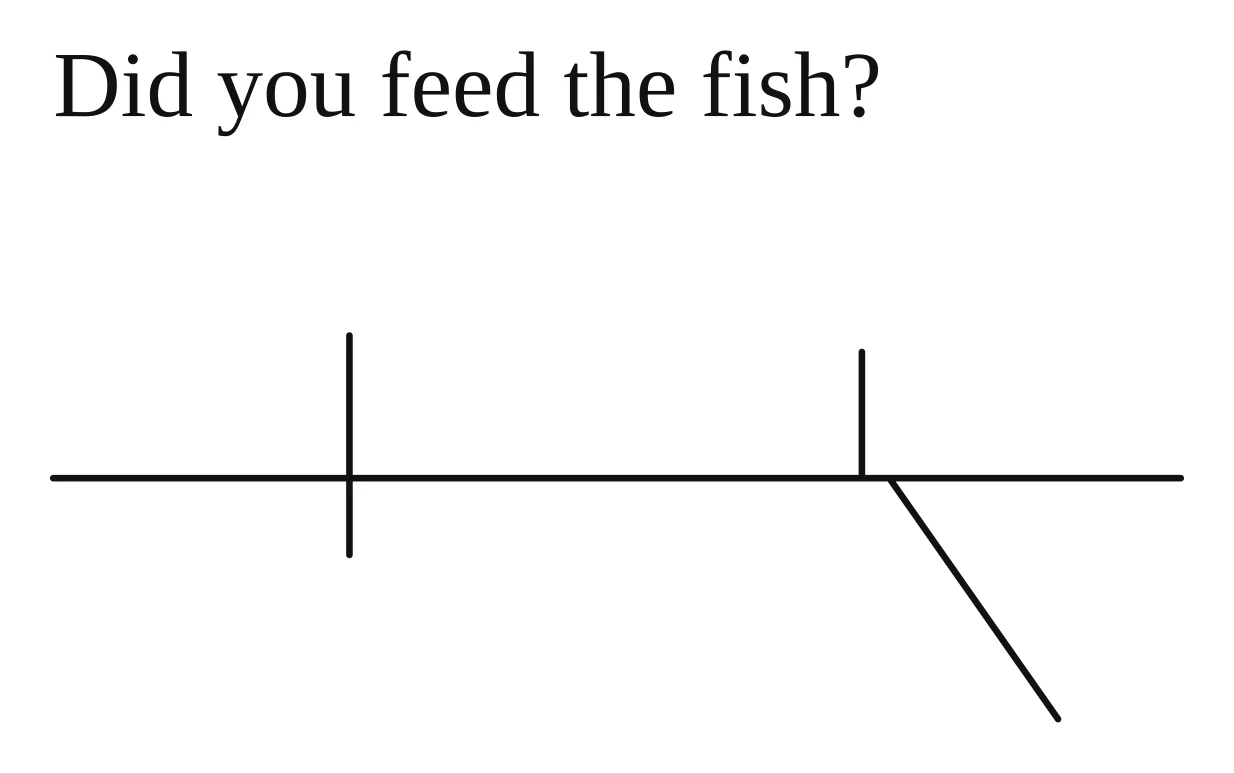
The lines are drawn for you. Copy the frame and fill in the words.
Show the answer
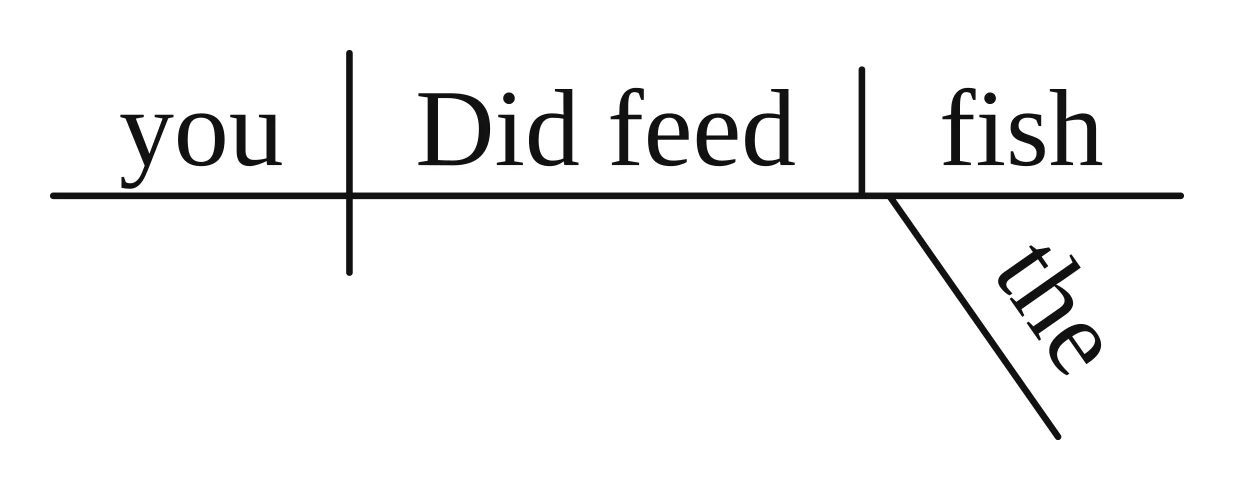
Turn it into a statement first: You did feed the fish. Now the subject is clearly you, did feed is the verb phrase, and fish is the direct object. The diagram keeps the capital D from the original question.
Did you get it right?Diagram this sentence in the generator → - 23.
Close the door.
Command with an understood subject
Hint: show the empty frame
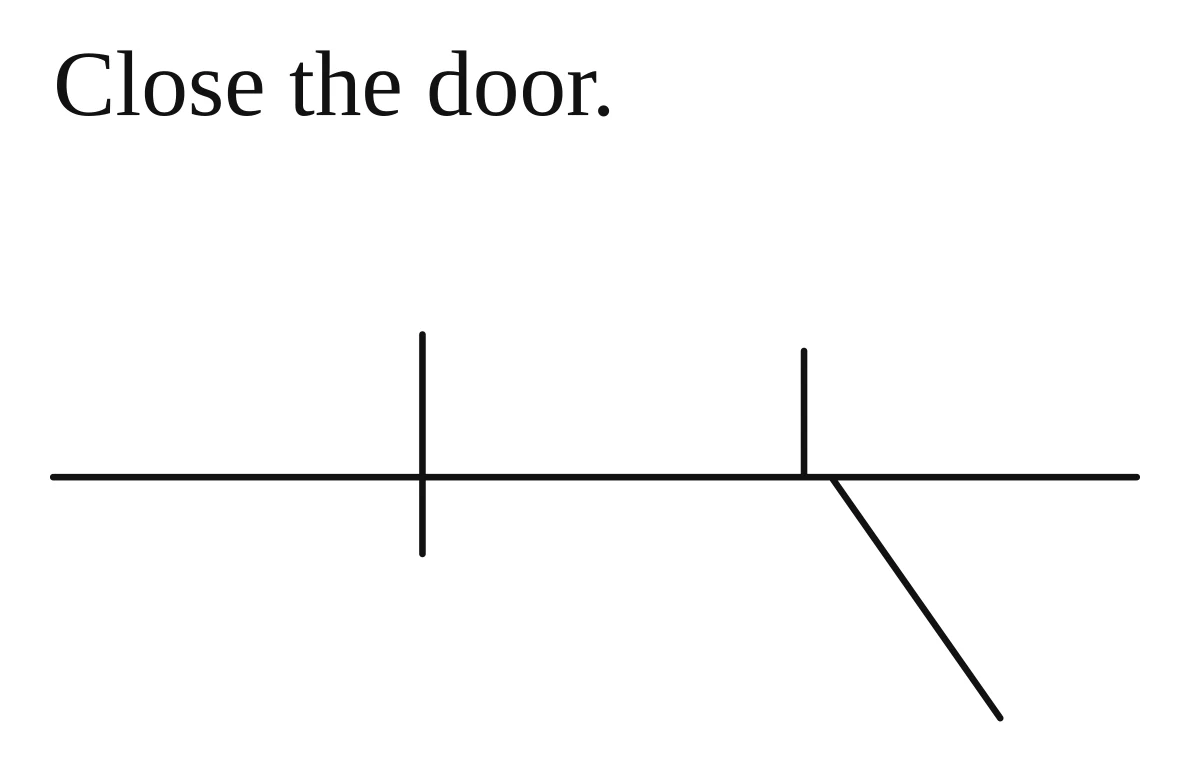
The lines are drawn for you. Copy the frame and fill in the words.
Show the answer
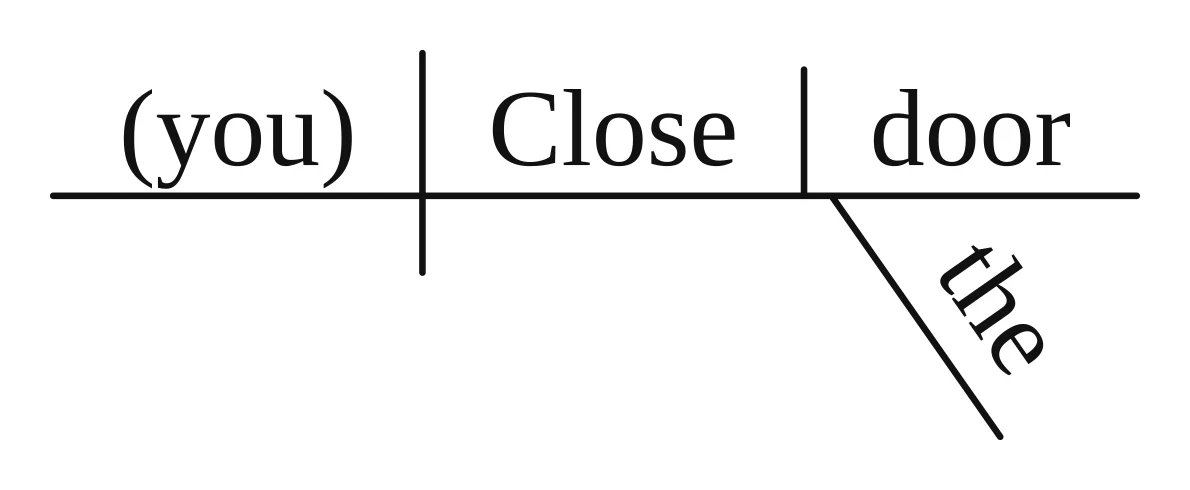
Every command is spoken to someone, so the subject is (you), written in parentheses because it is not in the sentence. Close is the verb and door the direct object.
Did you get it right?Diagram this sentence in the generator → - 24.
Wow, that was a great game!
Interjection
Hint: show the empty frame
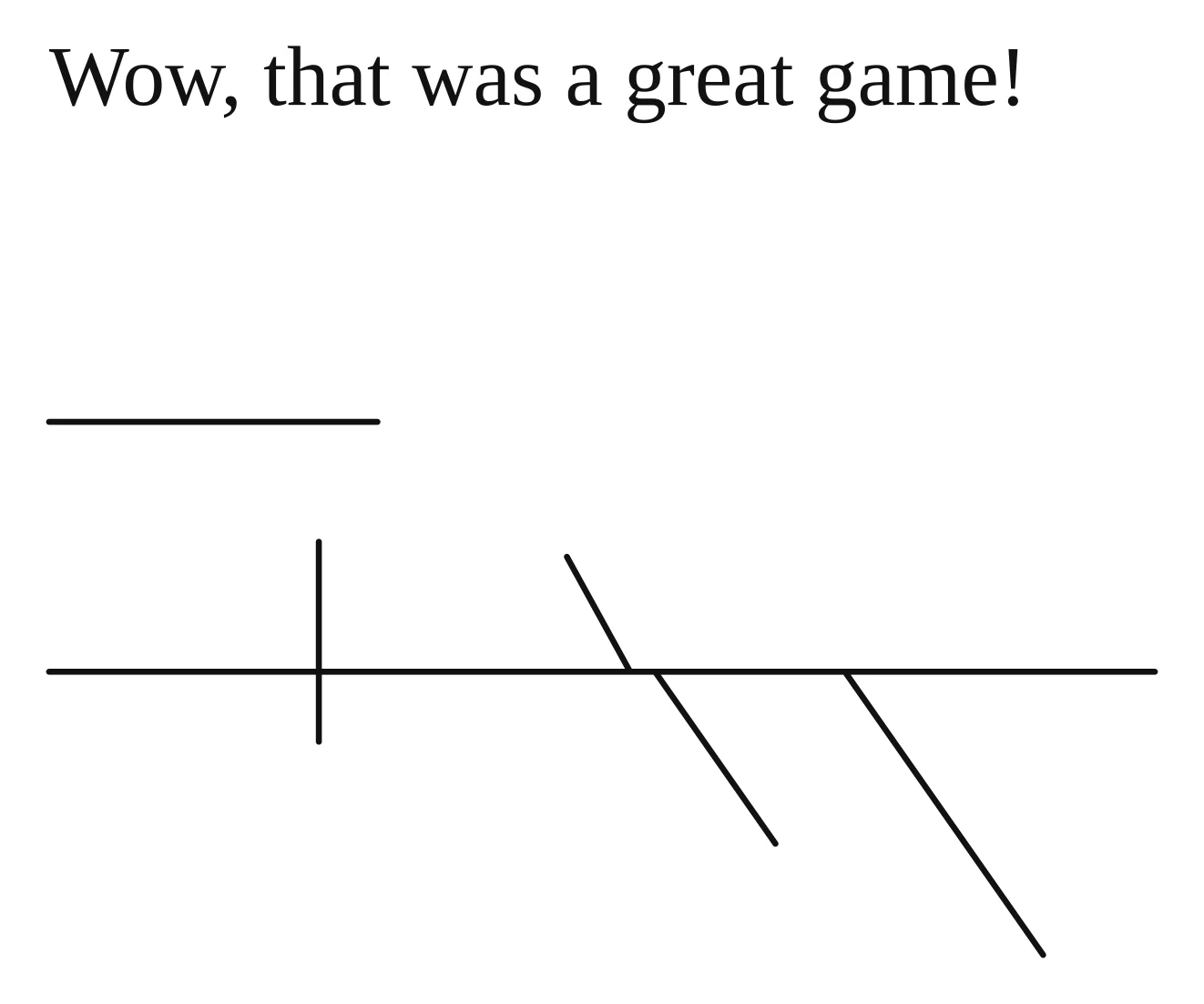
The lines are drawn for you. Copy the frame and fill in the words.
Show the answer
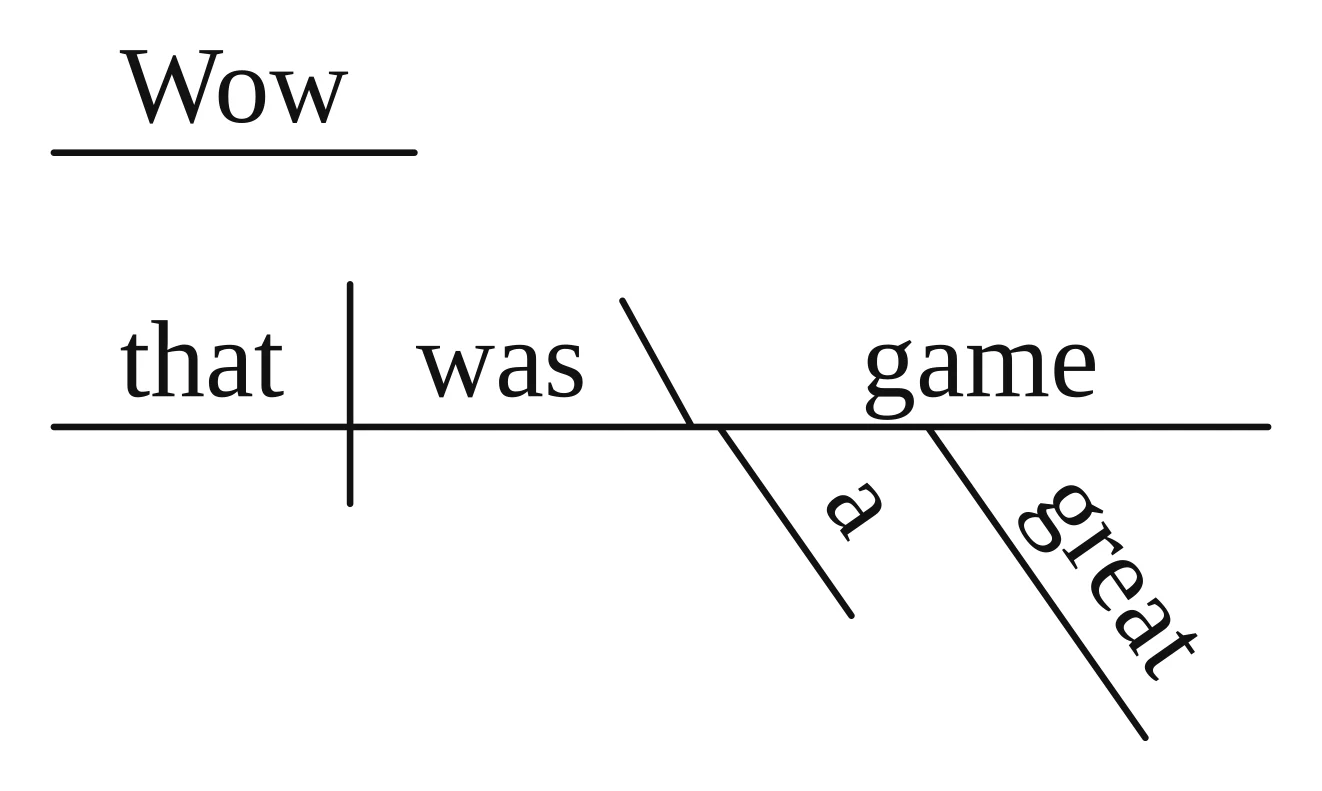
Wow has no grammatical link to the rest of the sentence, so it sits on its own line above it. The rest is a linking-verb sentence: that is the subject, game is a predicate noun, and a and great hang under game.
Did you get it right?Diagram this sentence in the generator →
Set 7: Gerunds, Infinitives and Participles
Verbals are verb forms doing another job. A gerund (-ing noun) or an infinitive used as a noun stands on a pedestal above the spot a noun would take. A participial phrase (-ing or -ed adjective) sits on the bent participle line under the noun it describes. The full set of shapes is in how to diagram verbals.
Printable version: worksheet · answer key.
- 25.
Swimming is good exercise.
Gerund as subject
Hint: show the empty frame
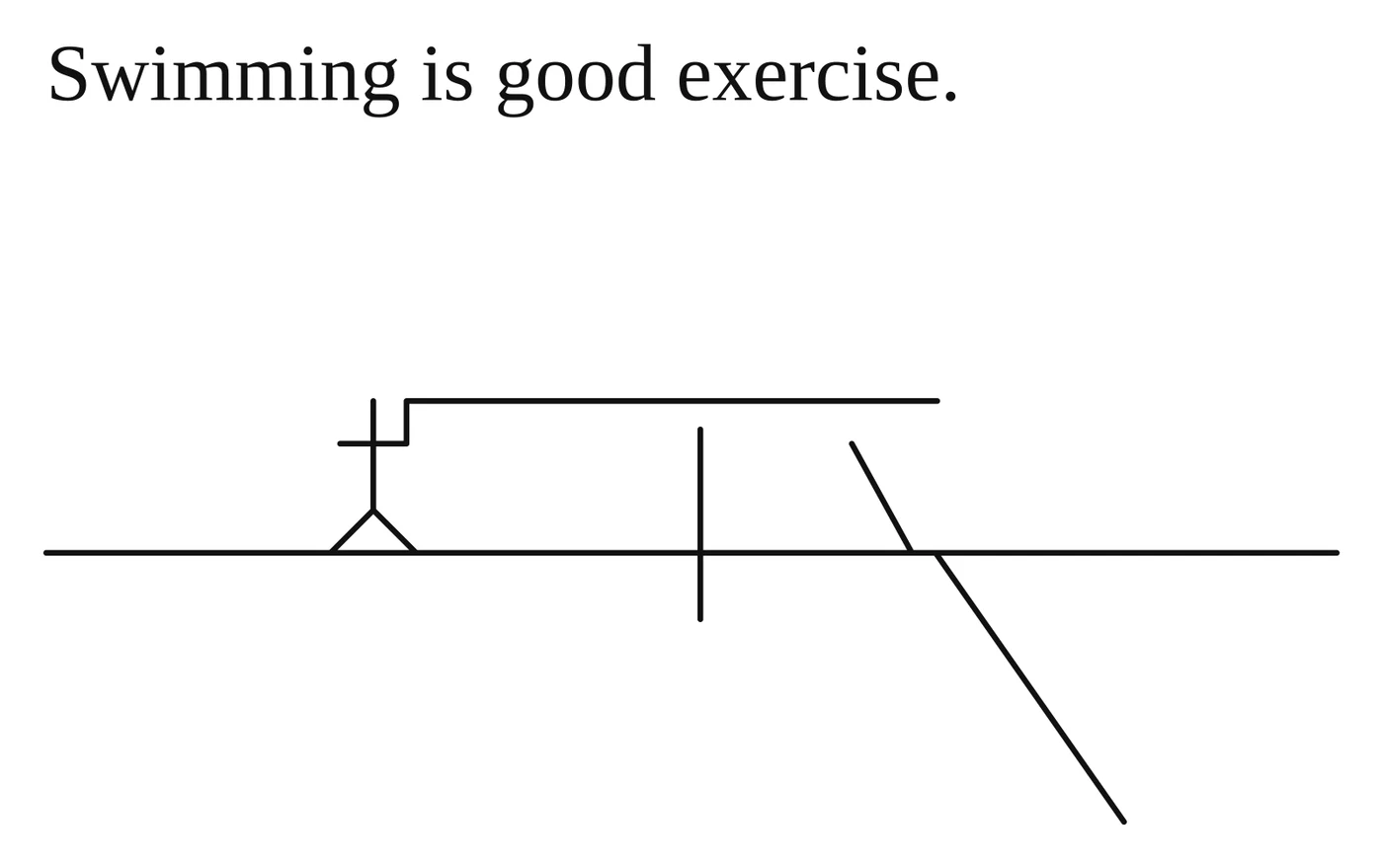
The lines are drawn for you. Copy the frame and fill in the words.
Show the answer
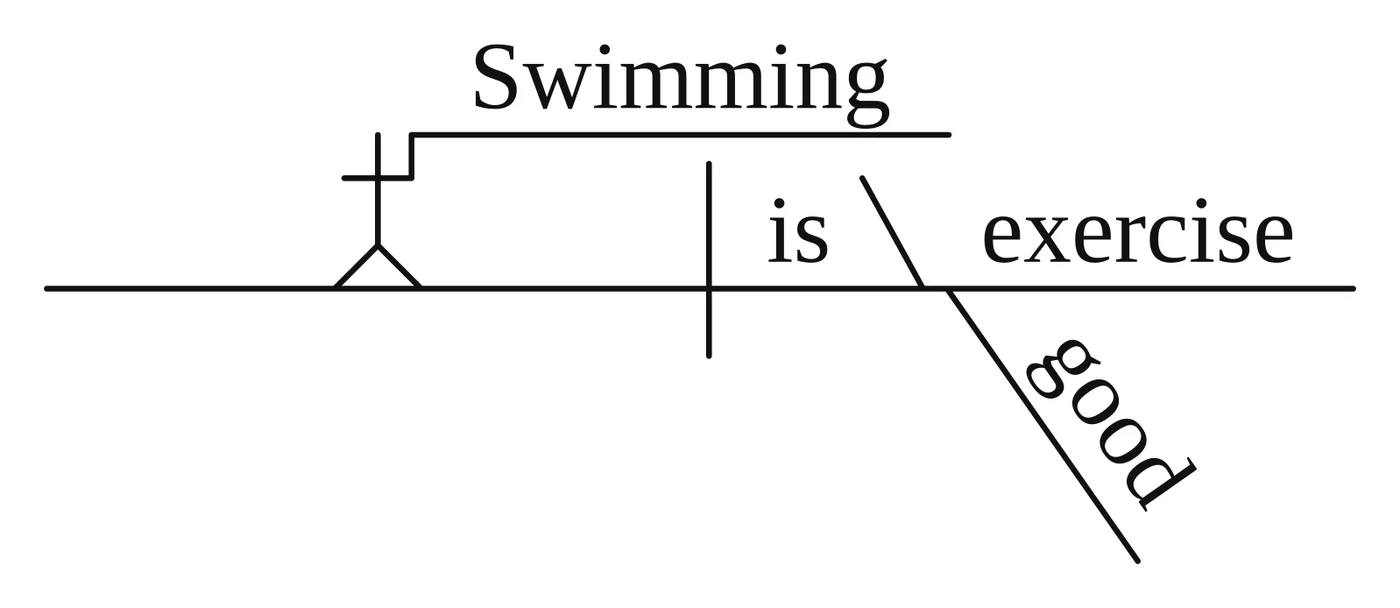
Swimming is a verb form used as a noun (a gerund) and it is the subject, so it stands on a stepped line raised on a pedestal over the subject's spot. Is links it to the predicate noun exercise.
Did you get it right?Diagram this sentence in the generator → - 26.
We wanted to see the stars.
Infinitive as direct object
Hint: show the empty frame
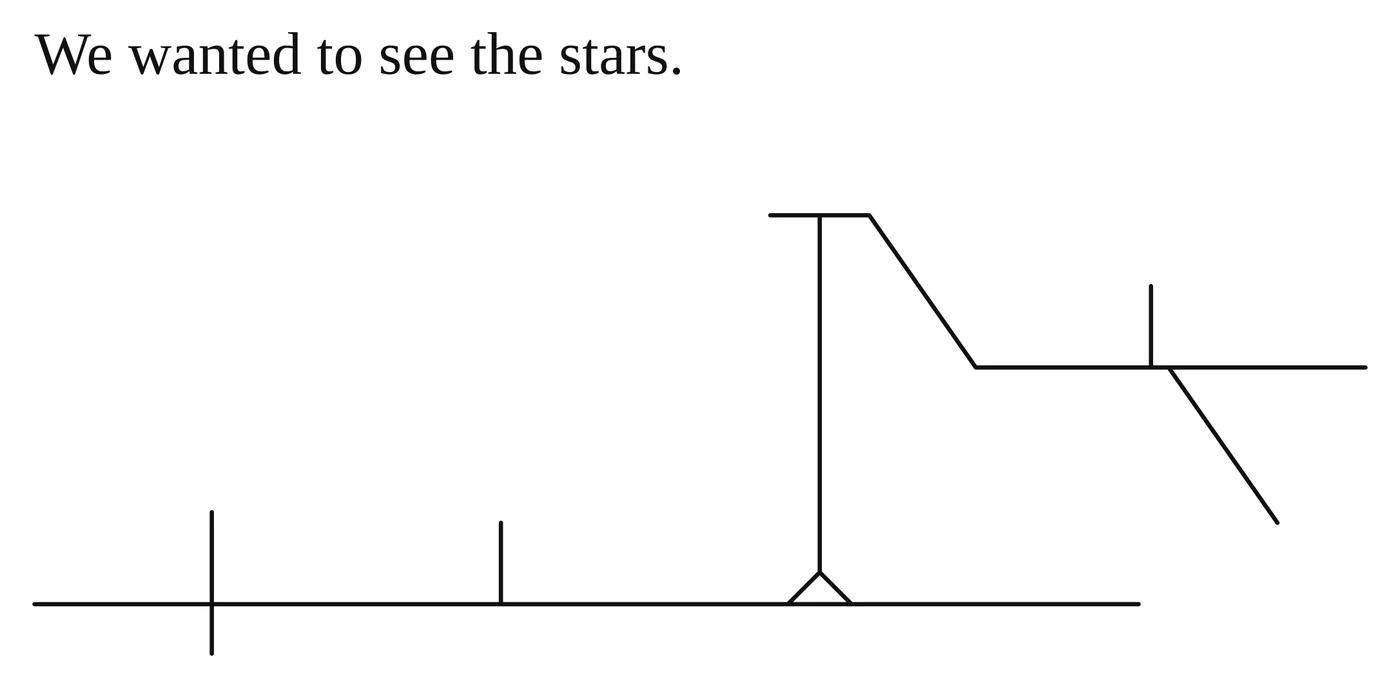
The lines are drawn for you. Copy the frame and fill in the words.
Show the answer
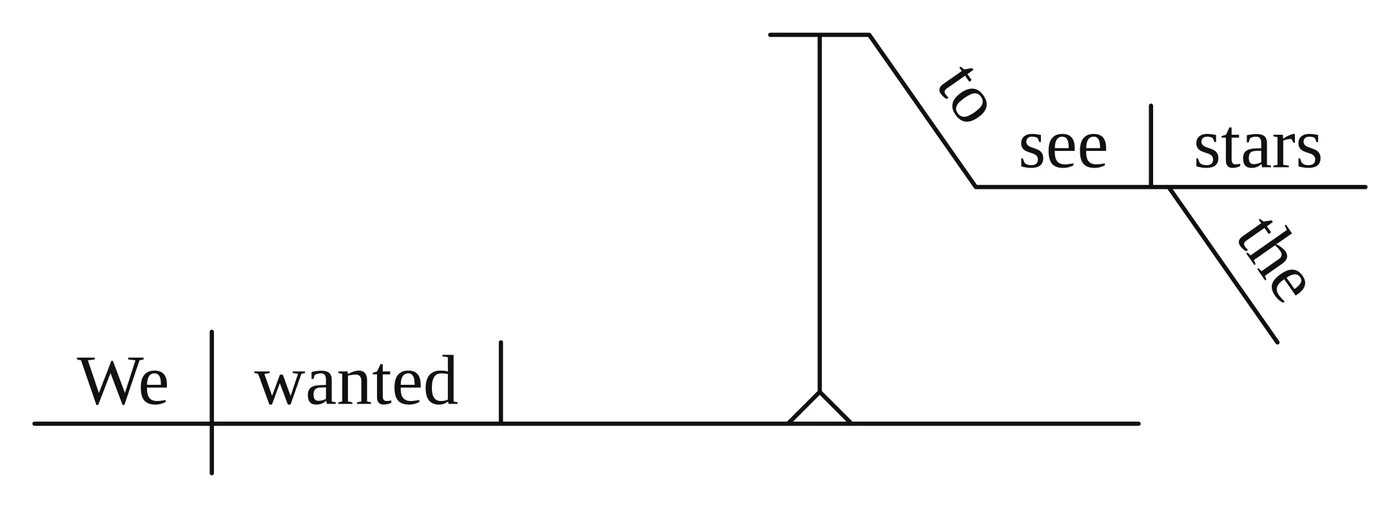
Wanted what? To see the stars, an infinitive phrase used as the direct object, so it goes on a pedestal in the object's spot: to on the slant, see on the flat line, then its own object stars.
Did you get it right?Diagram this sentence in the generator → - 27.
The barking dog woke the baby.
Participle as an adjective
Hint: show the empty frame
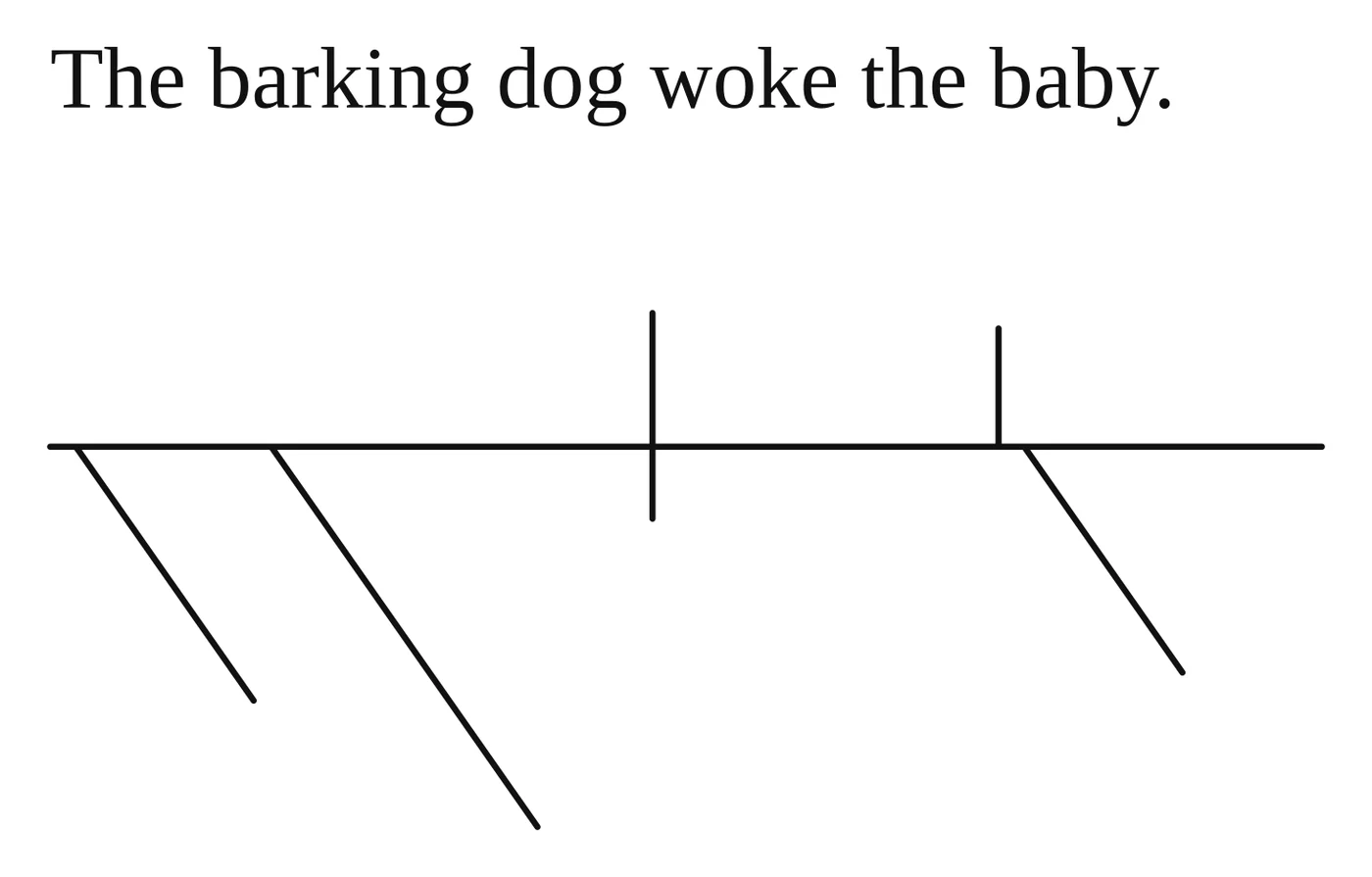
The lines are drawn for you. Copy the frame and fill in the words.
Show the answer
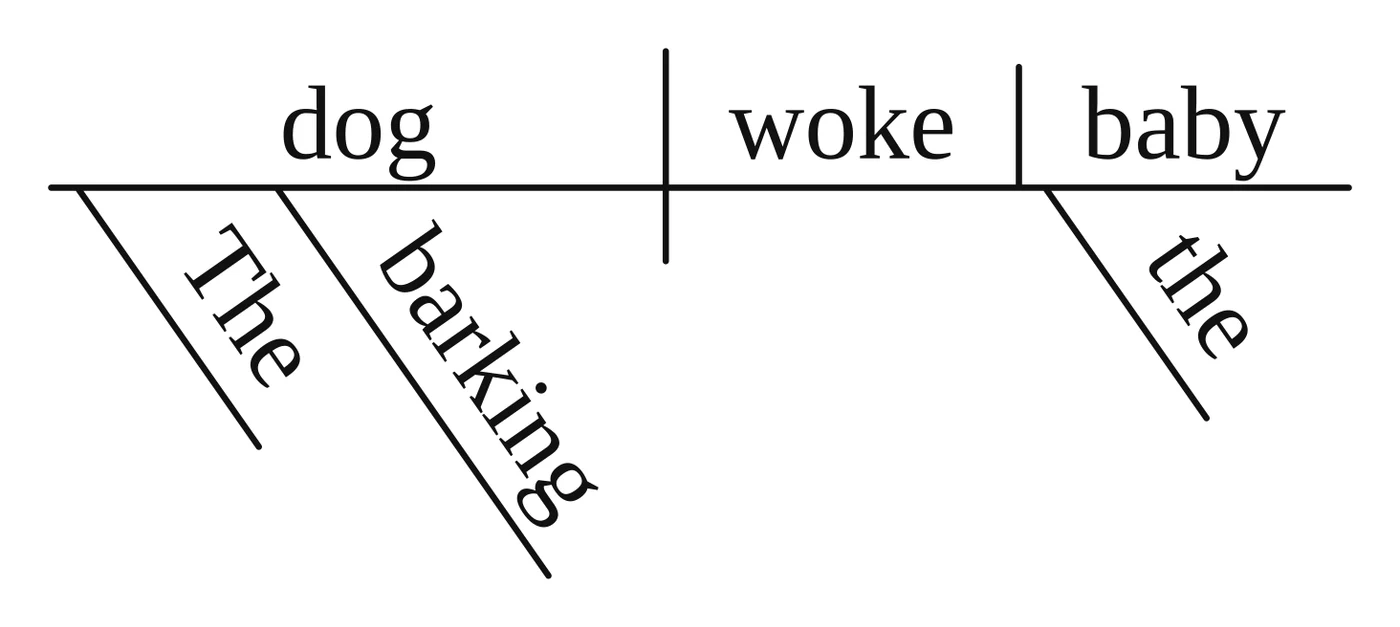
Barking describes which dog, so it works as an adjective. Our generator draws a one-word participle like this on a plain slant, the same as any adjective; many textbooks, Glencoe's among them, put even a one-word participle on the bent participle line, so follow your book. Baby is the direct object of woke.
Did you get it right?Diagram this sentence in the generator → - 28.
Kim enjoys reading mysteries.
Gerund phrase as direct object
Hint: show the empty frame
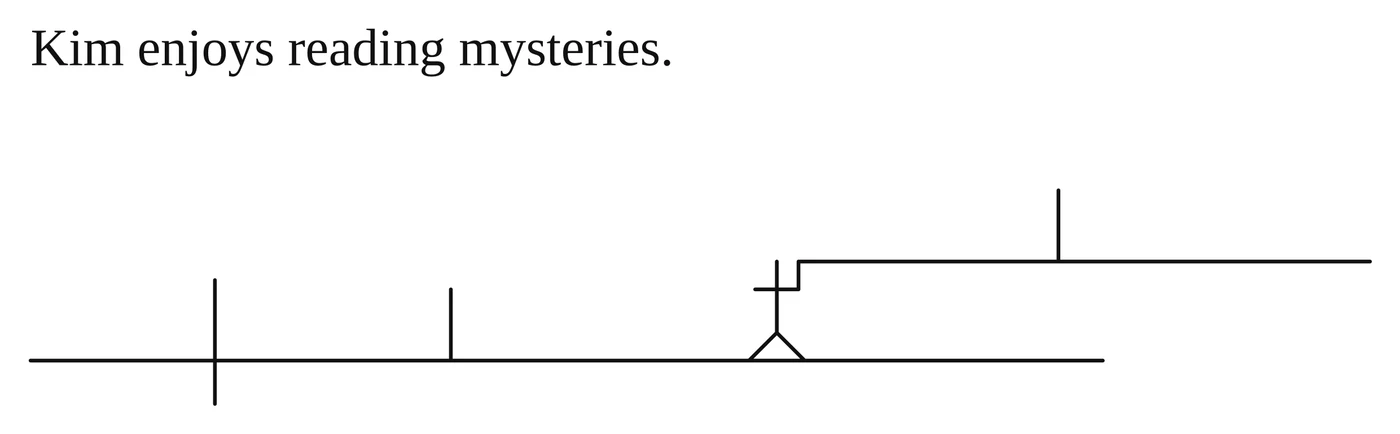
The lines are drawn for you. Copy the frame and fill in the words.
Show the answer

Enjoys what? Reading mysteries. Reading is a gerund with its own object (mysteries), so the whole phrase rides on a pedestal in the direct-object spot.
Did you get it right?Diagram this sentence in the generator →
Set 8: Appositives and Nouns of Direct Address
An appositive renames the noun right before it and goes in parentheses after that noun on the same line. A noun of direct address (the person being spoken to) is not part of the sentence's structure: it sits on its own line above the subject, like an interjection. Details: how to diagram appositives.
- 29.
Our teacher, Mr. Green, loves science.
Appositive after the subject
Hint: show the empty frame
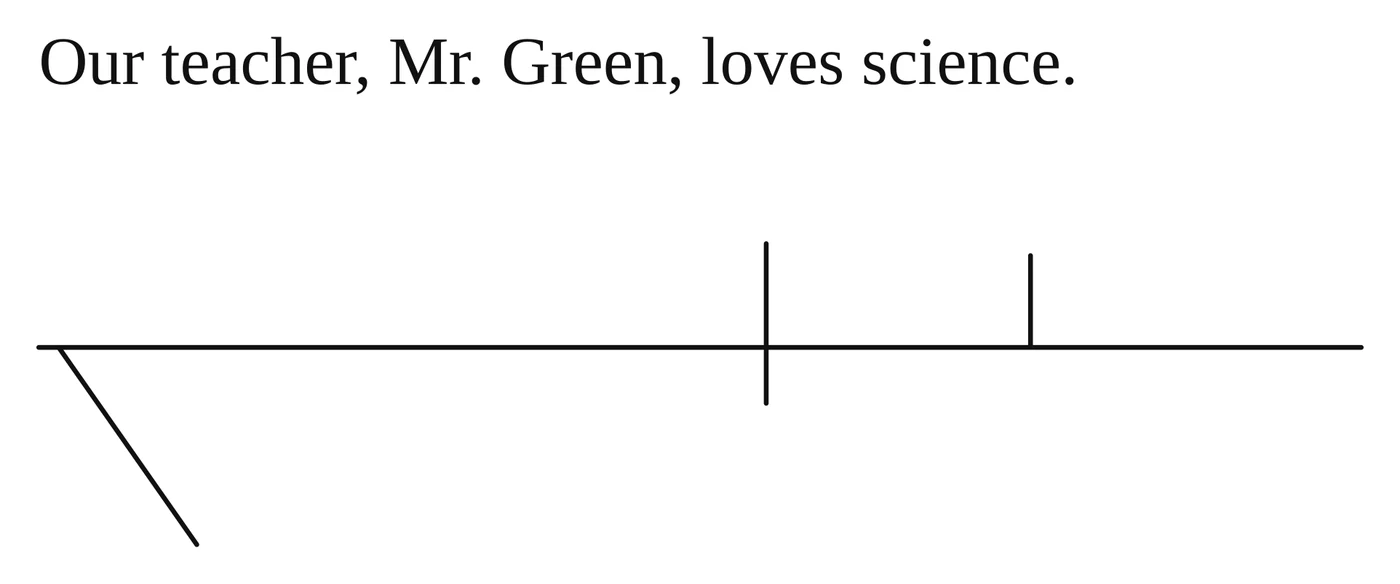
The lines are drawn for you. Copy the frame and fill in the words.
Show the answer
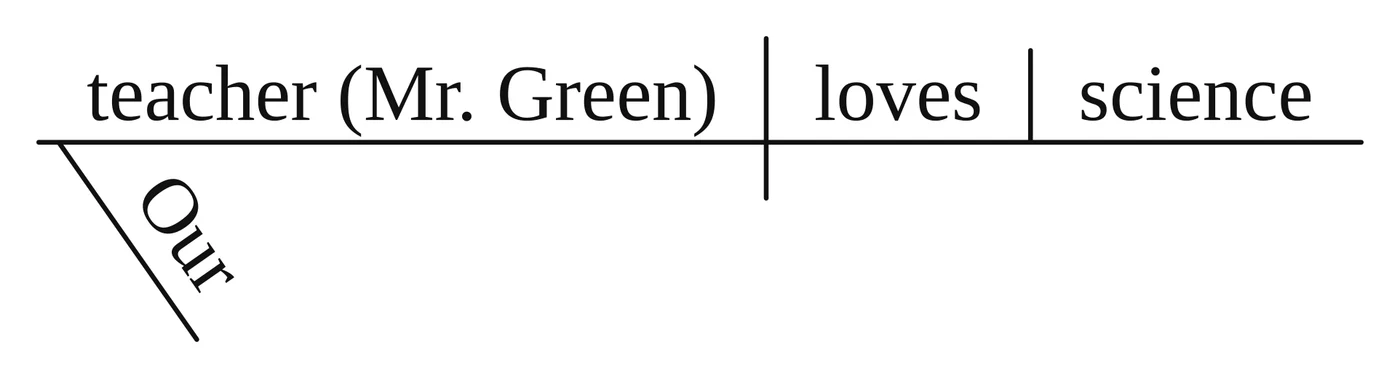
Mr. Green renames teacher, so it goes in parentheses right after teacher on the baseline. Our still hangs under teacher, and science is the direct object.
Did you get it right?Diagram this sentence in the generator → - 30.
Ben, please clean your room.
Noun of direct address
Hint: show the empty frame
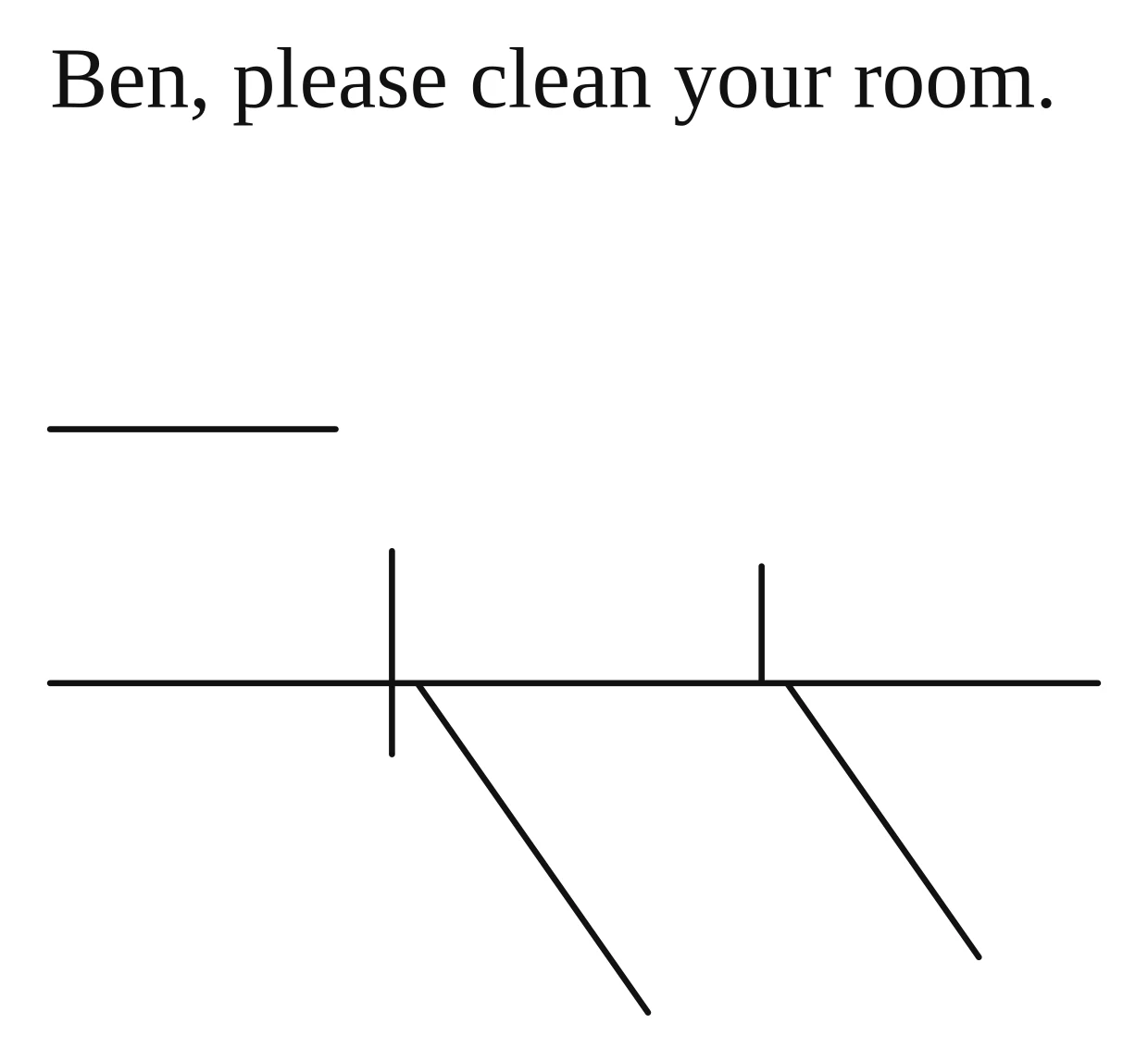
The lines are drawn for you. Copy the frame and fill in the words.
Show the answer
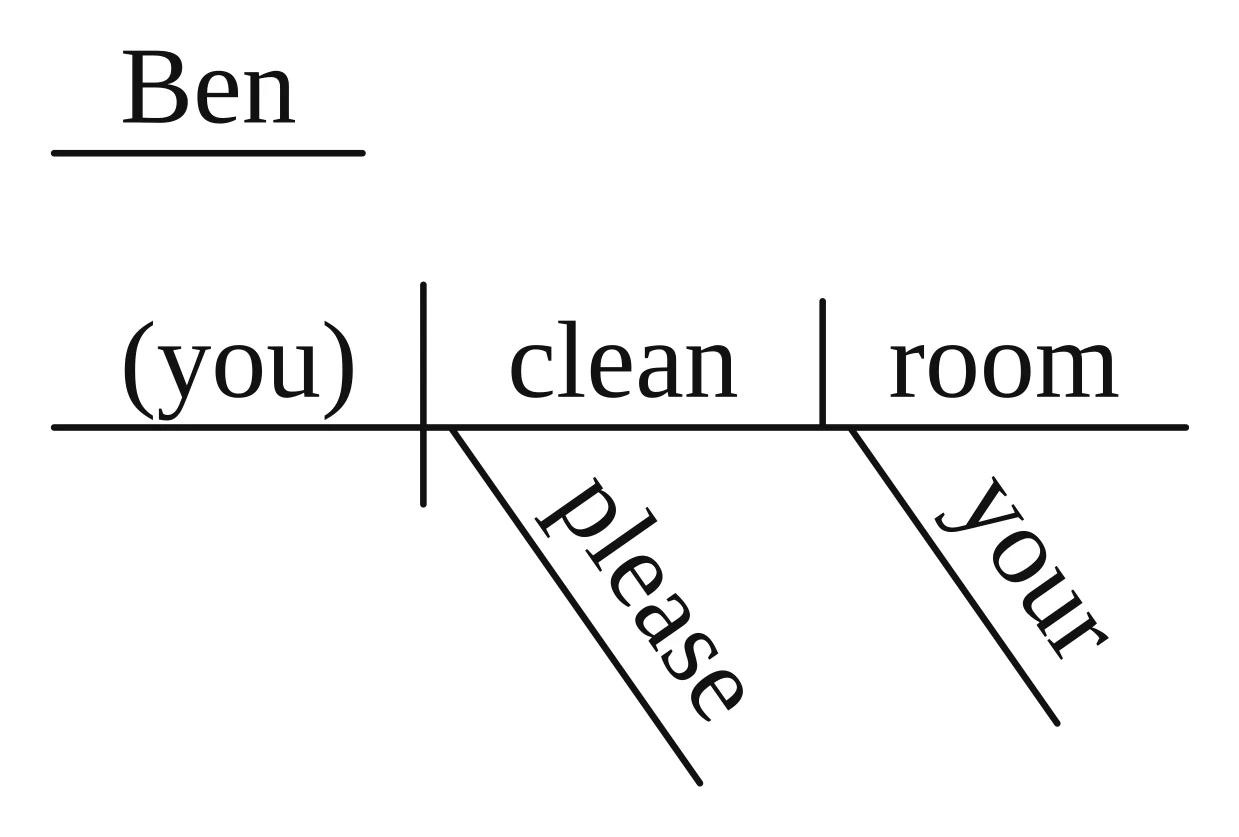
Ben is the person being spoken to (a noun of direct address), not the subject, so it sits on its own line above the diagram. The subject is the understood (you); please is an adverb under clean, and room is the direct object.
Did you get it right?Diagram this sentence in the generator → - 31.
I met Nina, my new neighbor.
Appositive phrase after the object
Hint: show the empty frame
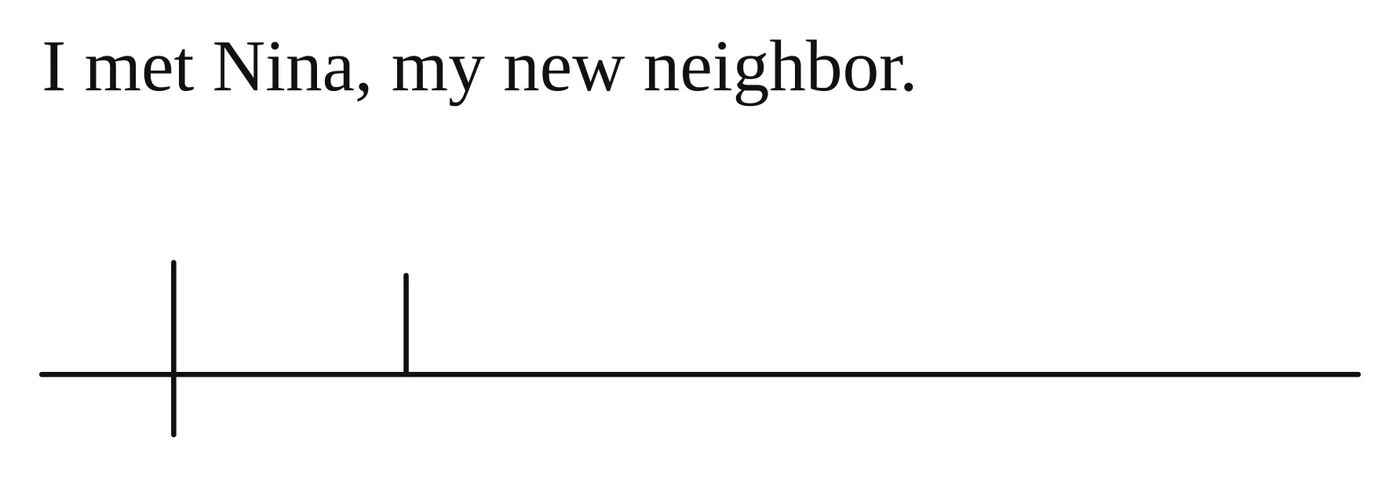
The lines are drawn for you. Copy the frame and fill in the words.
Show the answer

My new neighbor renames Nina, the direct object, so it goes in parentheses after Nina. The generator writes the whole phrase inside the parentheses; many textbooks instead write only neighbor there and hang my and new under it. Both show the same structure.
Did you get it right?Diagram this sentence in the generator →
Set 9: Adjective, Adverb and Noun Clauses
A dependent clause gets its own baseline. An adjective clause (who, which, that) sits below the main clause and a dashed line joins the relative pronoun to the noun it describes. An adverb clause is joined to the verb it modifies by a dashed line carrying the subordinating conjunction. A noun clause stands on a pedestal in the spot of a subject or object.
Printable version: worksheet · answer key.
- 32.
The girl who won the race is my cousin.
Adjective clause (who)
Hint: show the empty frame
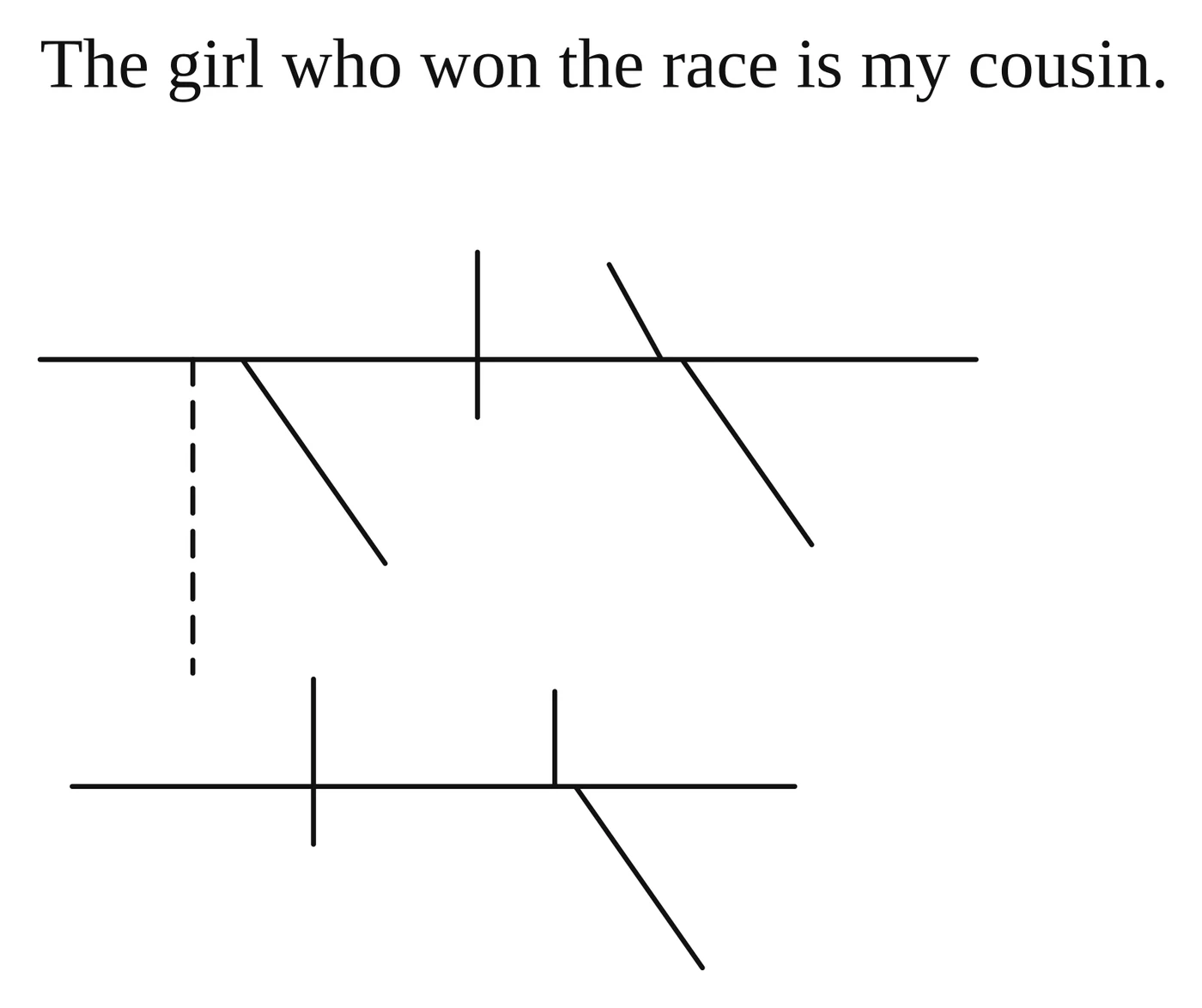
The lines are drawn for you. Copy the frame and fill in the words.
Show the answer
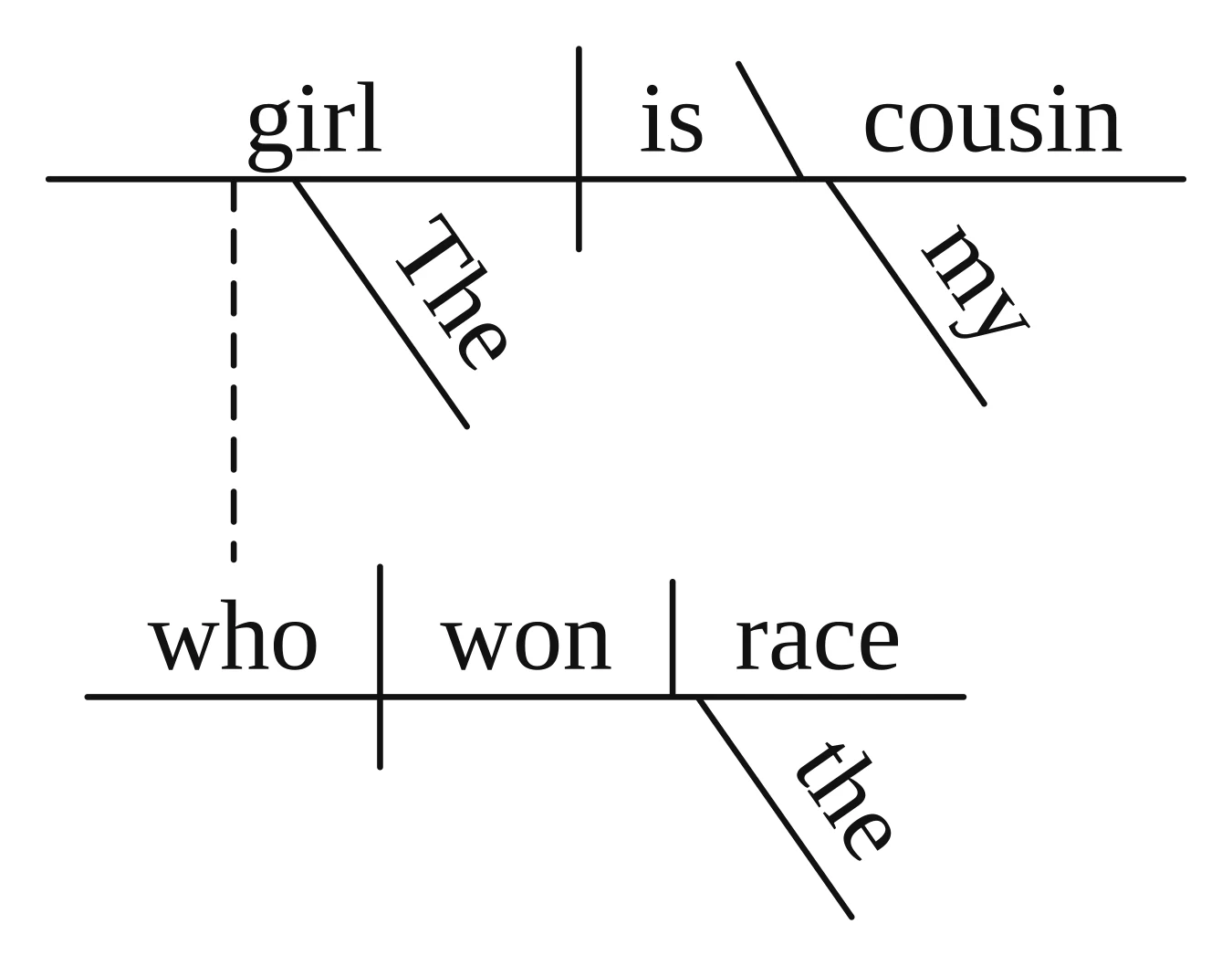
Who won the race tells which girl, so it is an adjective clause on its own baseline below. Who is that clause's subject, and a dashed line joins it to girl. The main clause is girl is cousin, with cousin a predicate noun.
Did you get it right?Diagram this sentence in the generator → - 33.
When the bell rang, the students left.
Adverb clause (when)
Hint: show the empty frame
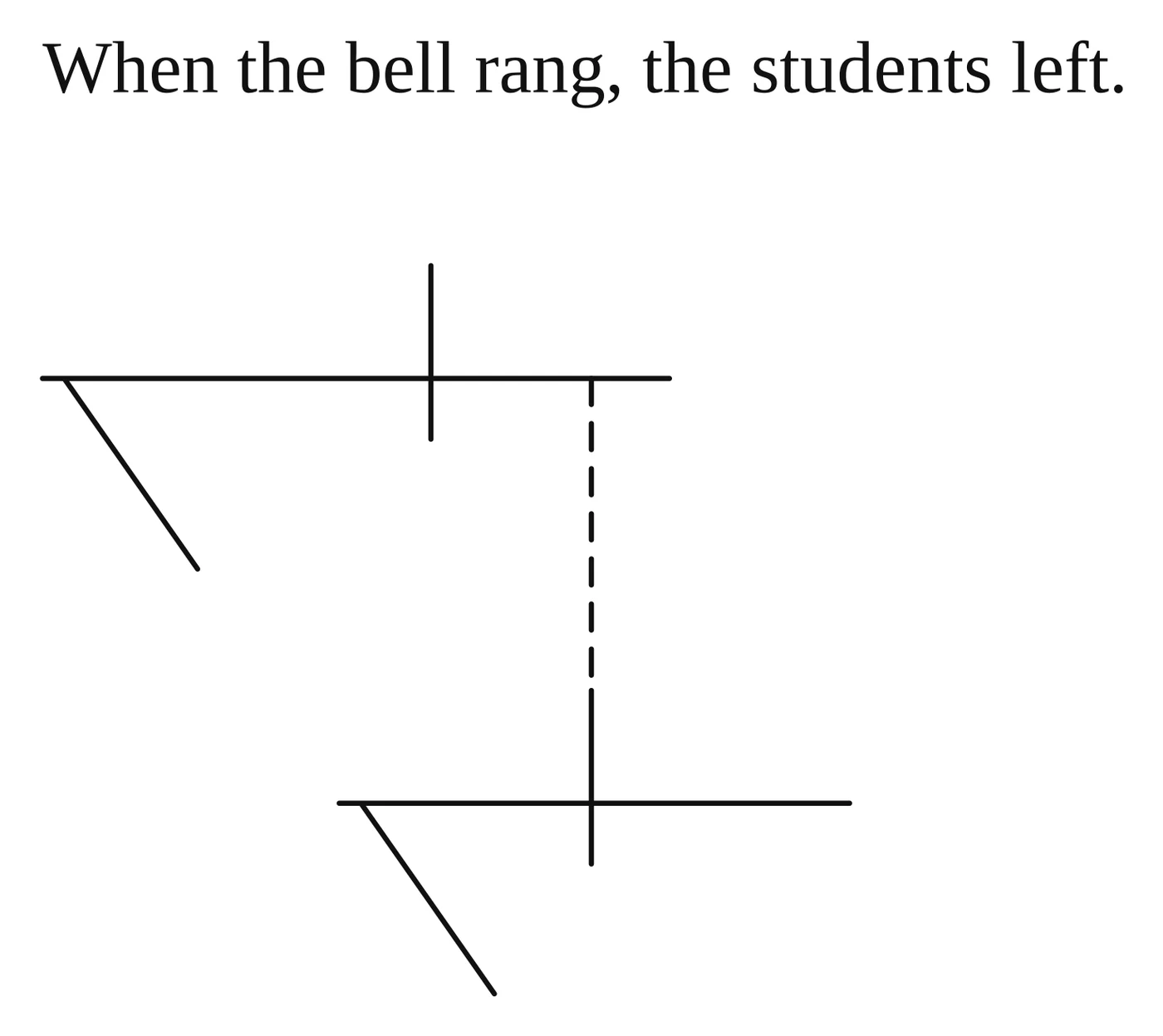
The lines are drawn for you. Copy the frame and fill in the words.
Show the answer
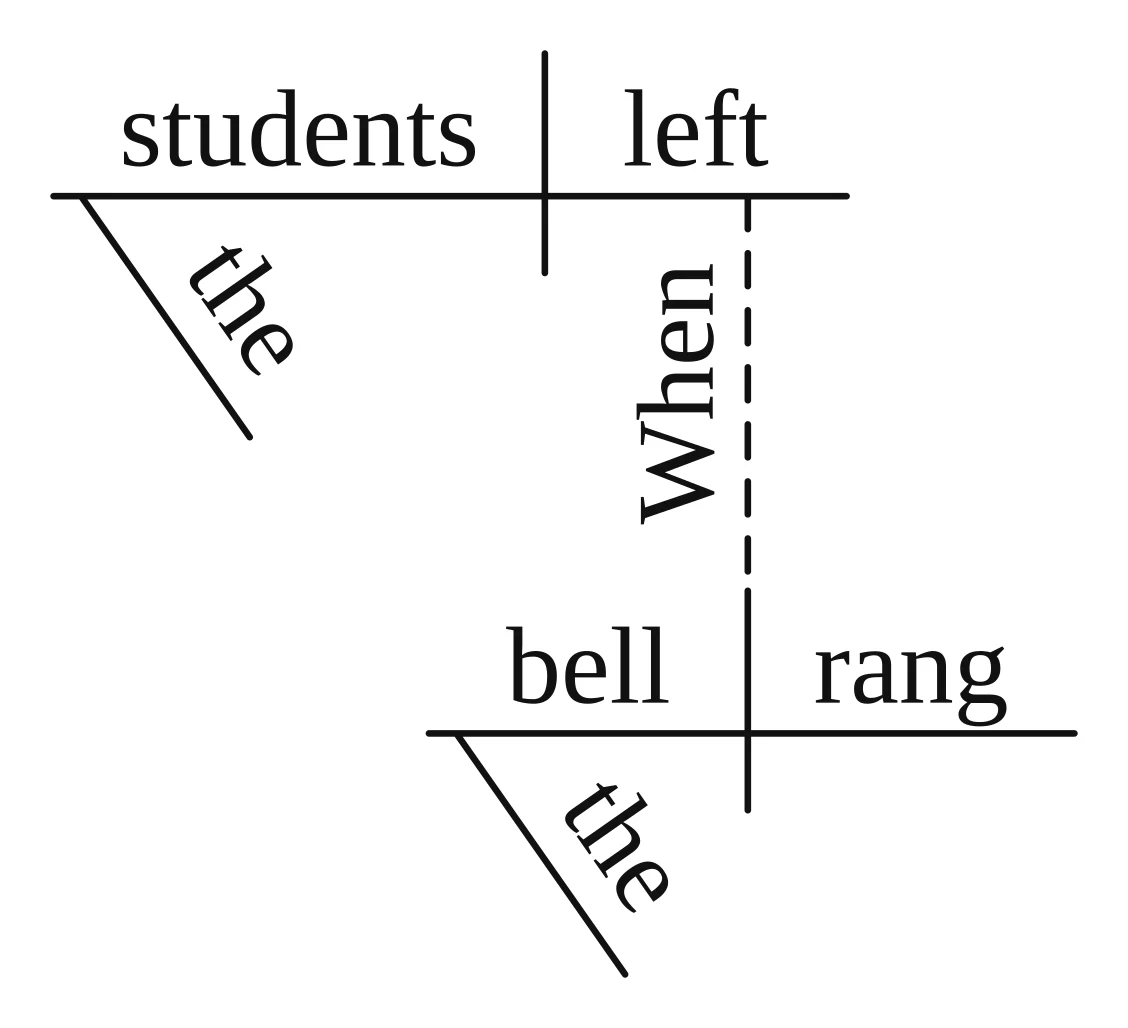
When the bell rang tells when the students left, so it is an adverb clause. It gets its own baseline below, and a dashed line from rang up to left carries the subordinating conjunction When.
Did you get it right?Diagram this sentence in the generator → - 34.
I know that you are right.
Noun clause as direct object
Hint: show the empty frame
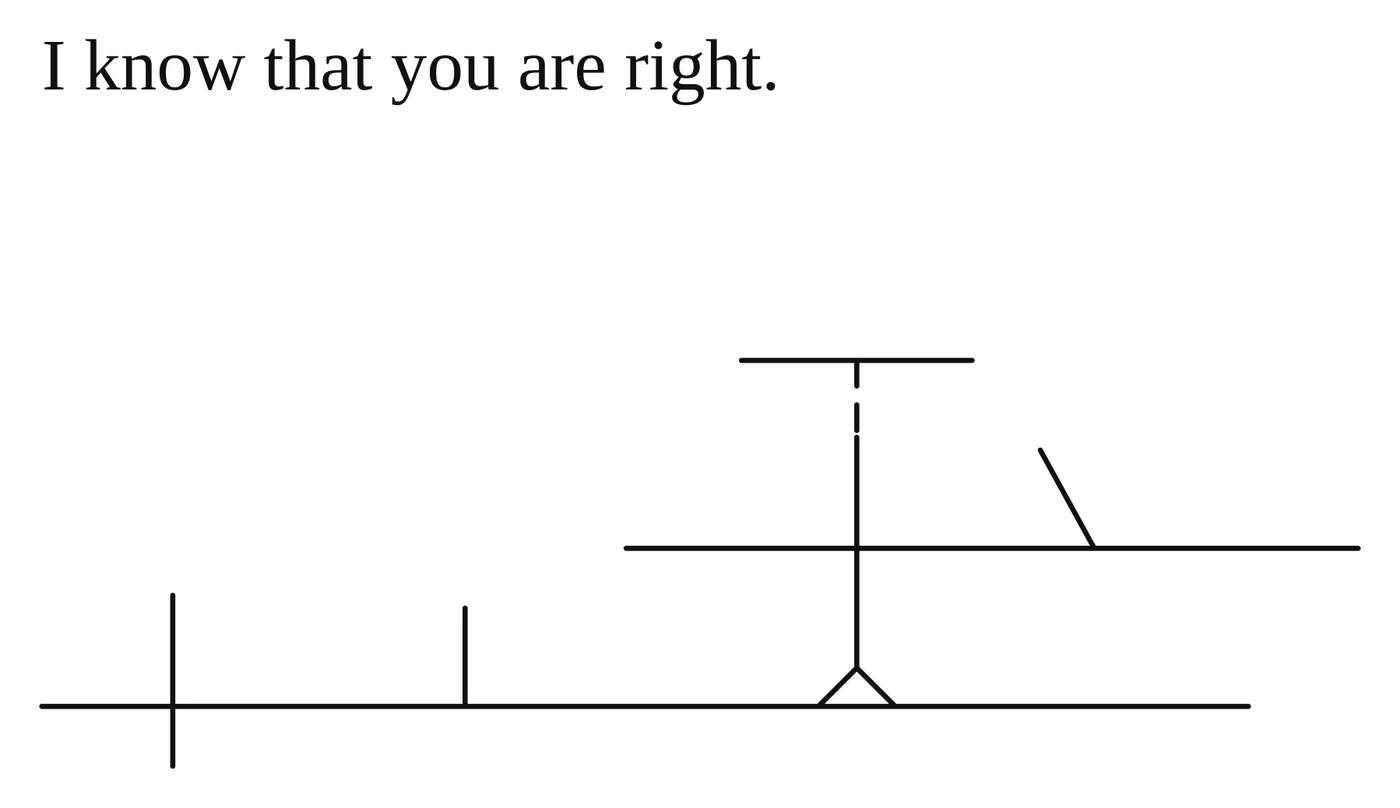
The lines are drawn for you. Copy the frame and fill in the words.
Show the answer
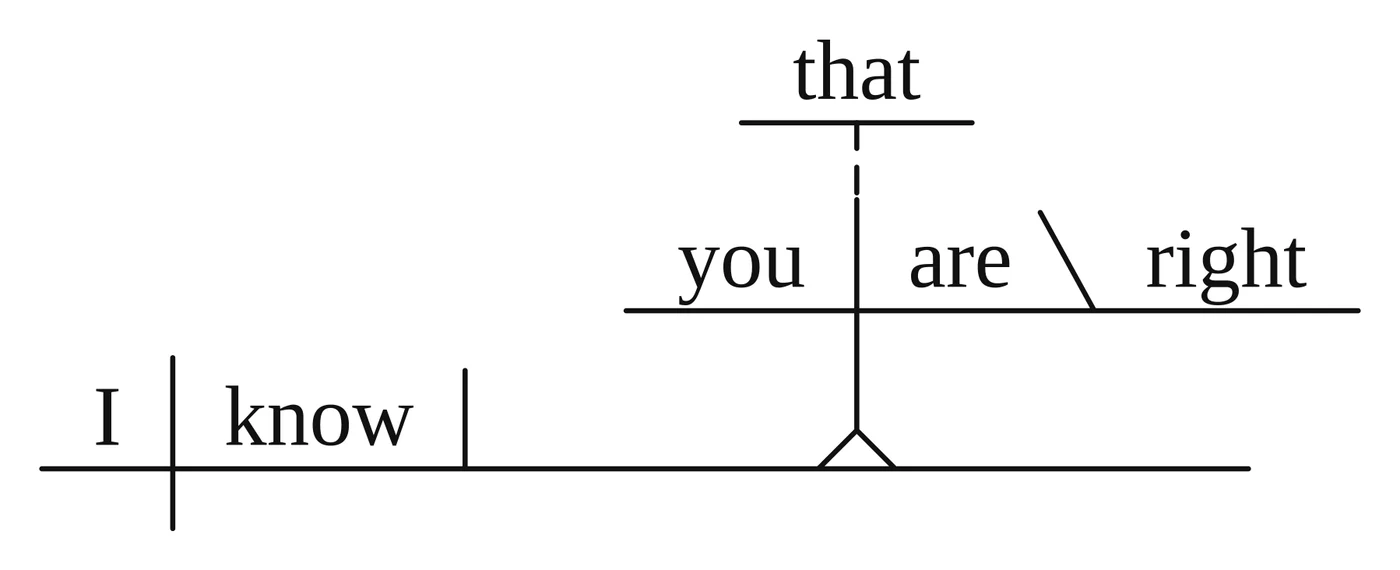
Know what? That you are right: the whole clause is the direct object, so it stands on a pedestal in the object's spot. Inside it, you are right is a linking-verb clause, and that only introduces it, so it floats on a line above, joined by a dashed line.
Did you get it right?Diagram this sentence in the generator → - 35.
The movie that we watched was funny.
Adjective clause (that) with a hidden object
Hint: show the empty frame
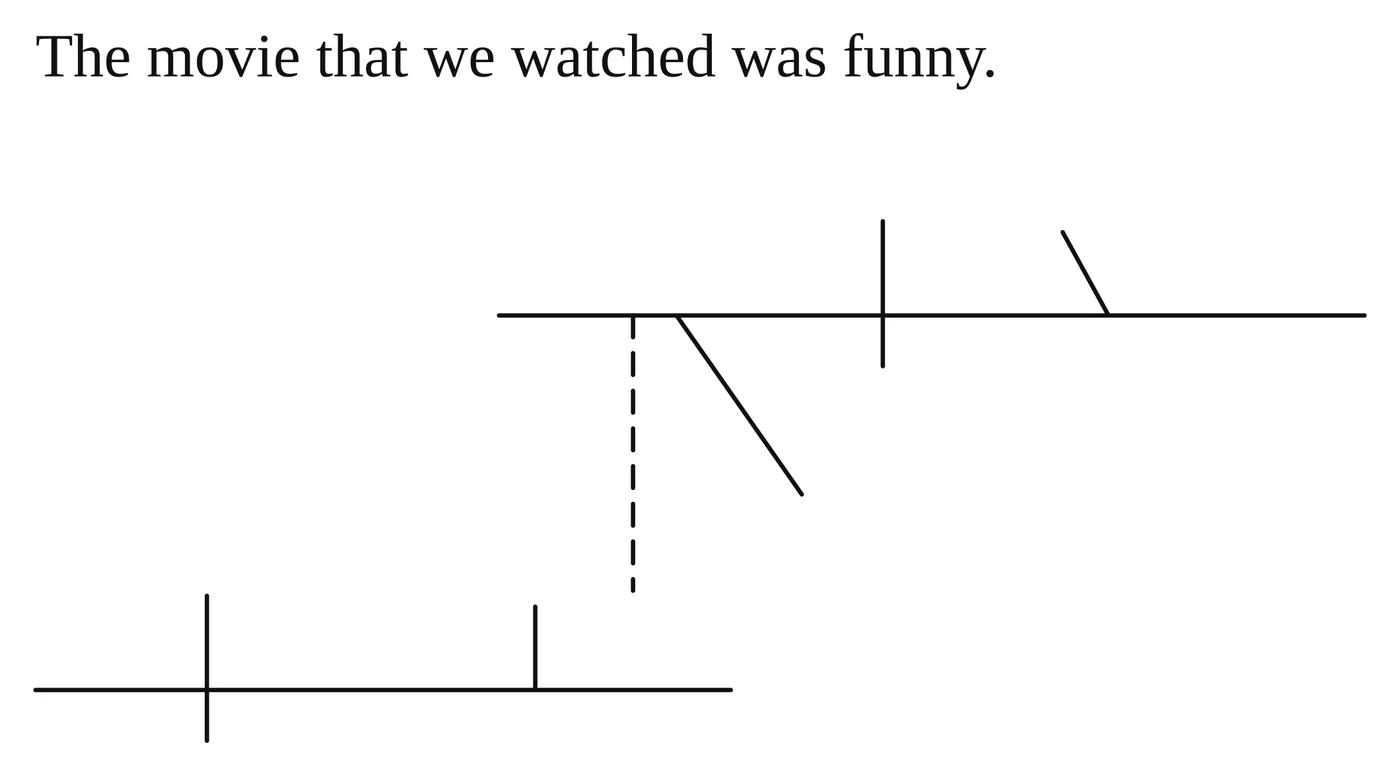
The lines are drawn for you. Copy the frame and fill in the words.
Show the answer
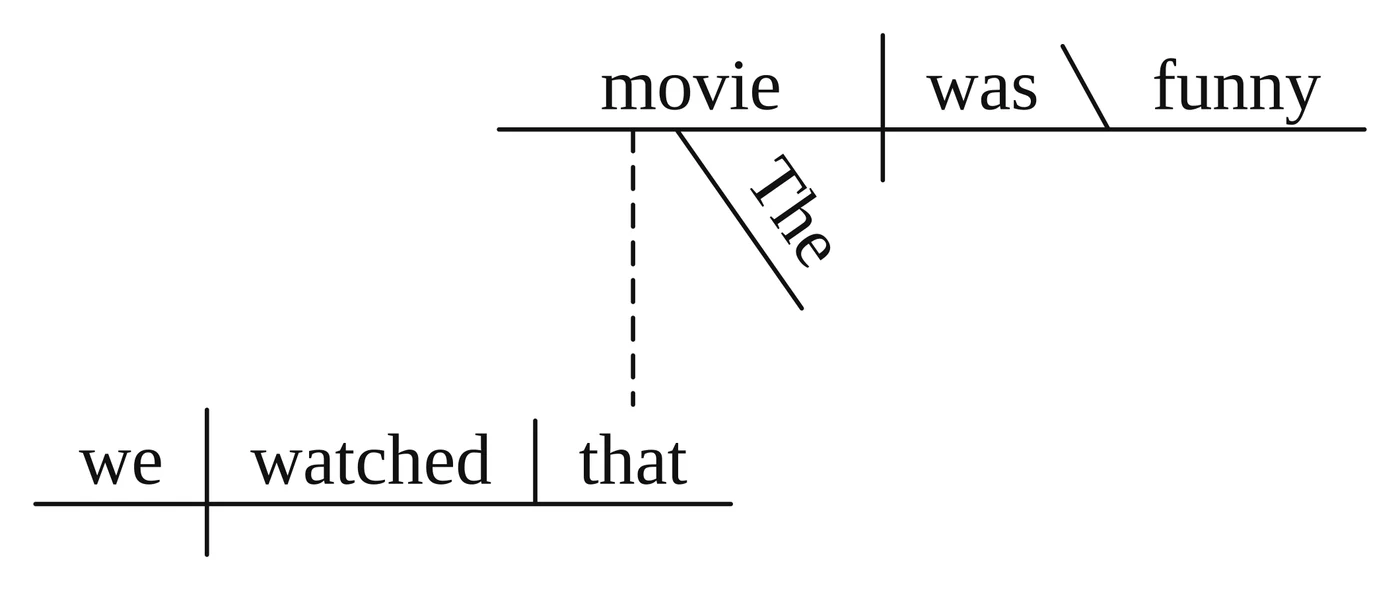
That we watched tells which movie. In statement order it is we watched that, so that is the direct object of watched, and the dashed line runs from that up to movie. The main clause is movie was funny.
Did you get it right?Diagram this sentence in the generator →
Set 10: Mixed Review
These sentences combine skills from the sets above: an adverb clause with a prepositional phrase, an appositive with an indirect object, an opening participial phrase, and a compound-complex sentence. Work in the same order every time: verbs, subjects, complements, then everything that hangs below.
- 36.
Although it rained, the team practiced on the muddy field.
Adverb clause + prepositional phrase
Hint: show the empty frame
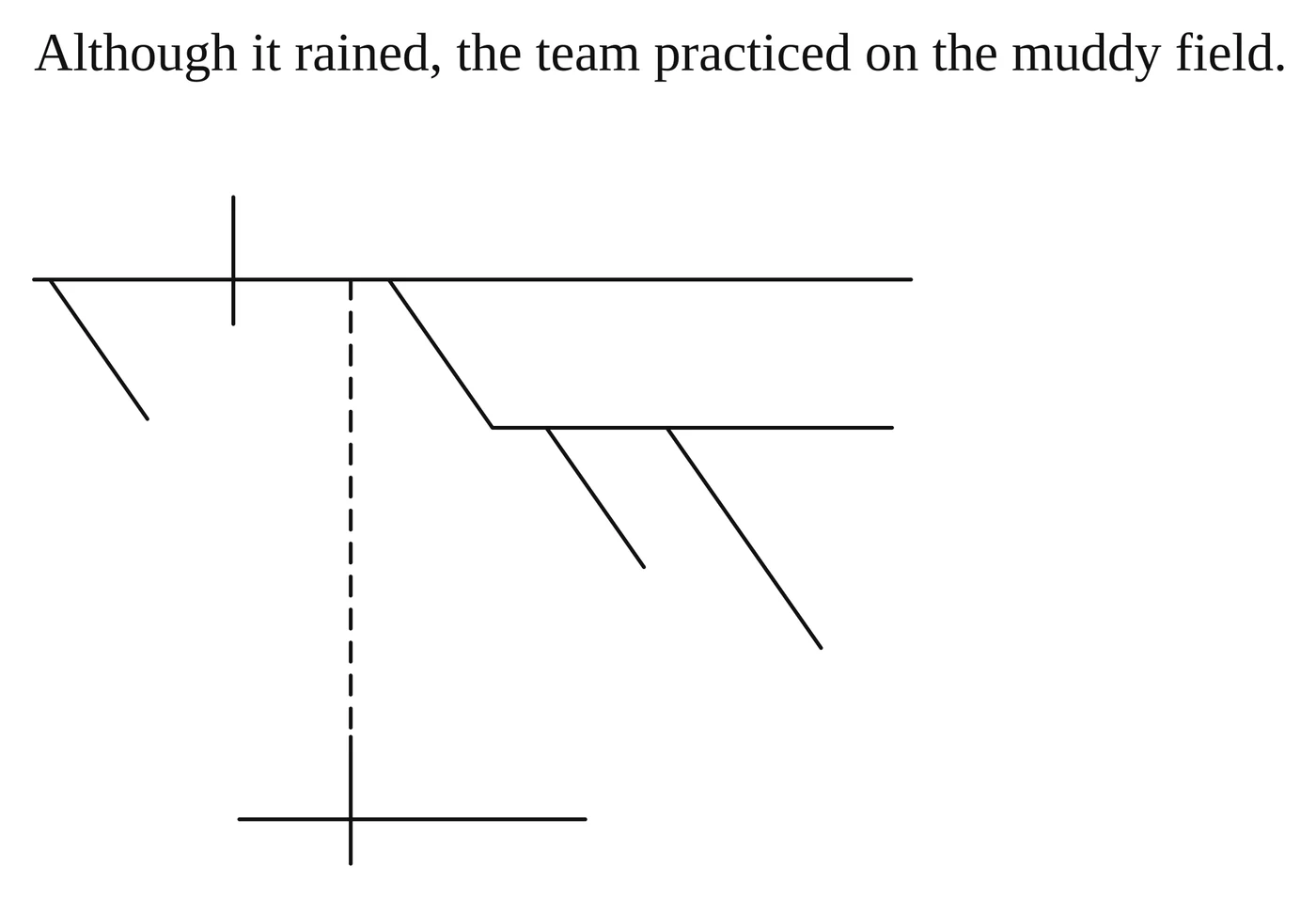
The lines are drawn for you. Copy the frame and fill in the words.
Show the answer
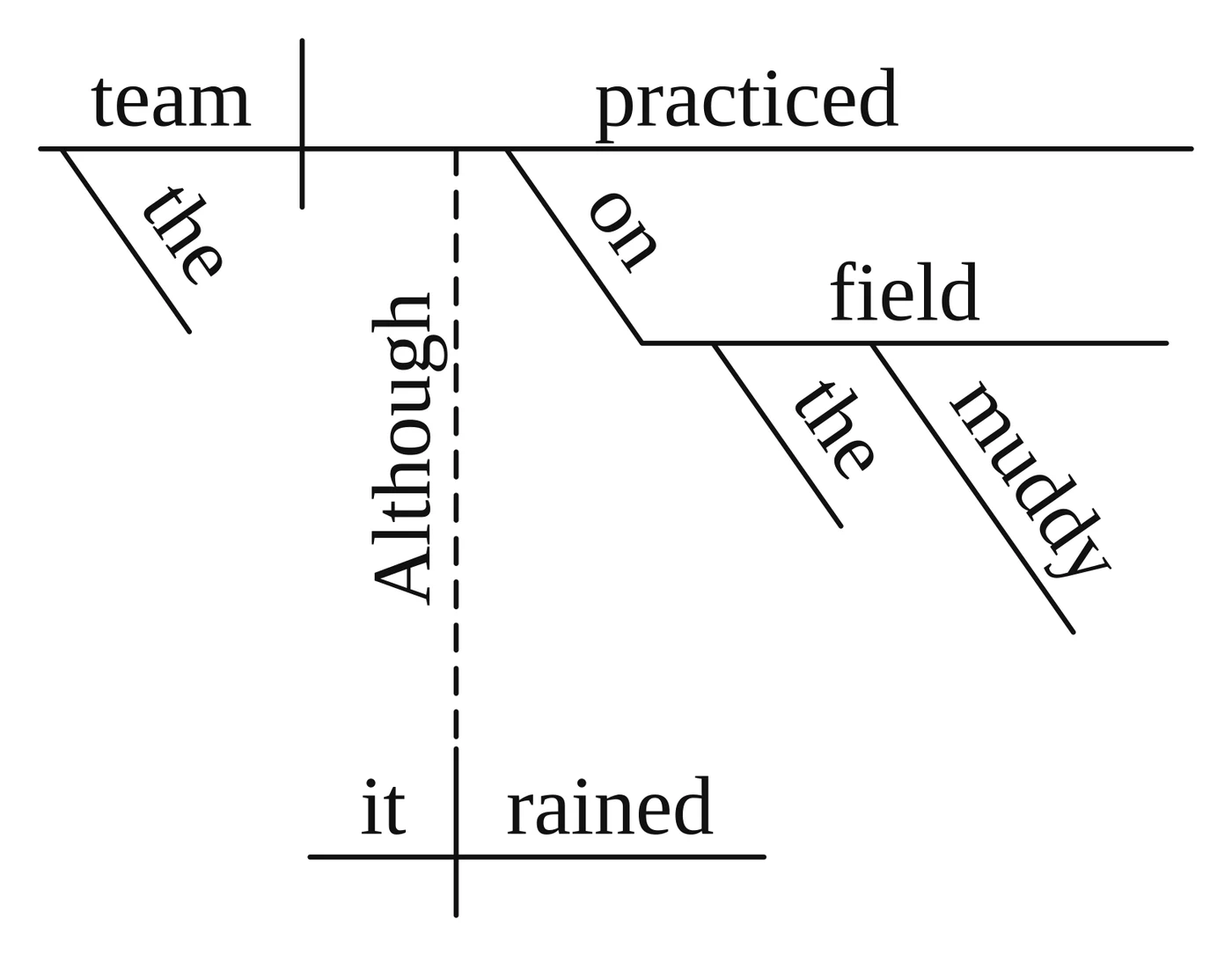
Main clause: team practiced, with on the muddy field hanging under practiced (where). Although it rained is an adverb clause on its own baseline, joined to practiced by a dashed line carrying Although.
Did you get it right?Diagram this sentence in the generator → - 37.
My father, a carpenter, built us a treehouse in the backyard.
Appositive + indirect object + phrase
Hint: show the empty frame
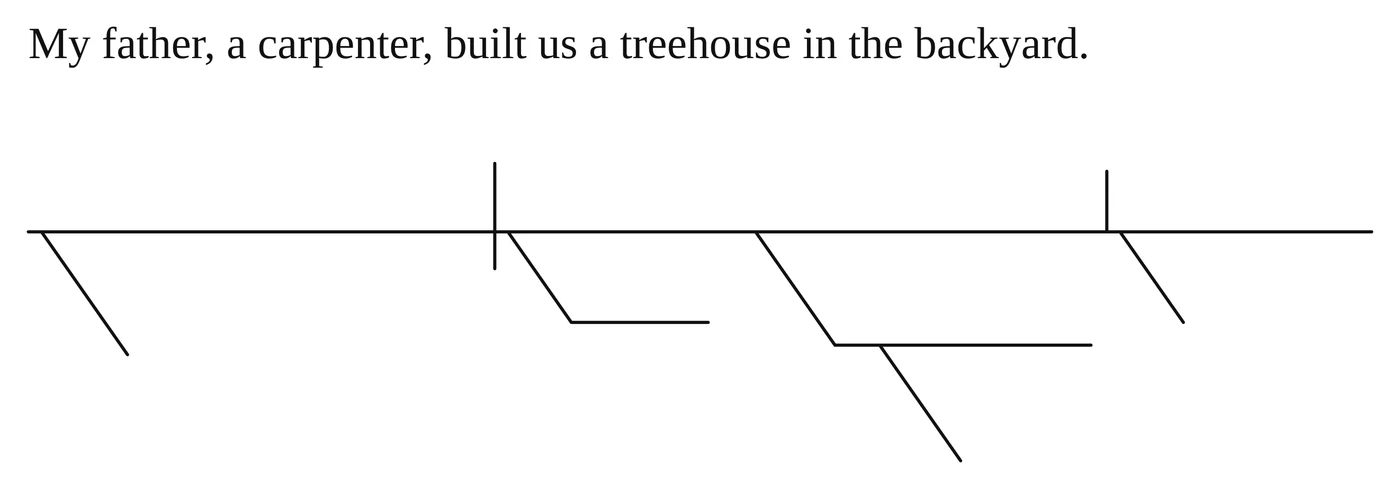
The lines are drawn for you. Copy the frame and fill in the words.
Show the answer
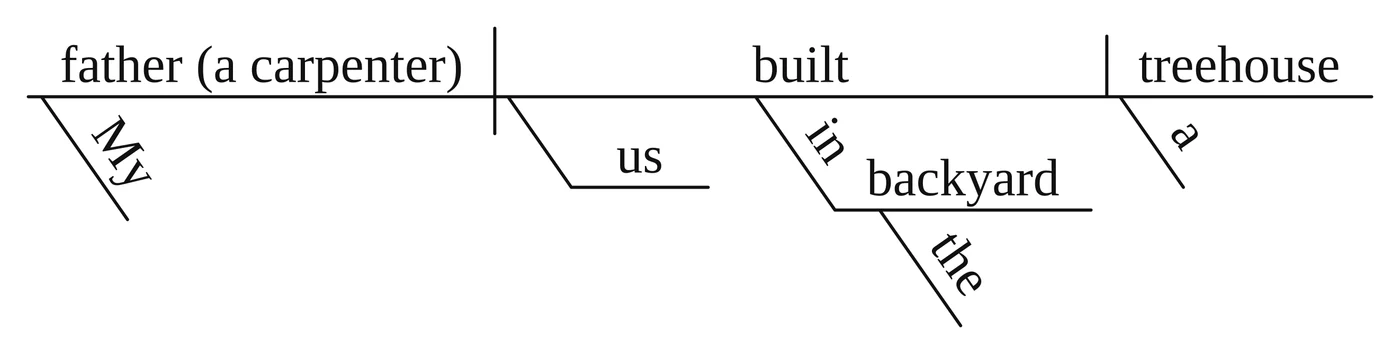
A carpenter renames father, so it goes in parentheses after the subject. Built what? A treehouse (direct object). For whom? Us (indirect object, under the verb). In the backyard tells where, so it hangs under built too.
Did you get it right?Diagram this sentence in the generator → - 38.
Running quickly, the boy caught the bus.
Opening participial phrase
Hint: show the empty frame
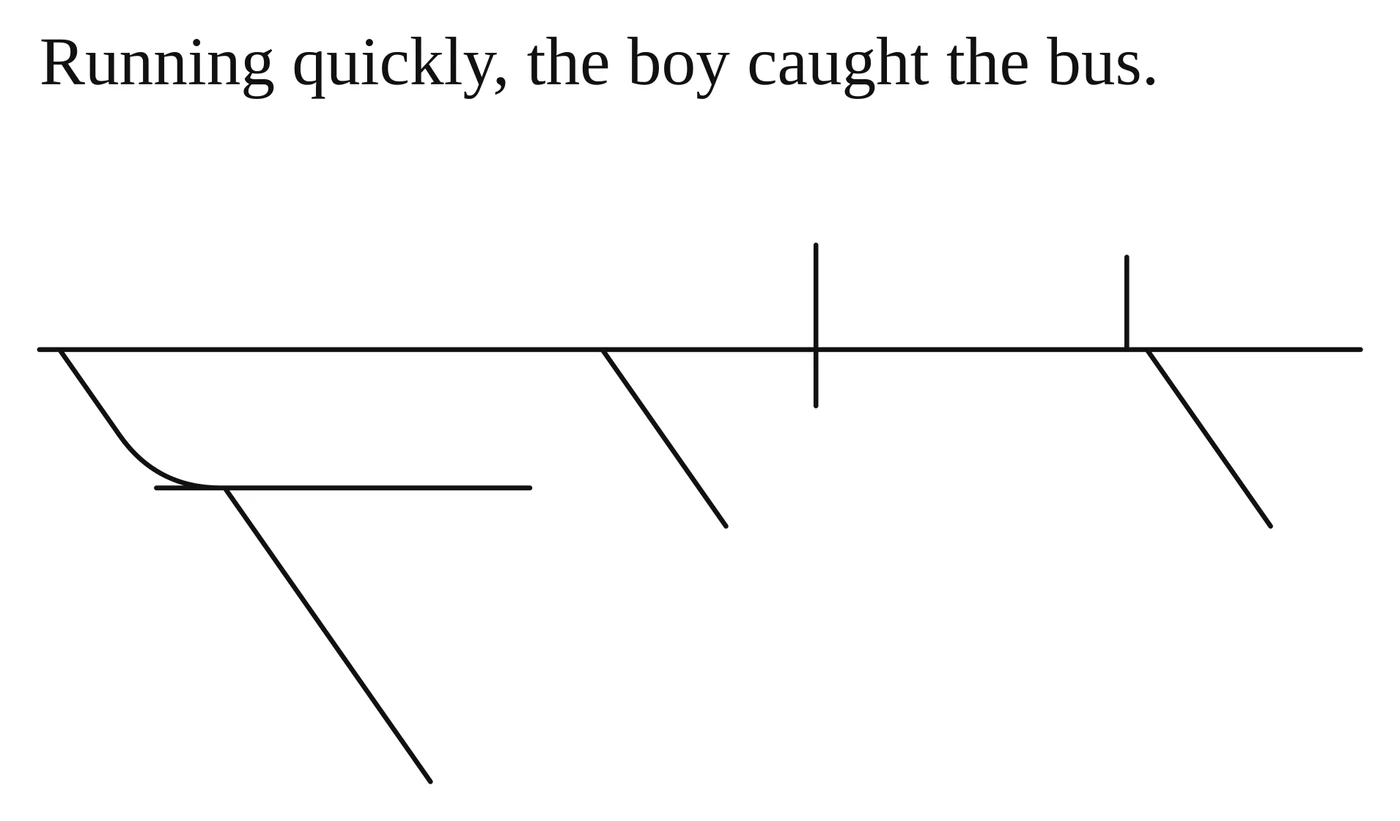
The lines are drawn for you. Copy the frame and fill in the words.
Show the answer
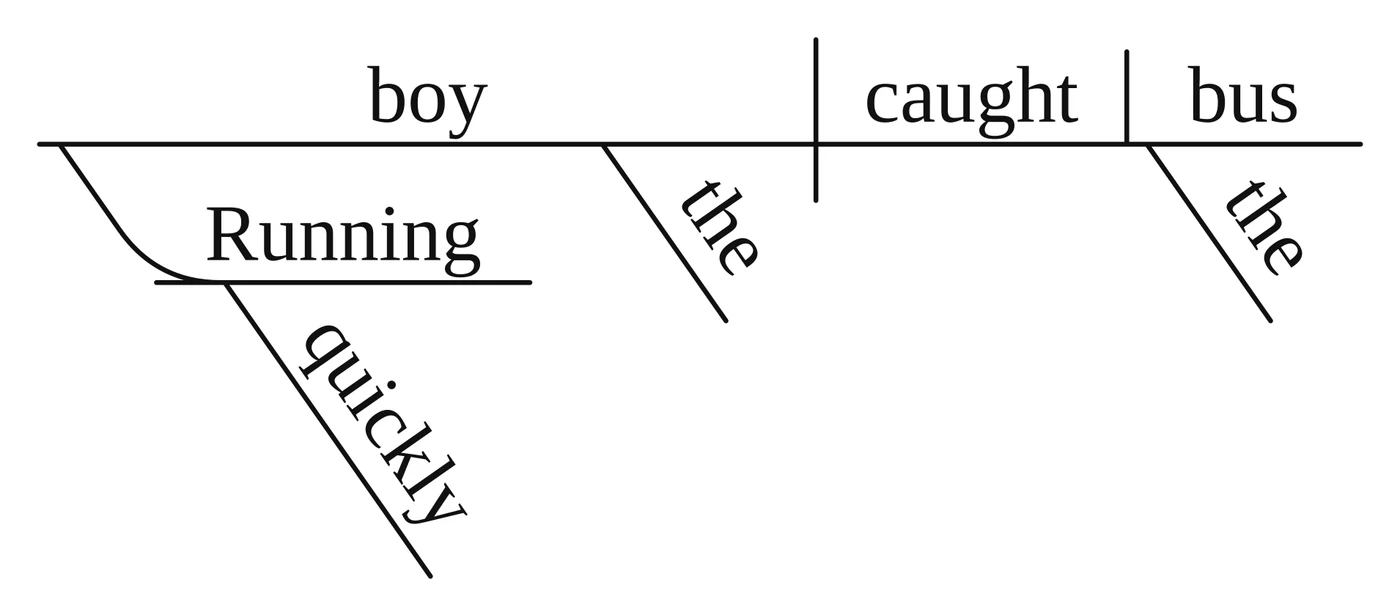
Running quickly describes boy, so it is a participial phrase: Running sits on the bent participle line under boy, and quickly hangs under Running. The core is boy caught bus.
Did you get it right?Diagram this sentence in the generator → - 39.
She studied hard, and she passed the test because she practiced every day.
Compound-complex sentence
Hint: show the empty frame
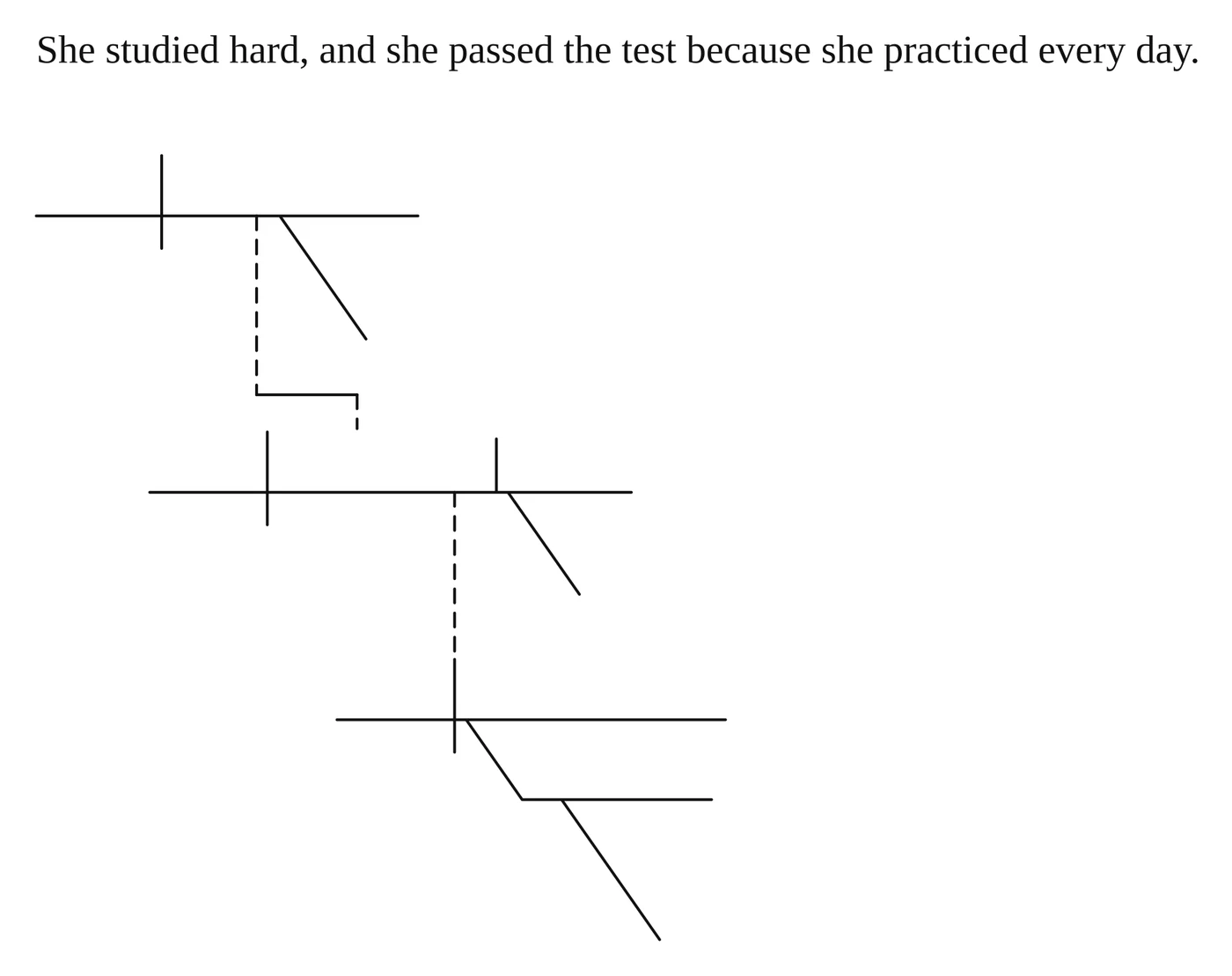
The lines are drawn for you. Copy the frame and fill in the words.
Show the answer
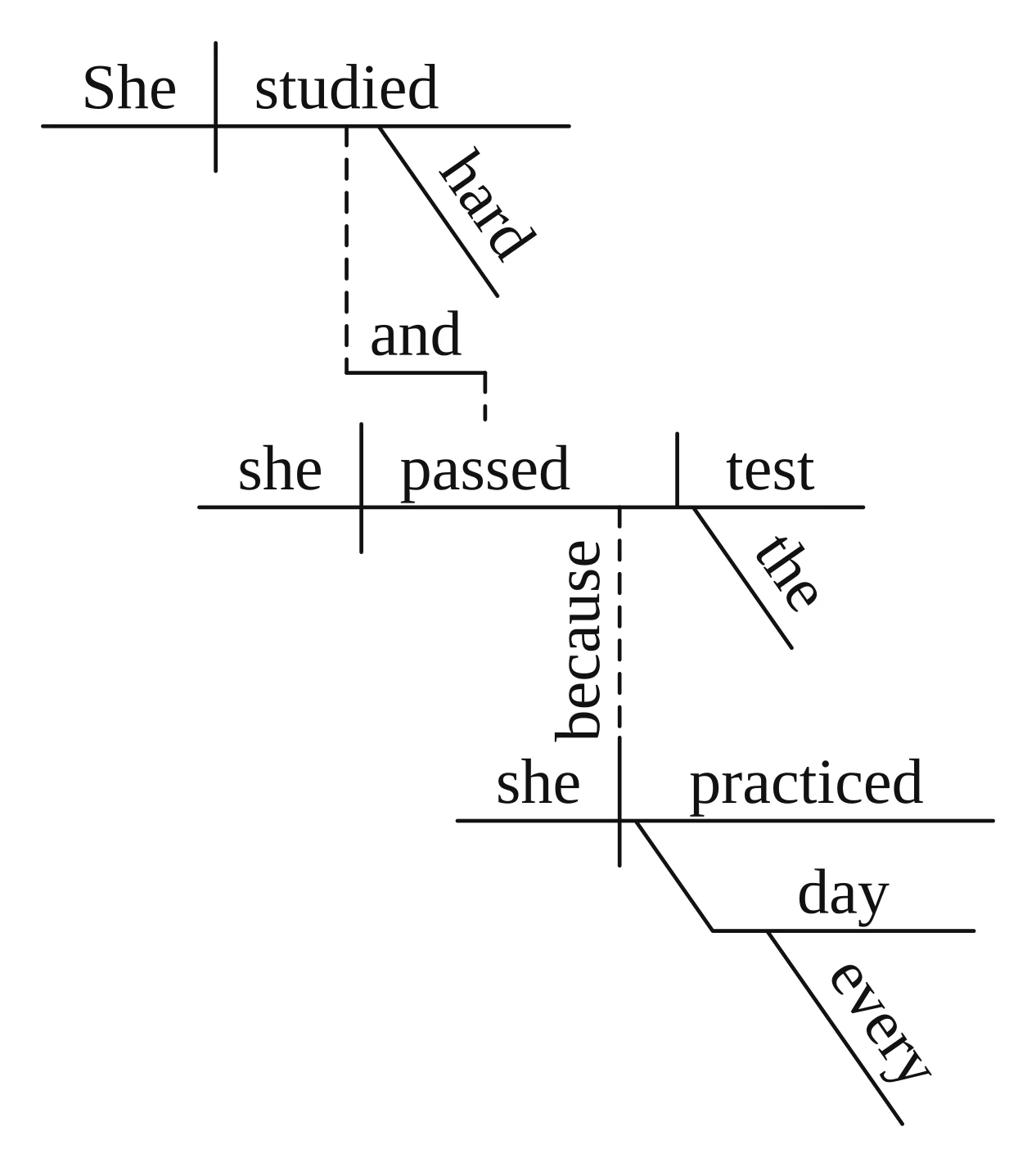
Two main clauses (She studied hard / she passed the test) are joined at the verbs by a dashed line carrying and. Because she practiced every day is an adverb clause under passed, joined by a dashed line with because. Every day tells when, so day hangs under practiced with every under it.
Did you get it right?Diagram this sentence in the generator →
Mistakes to Look For When You Check Your Answers
- Putting a predicate adjective under the subject. In The soup was cold, cold describes the soup but it comes after a linking verb, so it goes on the baseline behind a slanted line, not on a slant under soup.
- Calling every noun after the verb a direct object. After a linking verb it is a predicate noun (My grandfather was a sailor). After an action verb with two nouns, ask what the second one does: in bought the team pizza, team is the indirect object (bought pizza for the team); in They named the puppy Max, puppy is the direct object and Max renames it, an object complement.
- Hanging a prepositional phrase under the wrong word. With red boots tells you which girl, so it hangs under girl, not under splashed.
- Leaving a helping verb off the baseline. Have finished is one verb phrase; both words go after the subject–verb divider.
- Diagramming a question in question order. Turn it into a statement first; the subject is often hiding after the helping verb.
- Forgetting the understood (you). Every command has a subject even when you cannot see it.
- Treating a noun of direct address as the subject. In Ben, please clean your room, Ben is being spoken to; the subject is (you).
- Putting articles on the baseline. The, a and an always hang on slants under their noun. Keep capital letters as they appear in the sentence and leave out punctuation.
Finished? Make a Practice Set from Your Own Sentences
When your class or homeschool book has its own sentences, paste them into the generator's Worksheet mode: up to 20 sentences become a printable worksheet with empty frames and a matching answer key PDF. For one sentence at a time, type it into the sentence diagram generator and download the diagram as PNG or SVG.
Teachers can find classroom ideas on the sentence diagramming for teachers page.
Frequently Asked Questions
How can I learn to diagram sentences?
Learn one skill at a time and practice each one before adding the next: subjects and verbs, then modifiers, linking verbs, objects, prepositional phrases, compounds, and finally clauses. That is the order of the ten sets on this page. Read the rule, diagram a few sentences on paper, and check each answer right away so a mistake does not become a habit. The how to diagram a sentence guide explains every line type.
What grade is sentence diagramming taught in?
There is no single grade: it depends on the school and the curriculum. California's grade 3 standard (L.3.1), for example, asks students to explain what nouns, verbs, adjectives and adverbs do in a sentence and does not mention diagramming. Workbook series that teach it spread it over several years: The Critical Thinking Co.'s Sentence Diagramming: Beginning is listed for grades 3–12+ and starts with subjects and verbs, and Grammar for the Well-Trained Mind runs from grade 5 to 12 with diagramming throughout. Some high school and college grammar courses still use it. The ten sets on this page follow the same basics-to-clauses order, so start wherever your class is.
Can an app check my sentence diagram?
Not grade it, but you can compare. The Vizcept sentence diagram generator draws its own Reed–Kellogg diagram for the sentence you type, so you can diagram on paper first and put the two side by side. It does not read or mark your drawing. Its diagram can be wrong too: a single dropped word can still slip through, and a phrase can land on the wrong line when the grammar analysis misreads the sentence, so treat a mismatch as a reason to recheck, not as proof you are wrong. The answers on this page were drawn with the same tool and checked by hand.
Can I print these practice sentences?
Most sets link to a free printable worksheet and answer key on the same skill (different sentences, six per set). To print this page's sentences, paste them into the generator's Worksheet mode, which turns up to 20 sentences into a worksheet and answer key PDF.
Is this practice page free?
The page is: all 39 questions, hints and answer diagrams are free, with no account. The sentence diagram generator you use to check your own sentences is partly free. Your first diagram needs no account, new accounts get 5 sign-up credits (fewer in some countries) plus daily check-in credits (free credits expire after 30 days), and free downloads are 2K PNGs with a visible watermark; each diagram uses 2 credits once you sign in. Watermark-free downloads, editable SVGs and the watermark-free worksheet PDFs are paid: credit packs start at $19.90 and never renew, and monthly plans start at $14.90.
What if my answer is different from the answer key?
First check the common mistakes above; most differences come from the verb type (linking or action) or from where a prepositional phrase attaches. A diagram is checked on which word attaches to which, not on word order, so a correct answer can read in a different order from the sentence. If your diagram follows your textbook's convention and ours does not, your textbook wins: books differ on points such as the line for a one-word participle and where an appositive phrase's modifiers go.
Why is sentence diagramming no longer taught in many schools?
It lost support in US schools in the 1970s, and studies kept suggesting that grammar drills taught on their own, diagramming included, do little to improve students' writing. A 2004 EPPI-Centre systematic review found no high-quality evidence that teaching syntax improved the quality or accuracy of writing for ages 5 to 16, though it noted that grammar may still be worth learning for its own sake. It has not disappeared: grammar workbooks, classical schools and homeschool curricula still teach it, because a diagram shows each word's job in the sentence at a glance. See why teachers still teach sentence diagramming for more.
Diagram your own sentence to compare
Type a sentence from your lesson or textbook and get a Reed–Kellogg diagram to compare with yours, or switch to Worksheet mode for up to 20 sentences with an answer key.
