
Quick index: all 20 sentence diagram examples by level
Use this index to jump straight to the grammatical structure you are teaching or checking. Examples 1 through 8 cover all seven basic English sentence patterns taught in Reed–Kellogg courses (introduced in Alonzo Reed and Brainerd Kellogg's Higher Lessons in English, 1877, refining Stephen Watkins Clark's 1847 bubble diagrams).
| # | Grammar focus | Example sentence | Group |
|---|---|---|---|
| 1 | Simple subject + verb (Pattern 1: S–V) | Wolves howl. | Simple sentences |
| 2 | Adjectives, articles & adverb | The bright lantern glowed softly. | Simple sentences |
| 3 | Direct object (Pattern 2: S–V–DO) | The baker sliced fresh sourdough. | Simple sentences |
| 4 | Predicate nominative (Pattern 3: S–LV–PN) | Dr. Patel became our principal. | Simple sentences |
| 5 | Predicate adjective (Pattern 4: S–LV–PA) | The cedar soup smells savory. | Simple sentences |
| 6 | Indirect + direct object (Pattern 5: S–V–IO–DO) | The librarian handed Leo a thick atlas. | Phrases & complements |
| 7 | Objective complement noun (Pattern 6: S–V–DO–OC) | The choir named Devon soloist. | Phrases & complements |
| 8 | Objective complement adjective (Pattern 7: S–V–DO–OC) | The judges declared her essay brilliant. | Phrases & complements |
| 9 | Prepositional phrase (famous pangram) | The quick brown fox jumps over the lazy dog. | Phrases & complements |
| 10 | Appositive phrase | Our neighbor, a retired carpenter, built the porch. | Phrases & complements |
| 11 | Compound subject & compound verb | Maple leaves and pine needles drifted and settled. | Compounds & clauses |
| 12 | Compound sentence | The ferry docked, and the passengers hurried ashore. | Compounds & clauses |
| 13 | Complex sentence (adverb clause) | We lit candles when the storm cut the power. | Compounds & clauses |
| 14 | Complex sentence (adjective clause) | The violin that Clara restored sounded warm. | Compounds & clauses |
| 15 | Noun clause as subject | What the map showed surprised the crew. | Compounds & clauses |
| 16 | Gerund phrase as subject | Gardening in spring brings quiet joy. | Verbals & special forms |
| 17 | Infinitive phrase as direct object | Nora promised to finish the mural. | Verbals & special forms |
| 18 | Participle + passive voice | The shattered vase was swept into the dustpan. | Verbals & special forms |
| 19 | Interrogative sentence (question) | Did the orchestra rehearse the final movement? | Verbals & special forms |
| 20 | Imperative sentence (understood you) | Close the heavy gate quietly. | Verbals & special forms |
How to read a sentence diagram example (6 core line rules)
Every Reed–Kellogg diagram encodes grammar with six line shapes. Read the horizontal baseline left to right first—it always holds the core clause—then follow each branch downward to see what modifies or completes it.
| Line shape | Grammar role | Seen in examples |
|---|---|---|
| Vertical line crossing the baseline | Splits subject (left) from predicate verb (right) | All 20 examples |
| Short vertical line stopping at the baseline | Separates an action verb from its direct object | #3, #6–#8, #10, #19–#20 |
Backslash (\) leaning toward the subject | Marks a predicate noun, predicate adjective, or objective complement | #4, #5, #7, #8 |
| Slanted line beneath a word | Holds an article, adjective, adverb, or preposition | #2, #9, #20 |
| Dashed line (vertical, stepped, or diagonal) | Connects compound items or links a dependent clause to its anchor | #11–#14 |
| Pedestal (vertical stand with forked base) | Elevates a noun clause, gerund, or infinitive acting as a noun | #15–#17 |
Level 1: Five simple sentence diagram examples (core patterns)
These five simple sentence diagram examples cover the core baseline slots before phrases or extra clauses enter the picture. Each starts with a horizontal baseline split by a vertical line that crosses right through it.
1. Simple subject and intransitive verb
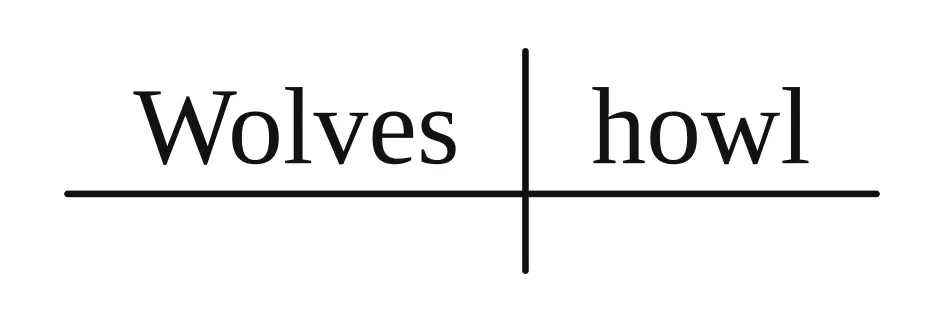
Sentence: Wolves howl.
Nothing follows the verb because howl is intransitive—it completes the thought without an object. The subject–predicate divider is the only vertical line that extends below the baseline.
Open this example in the generator
2. Articles, adjectives, and an adverb
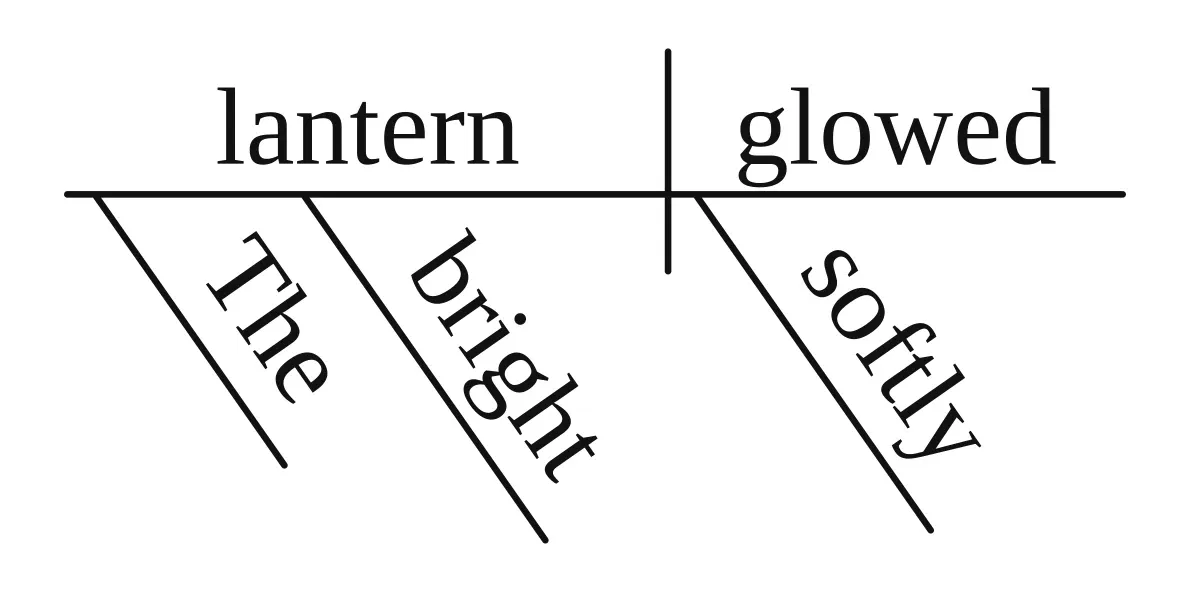
Sentence: The bright lantern glowed softly.
One-word modifiers sit on slanted lines beneath the exact word they describe. The and bright tell which lantern, so both hang under lantern; softly tells how it glowed, so it hangs under glowed.
Open this example in the generator
3. Action verb with a direct object
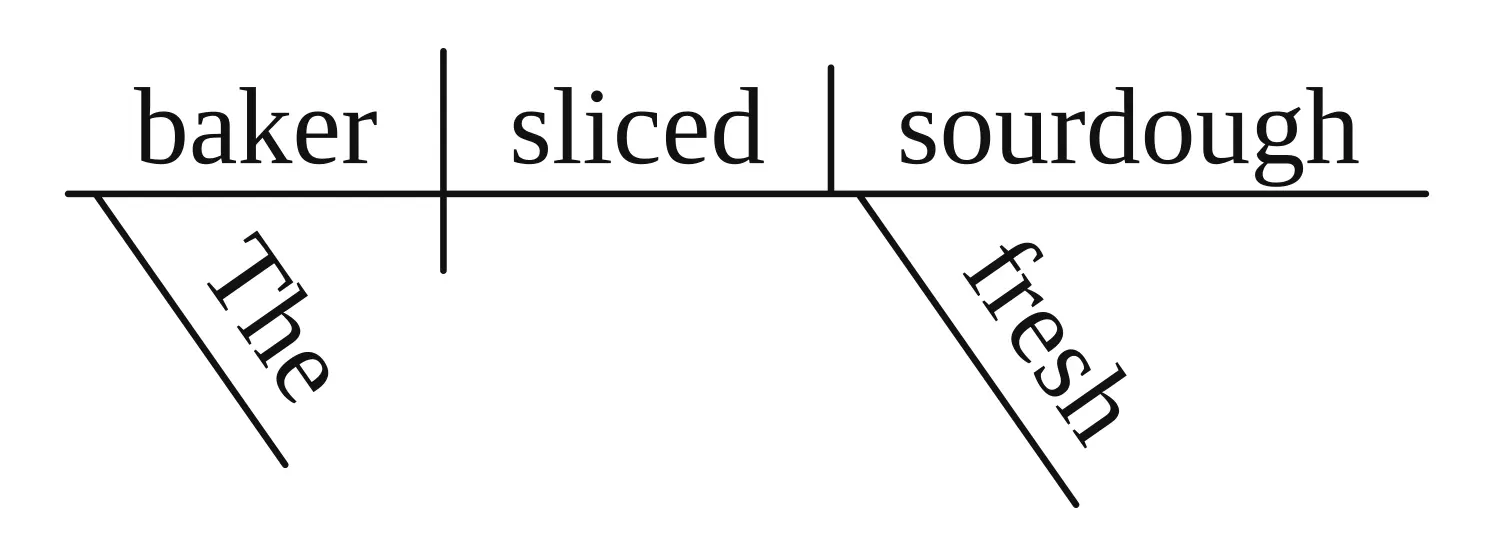
Sentence: The baker sliced fresh sourdough.
Ask "sliced what?" to locate the direct object (sourdough). Unlike the subject–verb divider, the vertical line before a direct object stops flush with the baseline.
Open this example in the generator
4. Linking verb with a predicate nominative
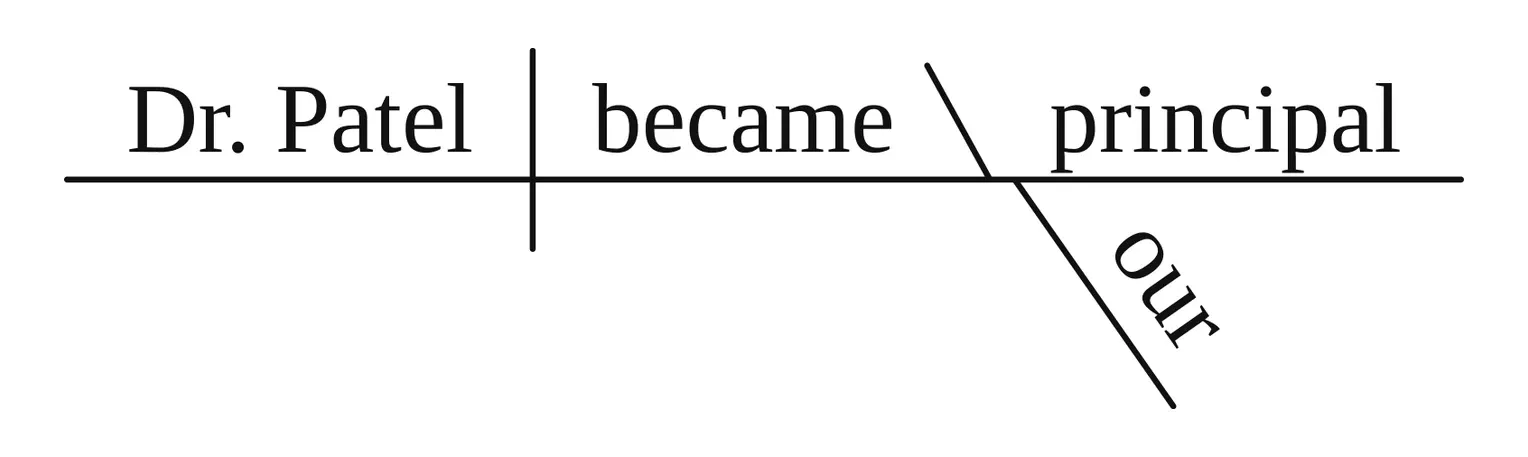
Sentence: Dr. Patel became our principal.
Became links the subject to a noun that renames it (Dr. Patel = principal). A backslash slanting back toward the subject marks a subject complement rather than a direct object. Keep multi-word proper names (Dr. Patel) together in the subject slot.
Open this example in the generator
5. Linking verb with a predicate adjective
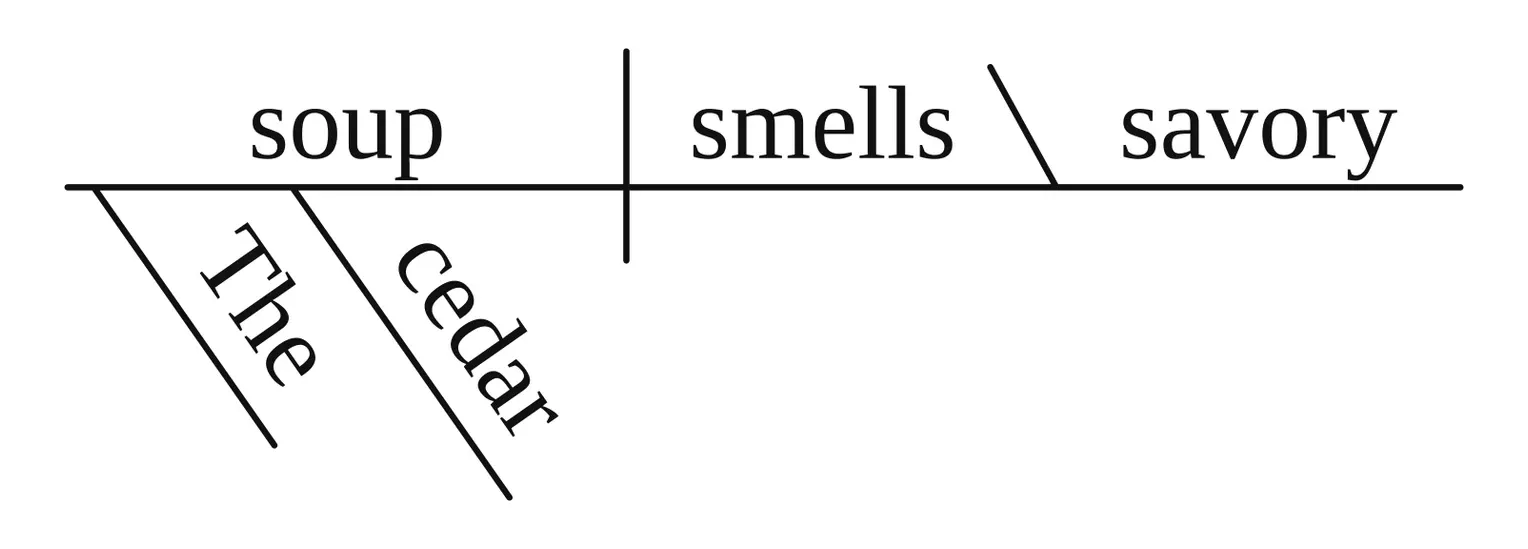
Sentence: The cedar soup smells savory.
Sense verbs (smells, tastes, looks, feels, sounds) act as linking verbs whenever you can replace them with is (The cedar soup is savory). Because savory describes soup, it sits behind a backslash on the baseline.
Level 2: Indirect objects, objective complements, prepositional phrases, and appositives
Once students recognize the five simple patterns, the next step is attaching indirect objects, objective complements (both noun and adjective), prepositional phrases, and appositives to the exact word they complete or modify.
6. Indirect object and direct object
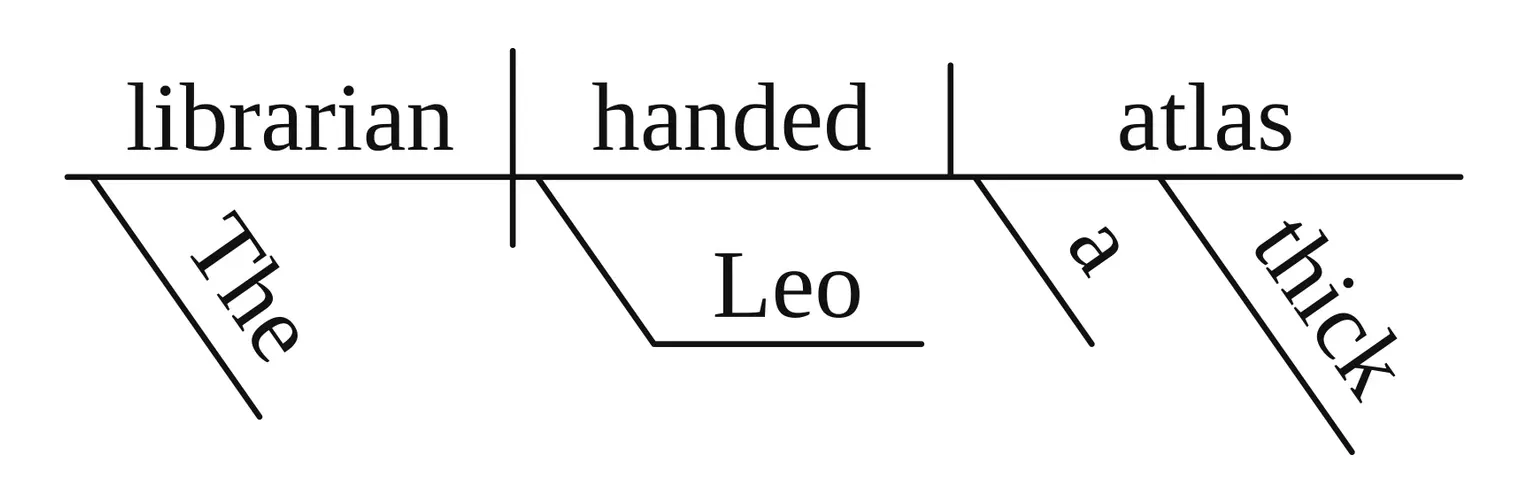
Sentence: The librarian handed Leo a thick atlas.
Atlas answers "handed what?" (direct object on the baseline). Leo answers "to whom?" (indirect object), so it drops beneath the verb on a horizontal line attached by an empty slant representing the unstated to. For more variations including compound objects, see the direct and indirect objects guide.
Open this example in the generator
7. Objective complement noun (renaming the direct object)
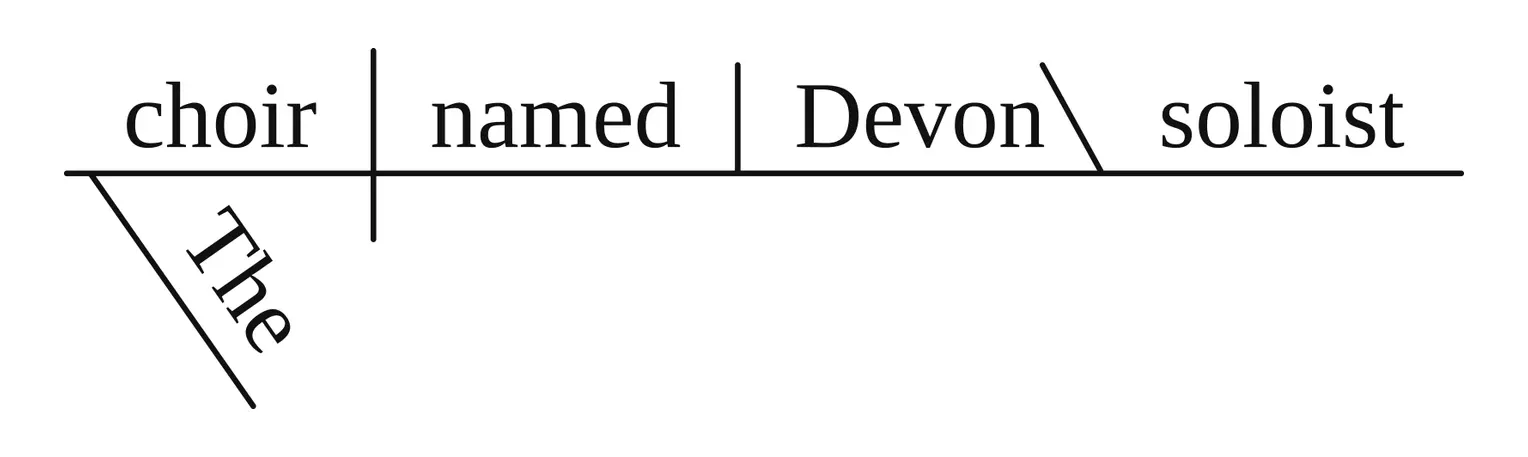
Sentence: The choir named Devon soloist.
Soloist renames the direct object Devon as a result of the action named. Because it completes the object rather than the subject, it stays on the baseline after Devon, separated by a backslash leaning back toward Devon.
Open this example in the generator
8. Objective complement adjective (describing the direct object)
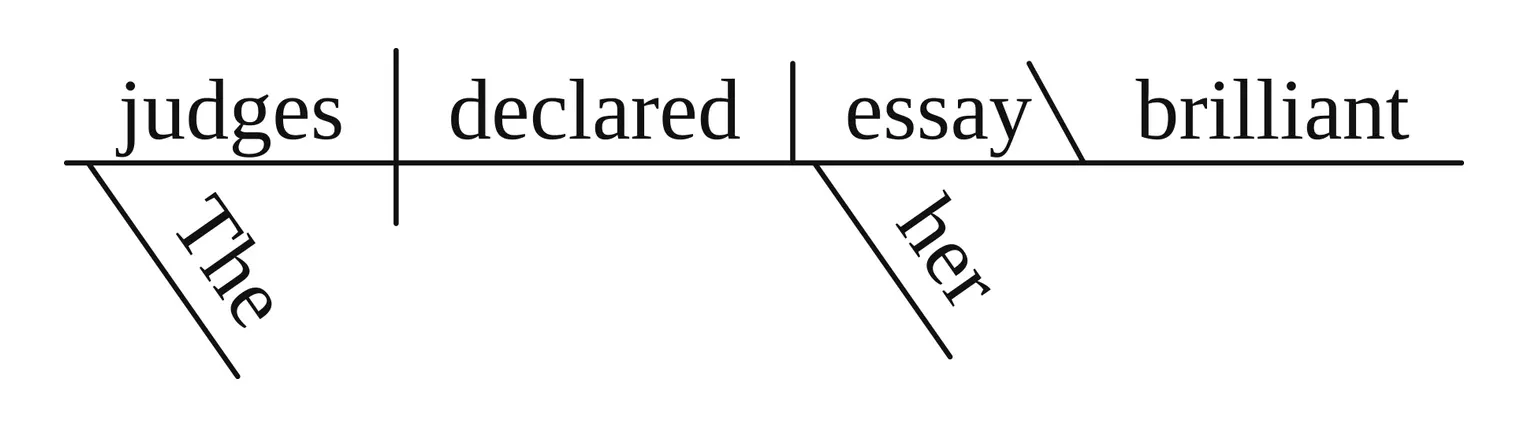
Sentence: The judges declared her essay brilliant.
Brilliant does not describe judges; it describes the direct object essay as a result of the verb declared. It uses the same backslash slot after the direct object as a noun objective complement.
Open this example in the generator
9. Prepositional phrase modifying the verb (classic pangram)
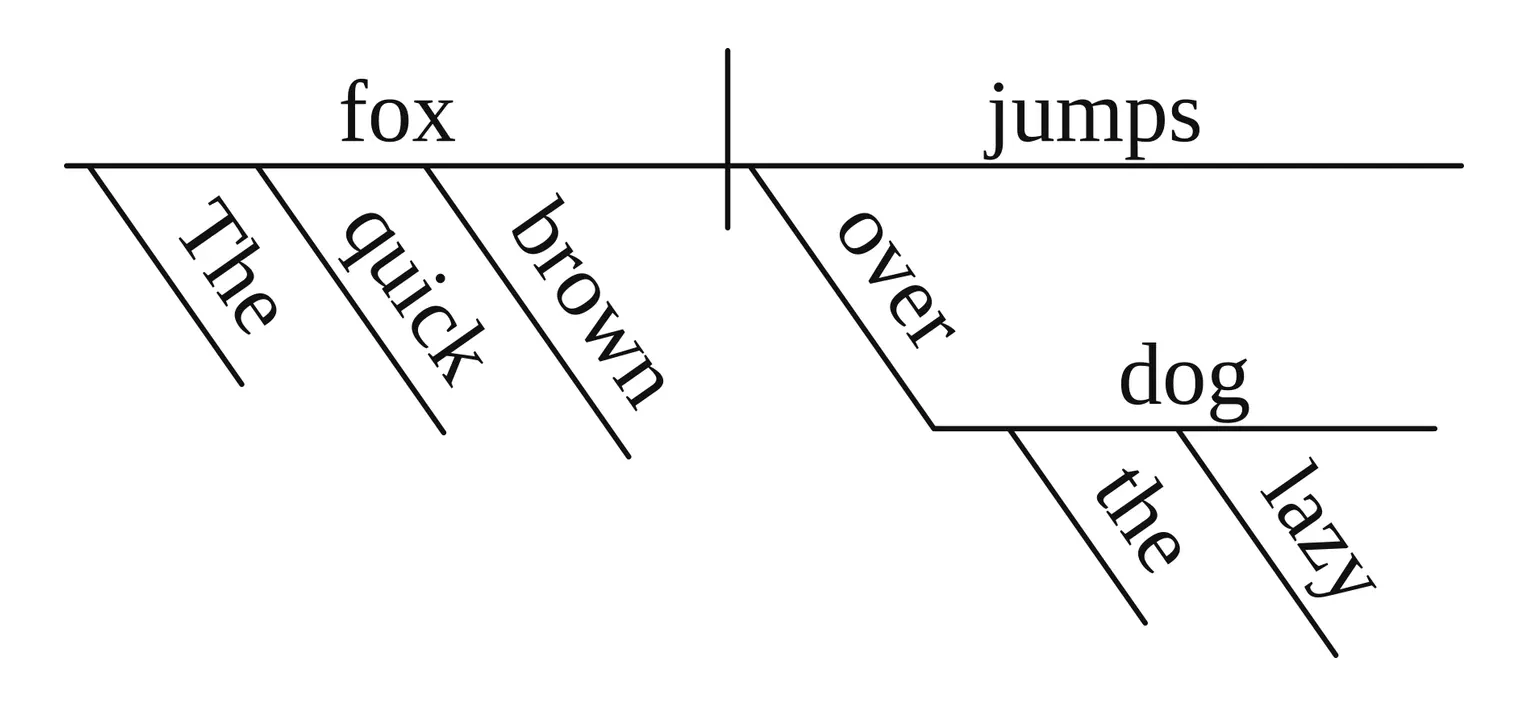
Sentence: The quick brown fox jumps over the lazy dog.
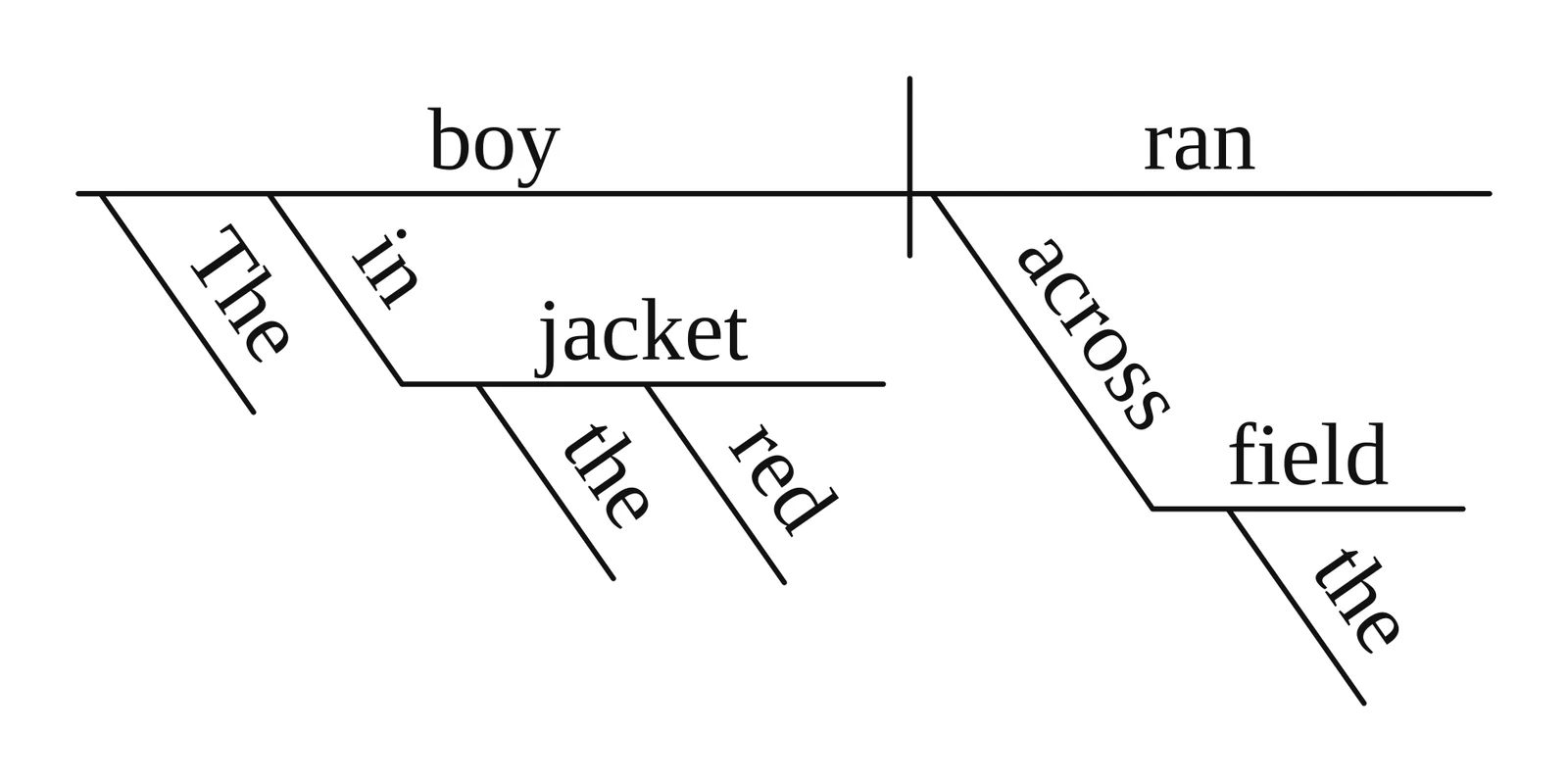
This well-known sentence packs three modifiers under the subject (The, quick, brown) and an adverbial prepositional phrase (over the lazy dog) under the verb jumps. The preposition over sits on the diagonal, its object dog sits on the horizontal foot, and the and lazy hang beneath dog. See prepositional phrase diagramming rules for stacked phrases and compound objects.
Open this example in the generator
10. Appositive phrase with modifiers
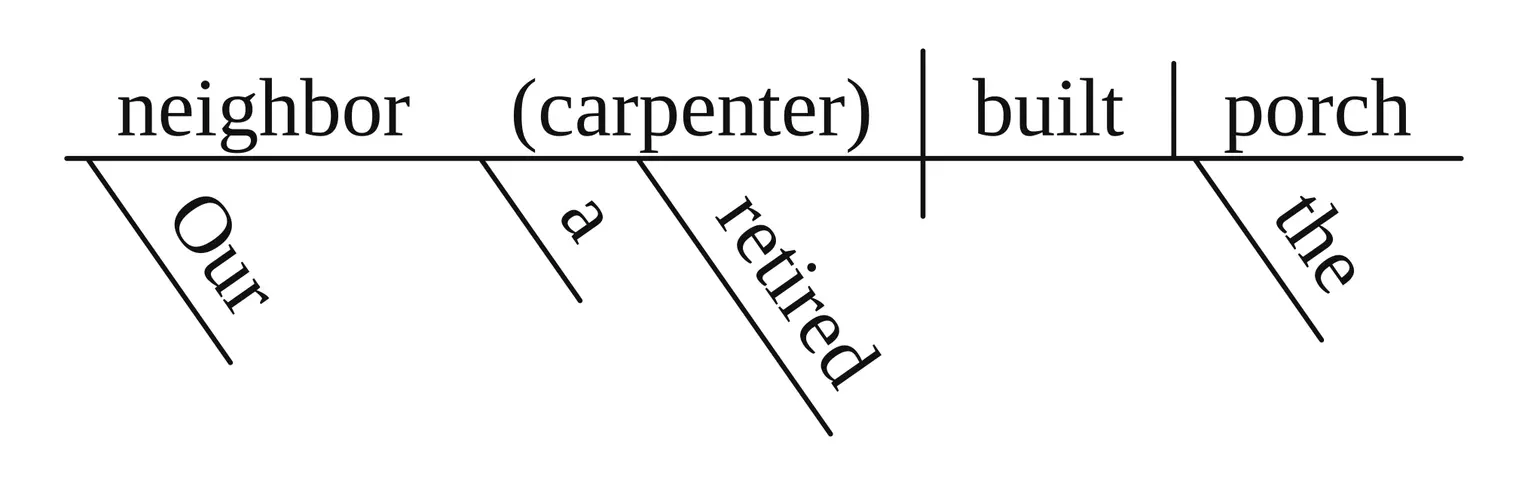
Sentence: Our neighbor, a retired carpenter, built the porch.
An appositive renames the noun beside it, so carpenter sits in parentheses right after neighbor on the baseline, while its own modifiers (a, retired) hang underneath it. For restrictive appositives and direct-address contrasts, see the appositives diagramming guide.
Level 3: Compound parts, compound sentences, and complex clauses
Compound elements fork a single baseline, while full clauses each earn a baseline of their own joined by a dashed line or placed on a pedestal.
11. Compound subject and compound verb
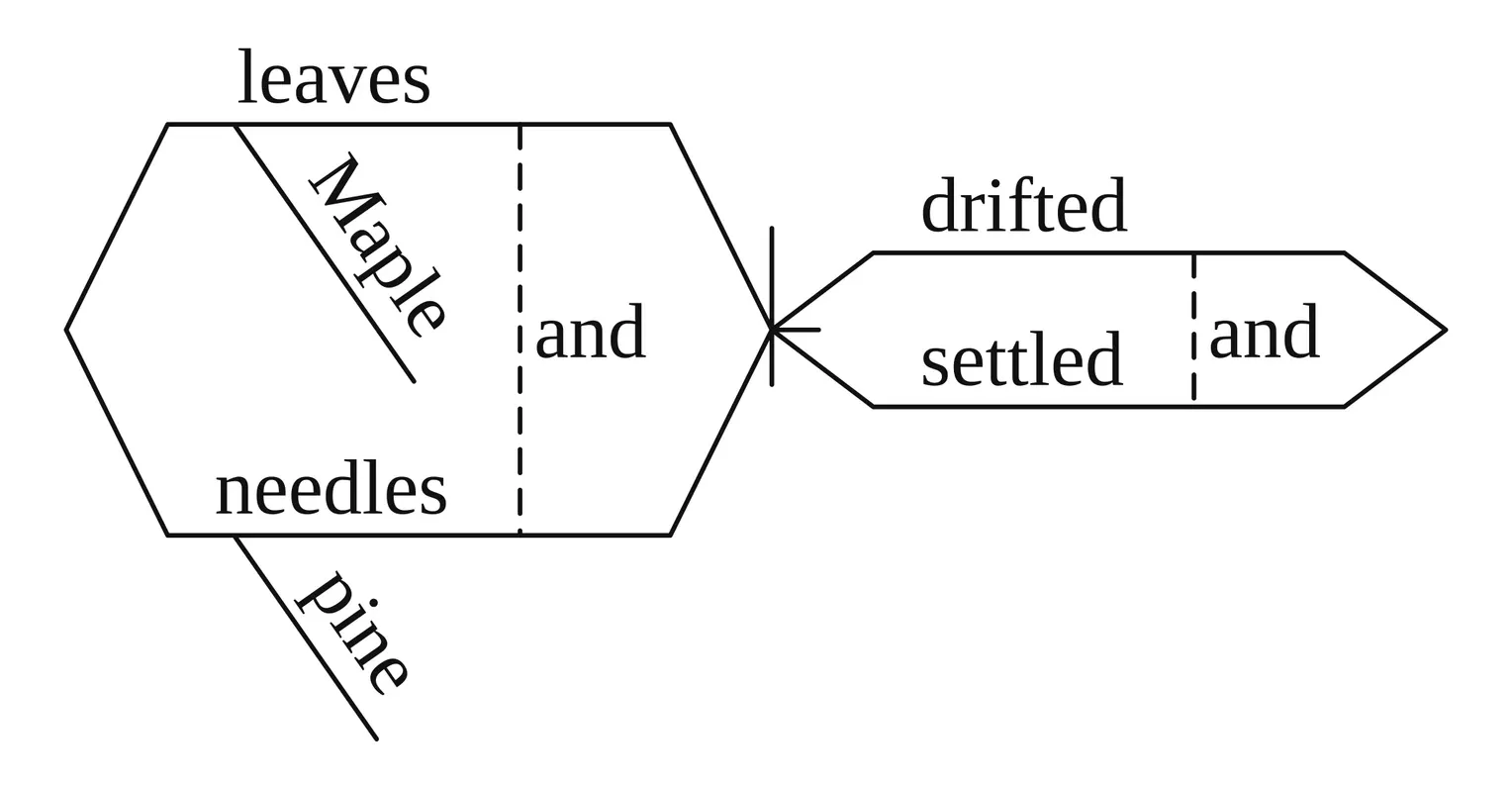
Sentence: Maple leaves and pine needles drifted and settled.
Both the subject (leaves / needles) and the predicate verb (drifted / settled) split into parallel horizontal branches, with each and written along the vertical dashed connector. Each noun keeps its own modifier (Maple under leaves, pine under needles).
Open this example in the generator
12. Compound sentence (two independent clauses)
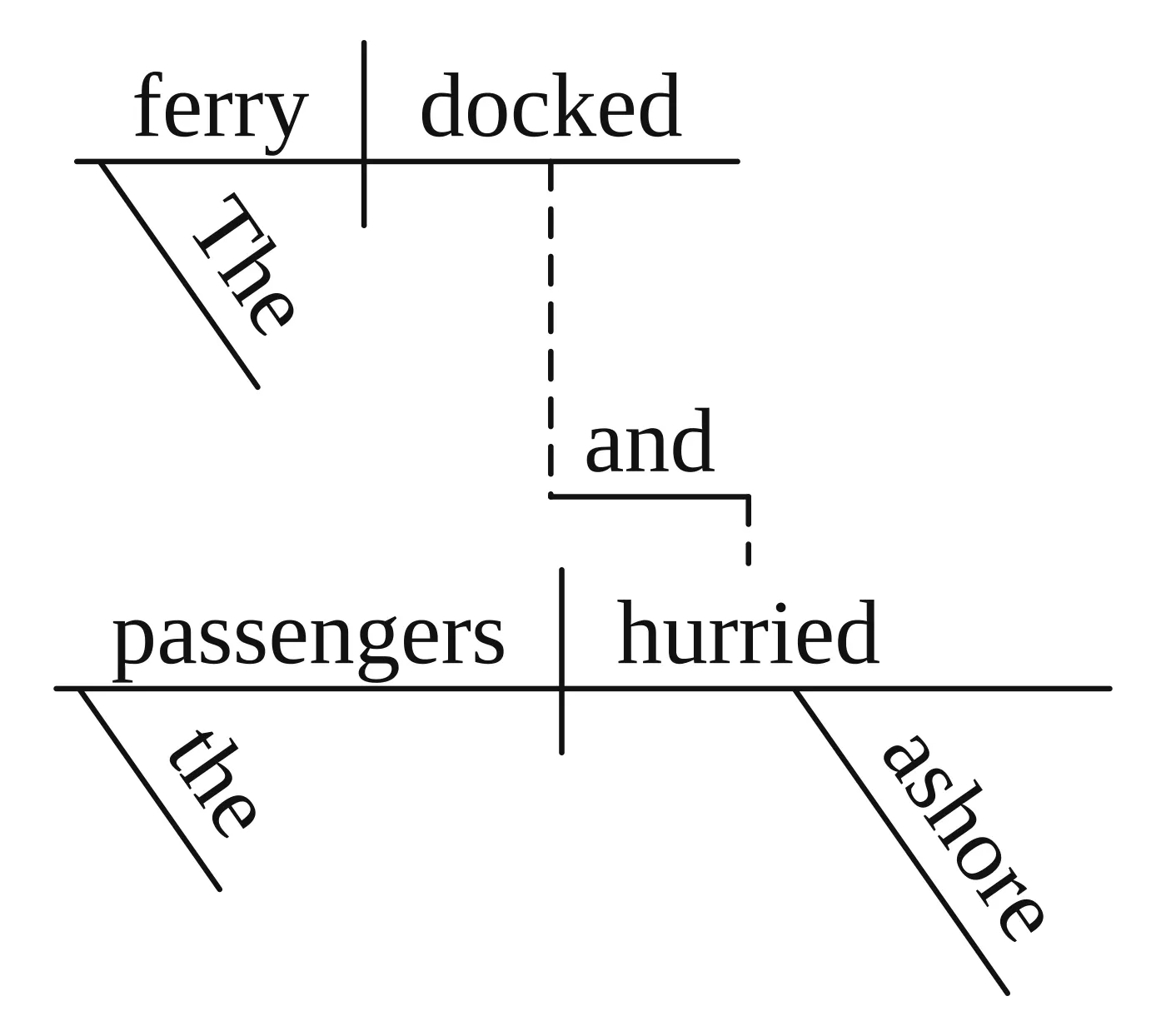
Sentence: The ferry docked, and the passengers hurried ashore.
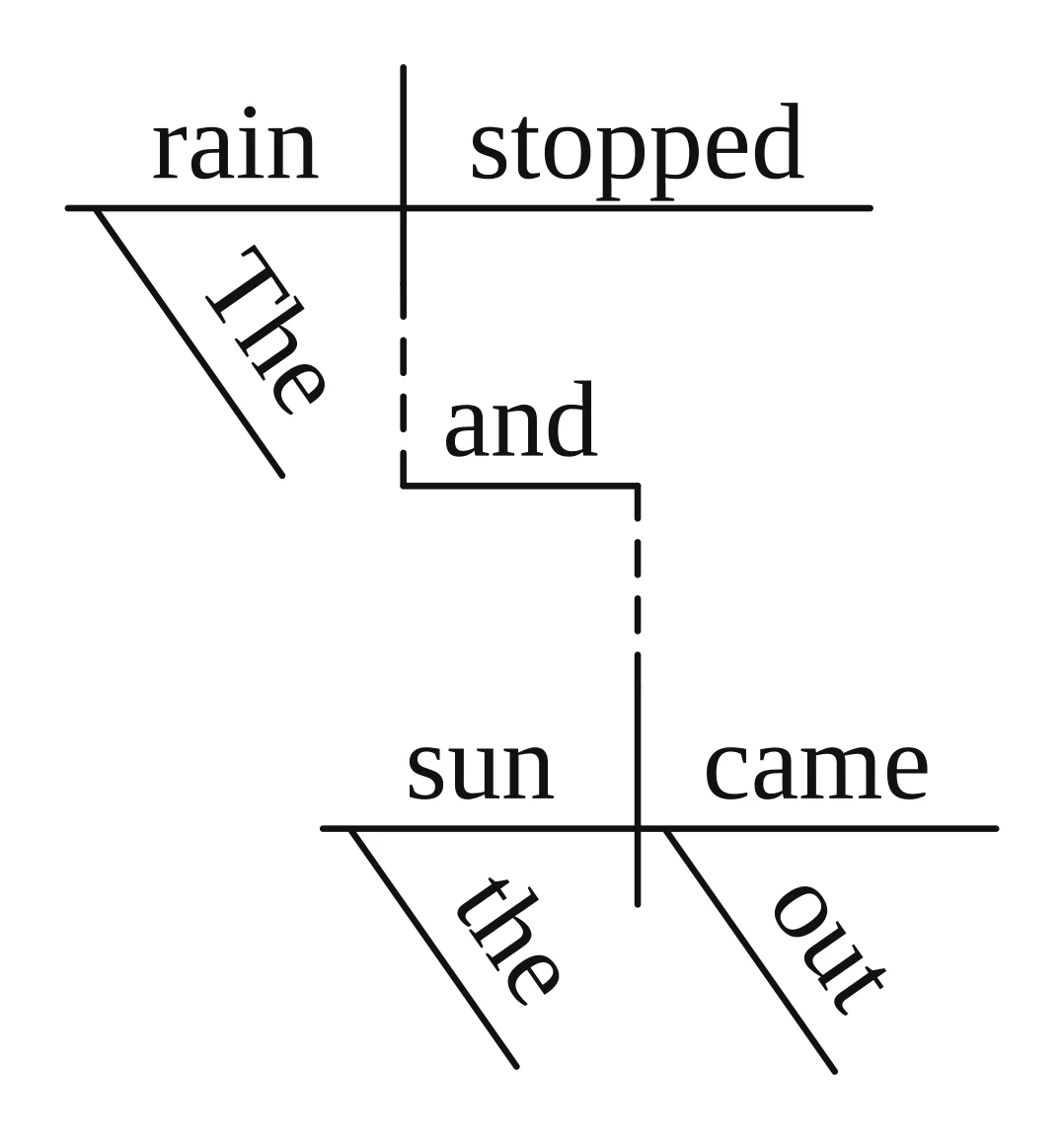
Each independent clause has its own subject and verb, so it gets a complete baseline stacked one above the other. A dashed stepped line links the first verb (docked) to the second verb (hurried) with and resting on the step. See compound and complex sentence diagramming for semicolons and three-clause sentences.
Open this example in the generator
13. Complex sentence with an adverb clause
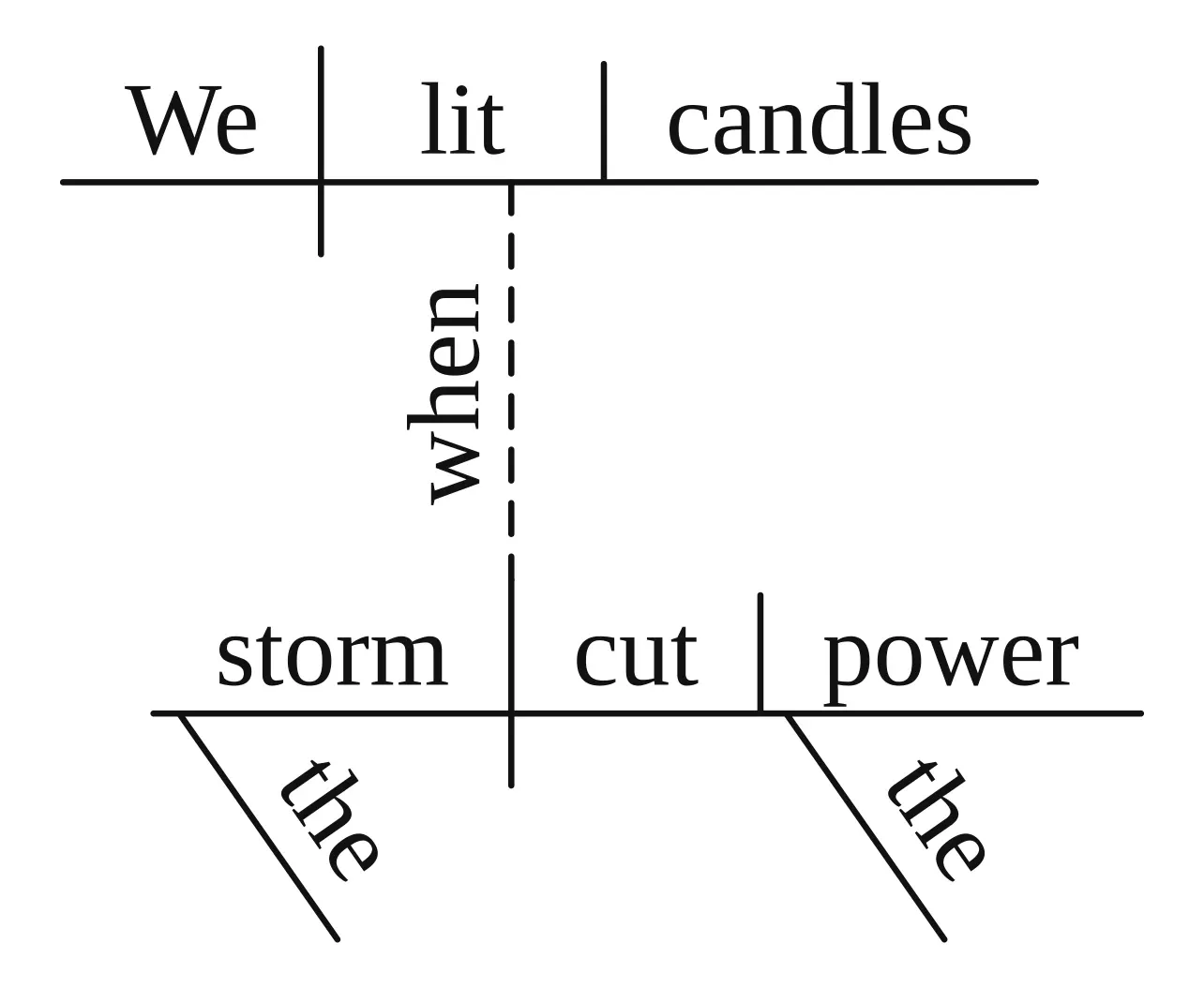
Sentence: We lit candles when the storm cut the power.
The dependent clause when the storm cut the power tells when we lit candles, so it functions as an adverb modifying lit. A slanted dashed line carries the subordinating conjunction when directly from the main verb lit to the clause's verb cut.
Open this example in the generator
14. Complex sentence with an adjective (relative) clause
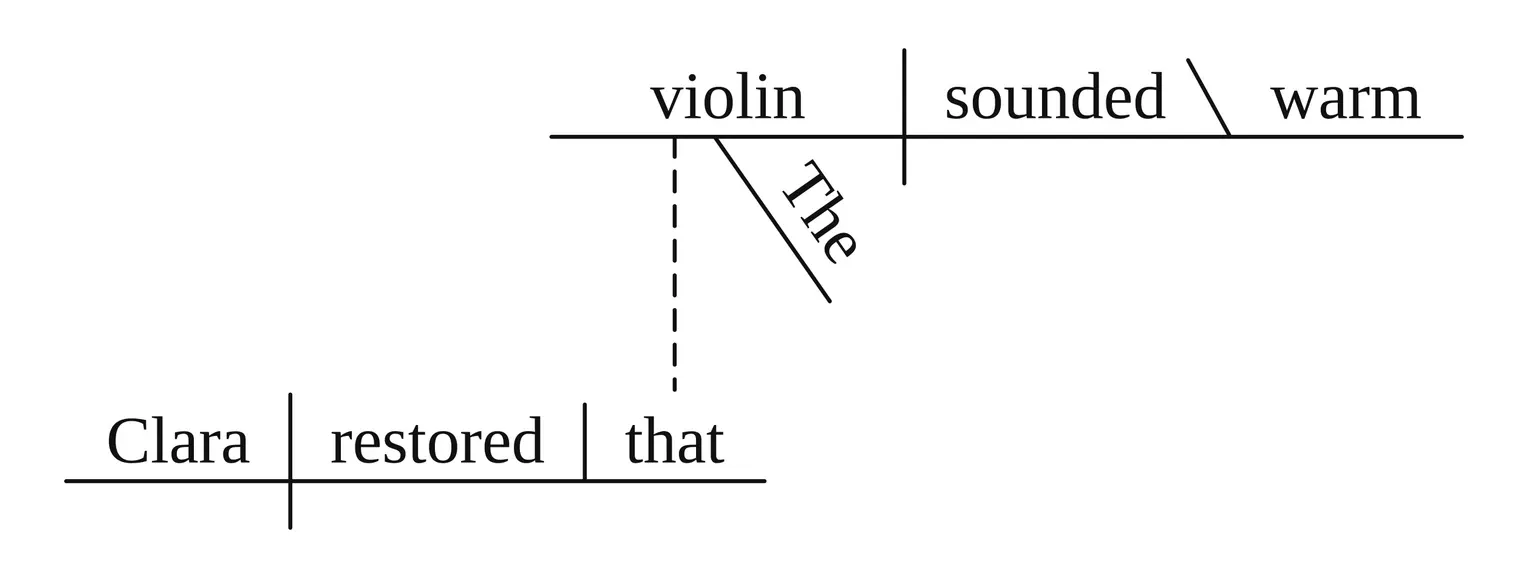
Sentence: The violin that Clara restored sounded warm.
Inside the lower clause, Clara is the subject, restored is the verb, and that is the direct object (Clara restored that). A dashed line connects the antecedent violin down to that, showing that the whole clause modifies violin.
Open this example in the generator
15. Noun clause standing in the subject slot
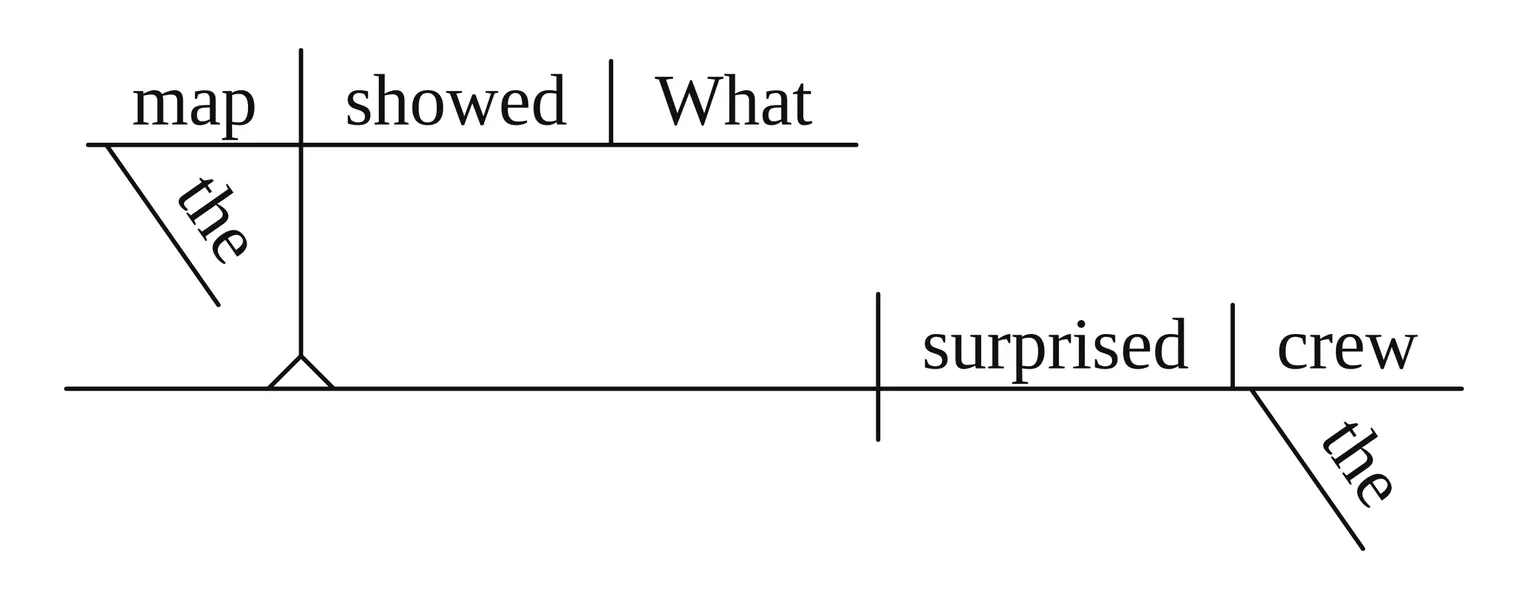
Sentence: What the map showed surprised the crew.
Because the entire clause What the map showed acts as the subject of surprised, it rises on a pedestal in the main subject slot. Inside the clause itself, map is the subject, showed is the verb, and What serves as its direct object.
Level 4: Verbals, passive voice, questions, and commands
Upper-middle and high-school grammar units introduce verbals (gerunds, infinitives, participles), passive verb phrases, inverted question order, and imperative sentences with an understood subject.
16. Gerund phrase as subject
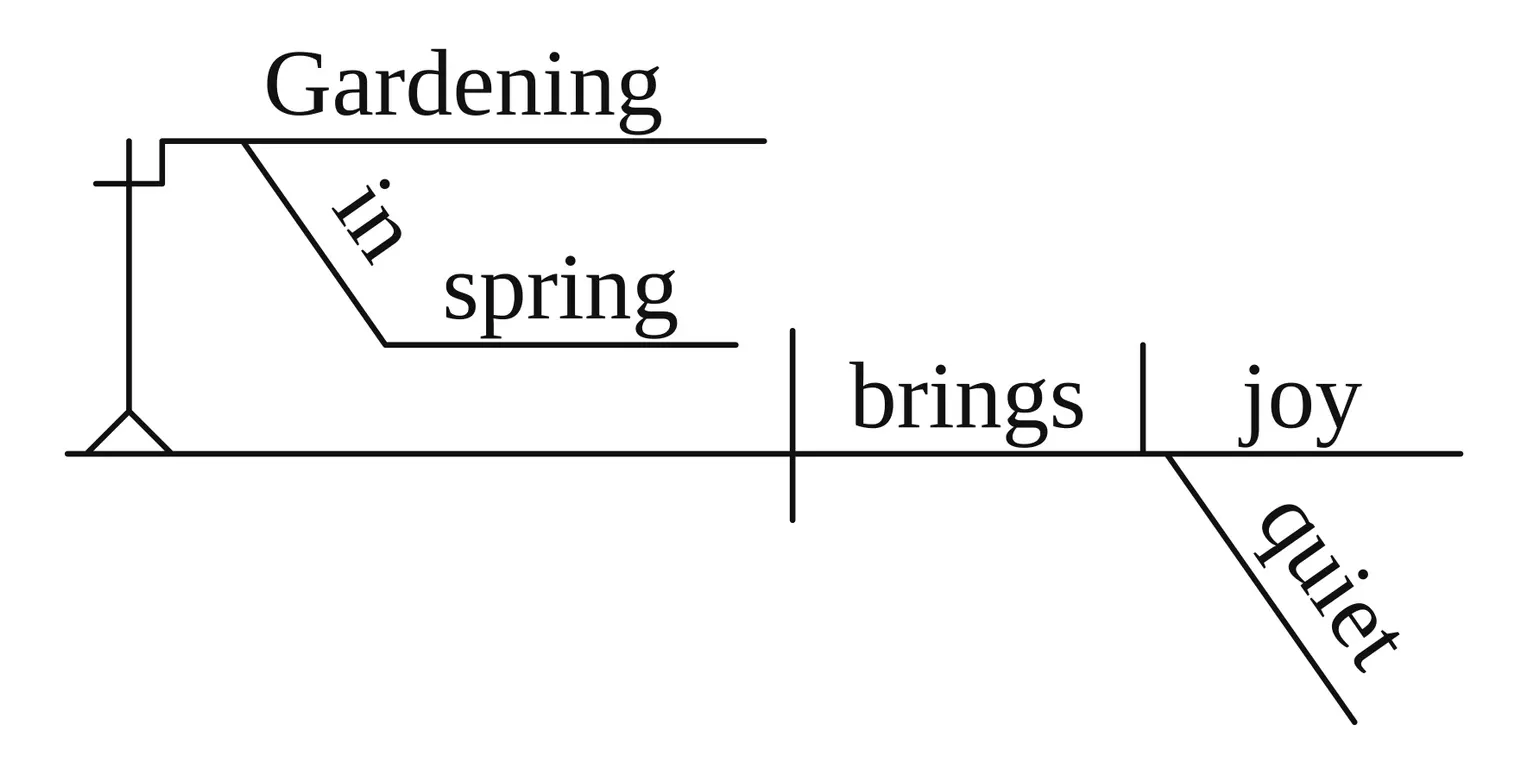
Sentence: Gardening in spring brings quiet joy.
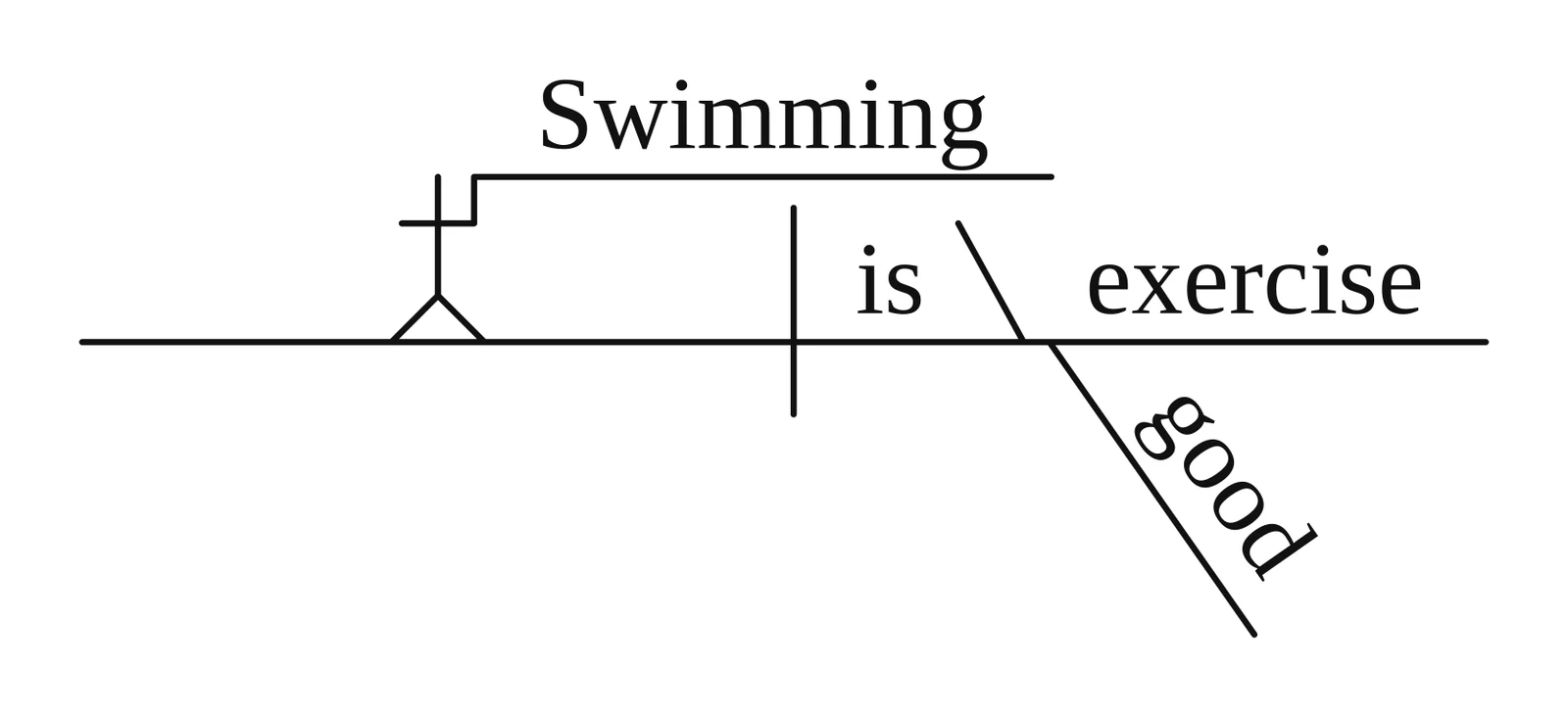
A gerund is an -ing verb form acting as a noun, so Gardening sits on a stepped line atop a pedestal in the subject slot. Because it still behaves like a verb internally, it can take its own adverbial modifier (in spring).
Open this example in the generator
17. Infinitive phrase as direct object
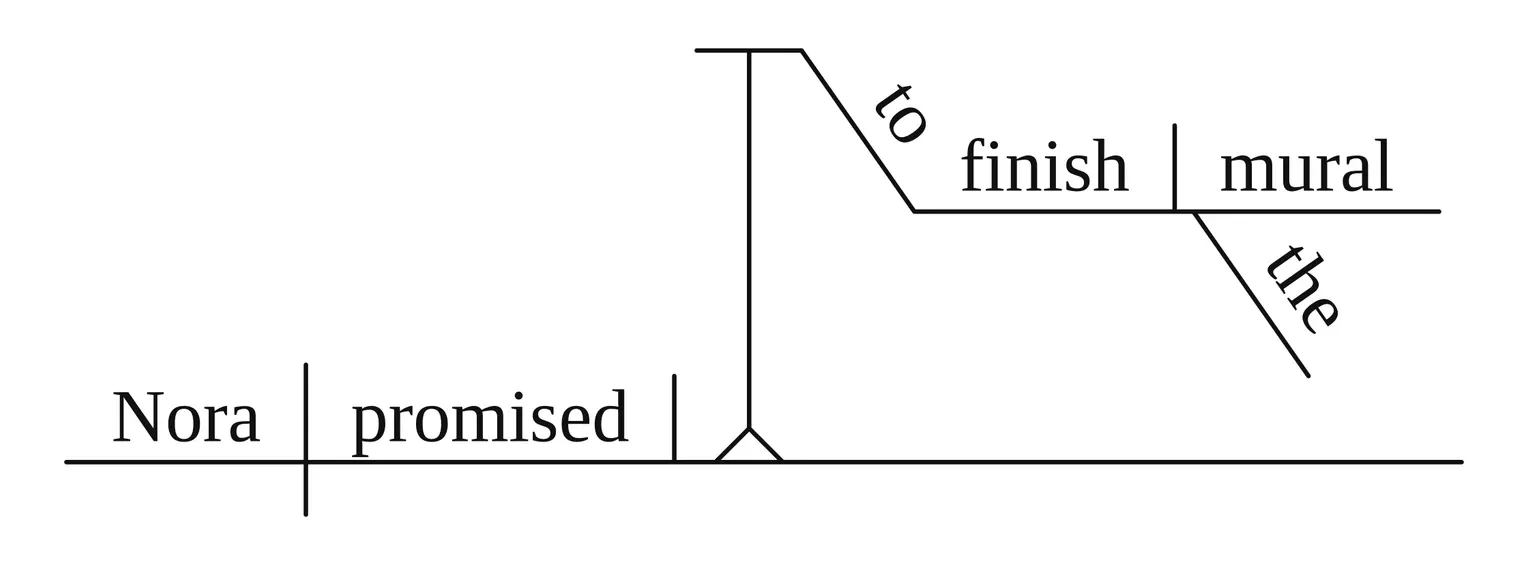
Sentence: Nora promised to finish the mural.
To finish the mural answers "promised what?", so the phrase stands on a pedestal after the direct-object vertical line. To sits on the short diagonal, finish on the horizontal, and the infinitive's own object (mural) follows a short vertical divider. For participles vs. gerunds and opening phrases, see the verbals diagramming guide.
Open this example in the generator
18. Participle modifier and passive voice
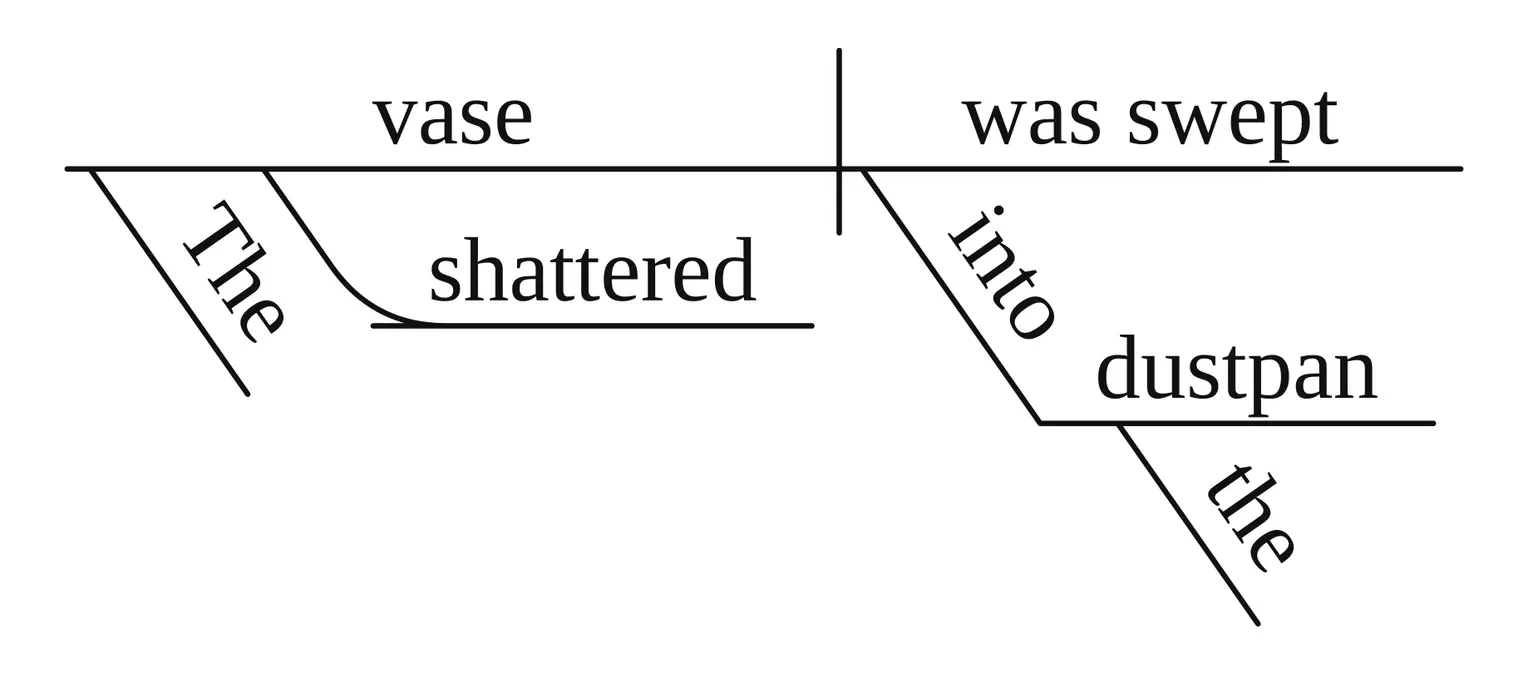
Sentence: The shattered vase was swept into the dustpan.
Two high-frequency test items appear together here: shattered is a past participle modifying vase, drawn along a bent line that curves from slanted to flat; was swept is a passive verb phrase, so both words stay together in the verb slot with no direct object.
Open this example in the generator
19. Question with a helping verb
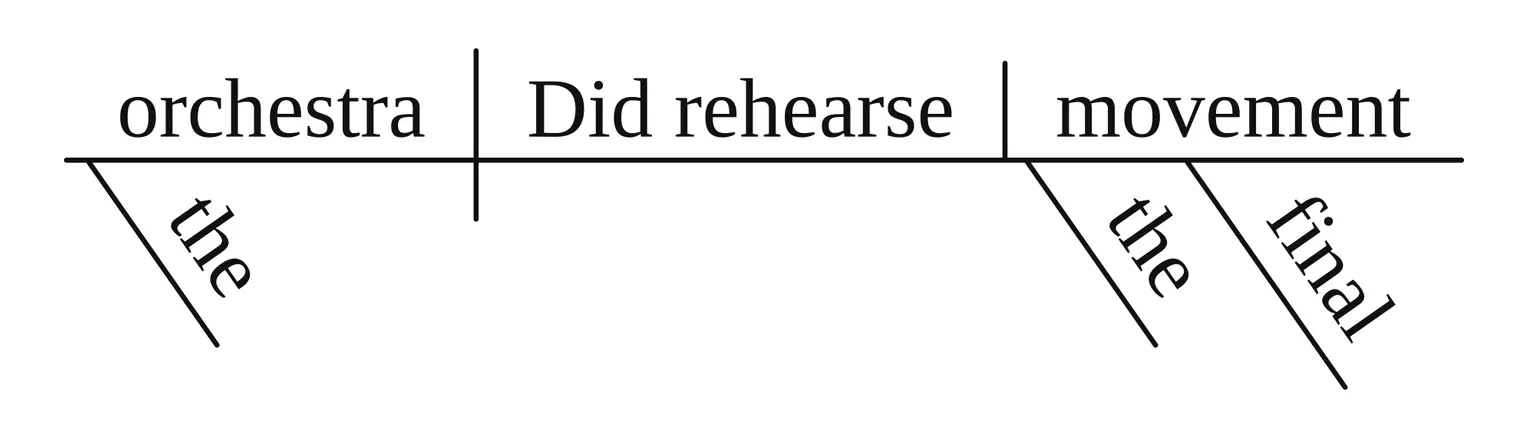
Sentence: Did the orchestra rehearse the final movement?
To diagram a question, mentally reorder it into a statement (The orchestra did rehearse the final movement) while keeping the original capitalization. Did rehearse sits together on the verb side, with orchestra as subject and movement as direct object.
Open this example in the generator
20. Imperative sentence (command with understood you)
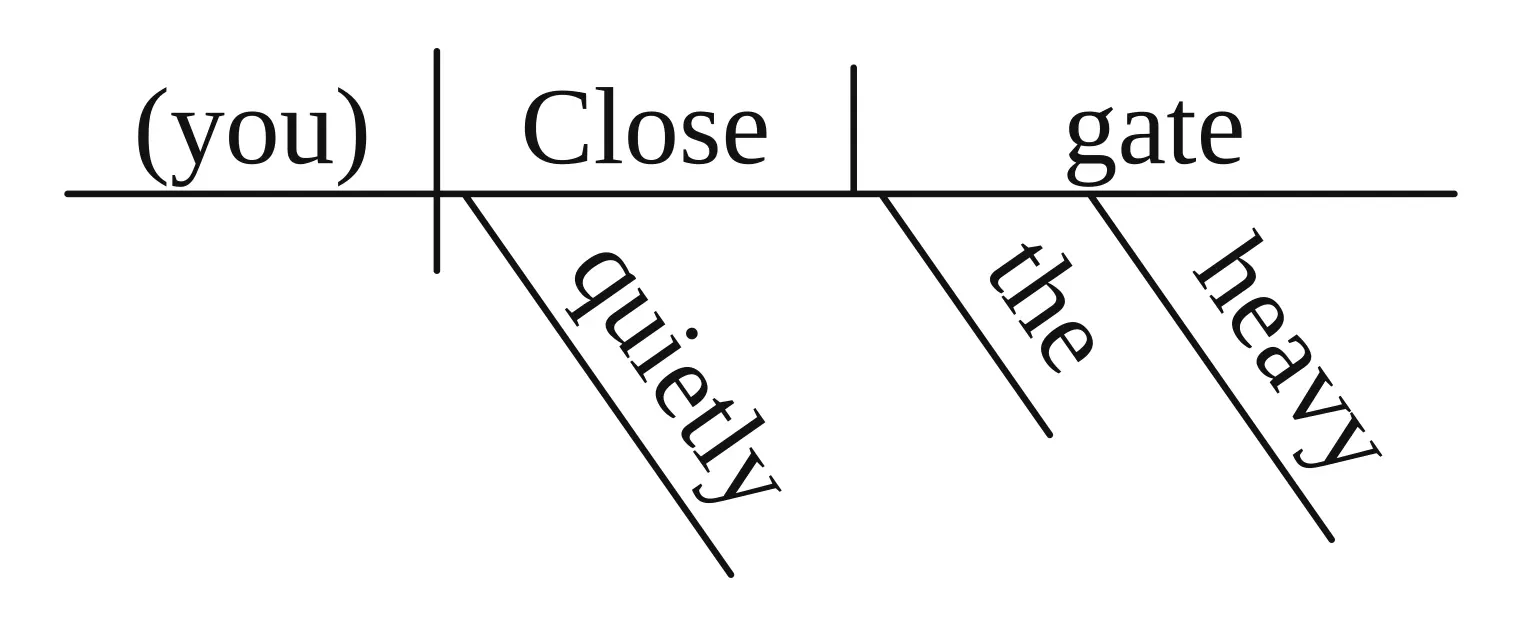
Sentence: Close the heavy gate quietly.
In a command, the subject is implied rather than written, so Reed–Kellogg places (you) in parentheses in the subject slot. Close stays capitalized on the verb side, gate follows the direct-object line, and quietly hangs beneath Close.
How these diagrams were produced—and what to check when generating your own
Every image on this page follows standard Reed–Kellogg conventions from Alonzo Reed and Brainerd Kellogg's Higher Lessons in English (1877) and modern U.S. classroom grammar curricula. Each of the 20 worked examples was rendered by the same deterministic layout code that powers the sentence diagram generator and verified line by line for baseline slots and modifier attachments.
When you type a brand-new sentence into the generator, a language model first analyzes the grammar and passes the structure to that layout engine. Code guarantees crisp lettering and standard Reed–Kellogg line geometry, not that the grammar reading is infallible. A single dropped word can still slip through (automated checks reject and retry when two or more words are missing or extra words are added), and an ambiguous prepositional phrase or long multi-clause sentence can still attach to the wrong word. Always check generated diagrams against your textbook's conventions before handing them out as a class answer key—our accuracy page documents known limits and benchmark results.
Continue with step-by-step rules, practice sets, and printable worksheets
Use the 20 worked examples above as a reference, then drill specific structures or print classroom packets.
How to Diagram a Sentence (Complete Guide)
Full Reed–Kellogg line rules, step-by-step walkthrough, and a one-page cheat sheet.
Sentence Diagramming Practice (39 Sentences)
Self-check 10 graded sets with empty-frame hints, full answers, and live scoring.
Printable Sentence Diagramming Worksheets
Paste up to 20 sentences to build matching blank-frame student sheets and answer keys in PDF.
Compound and Complex Sentences
Semicolons, subordinating clauses, three-clause diagrams, and compound-complex layouts.
Prepositional Phrases
Adjective vs. adverb attachment, stacked phrases, compound objects, and ambiguous cases.
Gerunds, Infinitives, and Participles
Pedestals, bent lines, and how to tell a gerund from a participle in context.
Sentence diagramming examples: frequently asked questions
What are the 7 basic sentence patterns shown in sentence diagrams?
Most grammar textbooks teach seven core baseline patterns: (1) Subject + Verb (Wolves howl., #1), (2) Subject + Verb + Direct Object (The baker sliced fresh sourdough., #3), (3) Subject + Linking Verb + Predicate Nominative (Dr. Patel became our principal., #4), (4) Subject + Linking Verb + Predicate Adjective (The cedar soup smells savory., #5), (5) Subject + Verb + Indirect Object + Direct Object (The librarian handed Leo a thick atlas., #6), (6) Subject + Verb + Direct Object + Objective Complement noun (The choir named Devon soloist., #7), and (7) Subject + Verb + Direct Object + Objective Complement adjective (The judges declared her essay brilliant., #8). All seven are illustrated with full diagrams in Levels 1 and 2 above.
Can I use these sentence diagramming examples to make printable worksheets and answer keys?
Yes. Open any example in the sentence diagram generator and switch to Worksheet mode to paste up to 20 sentences at once. Vizcept builds two matching PDFs—a blank student worksheet with empty Reed–Kellogg frames and a matching answer key in Letter or A4—charging 2 credits per sentence drawn. Free accounts can preview watermarked output; watermark-free PDFs require a paid plan or non-renewing credit pack.
Is the Vizcept sentence diagram generator free?
Watermark-free downloads, editable SVGs, and clean worksheet PDFs are paid, because running the grammar analysis models and rendering infrastructure has ongoing costs. Paid plans start at $14.90/month (or $106.80/year), and non-renewing credit packs start at $19.90 for 150 credits valid for 365 days; logged-in code-rendered sentence diagrams cost 2 credits each. To try it first, you get 5 free trial credits without an account (enough for 1 diagram), 5 sign-up credits (varying by country, valid for 30 days), and daily check-in credits that expire after 30 days, with free watermarked 2K PNG downloads. If you only need a free static reference, all 20 worked diagrams on this page and our 39 practice sentences are free to browse.
Do teachers still teach sentence diagramming?
While fewer public high schools require sentence diagramming than in the mid-twentieth century, it remains widely taught in classical schools, homeschool grammar curricula, writing labs, and introductory English grammar courses. Teachers use Reed–Kellogg diagrams because they make clause boundaries, dangling modifiers, and subject–verb agreement visible at a glance.
Why does a predicate adjective use a backslash instead of a vertical line?
In the Reed–Kellogg system, a short vertical line shows that an action verb passes energy forward to a direct object (sliced | sourdough). A backslash leans back toward the subject (smells \ savory) to show that a linking verb points the complement back to describe or rename the subject rather than receiving an action.
Diagram a sentence from your lesson or assignment
Type any English sentence to get a Reed–Kellogg diagram typeset by code, or switch to Worksheet mode to generate up to 20 blank frames and an answer key PDF.
